From the New Jersey Department of Environmental Protection to the Department of Expedited Permits
June 9, 2026
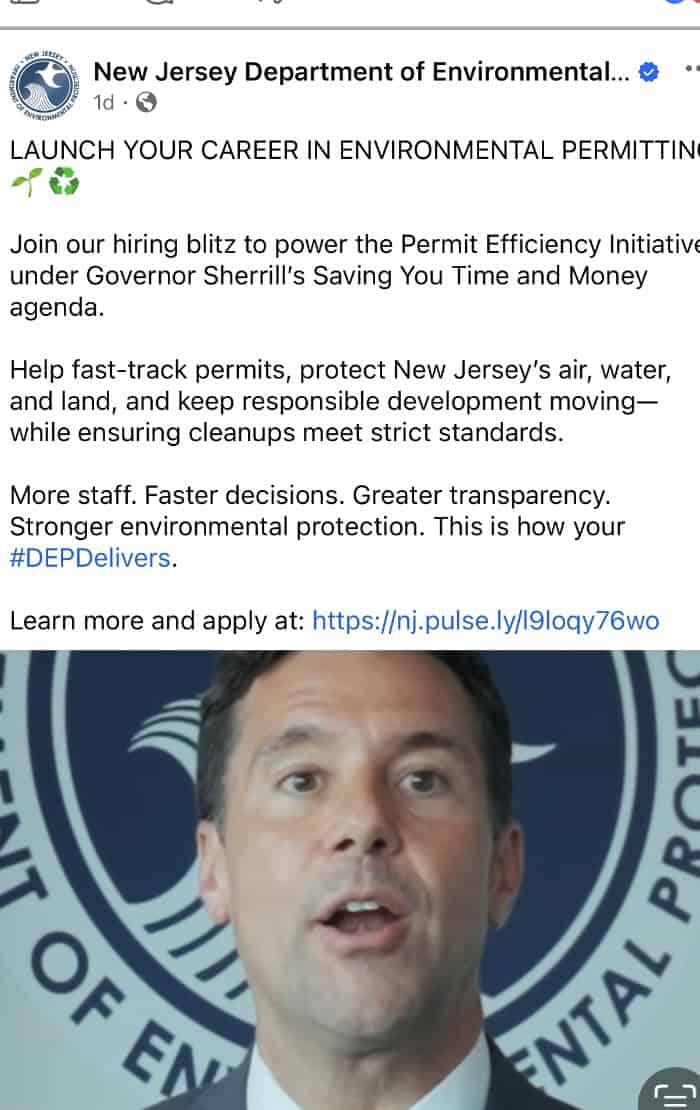
There are some things you see online that make you laugh because they are obviously satire. Then there are things so bizarre that you assume they must be from The Onion. Recently, one of those moments came from an official social media post featuring New Jersey Department of Environmental Protection Commissioner Ed Potosnak recruiting people to help implement Governor Sherrill’s permitting agenda.
The message might as well have said: “Uncle Ed Wants You! Help Turn the Department of Environmental Protection into the Department of Expedited Permits.”
Or perhaps more accurately: “Join the Department of Excess Pollution, Overdevelopment, and Rubber-Stamp Approvals.”
The irony is almost too much to believe.
Many people thought the post was a joke. Unfortunately, it wasn’t.
What makes it even more troubling is that Commissioner Potosnak previously served as executive director of the New Jersey League of Conservation Voters, an organization that historically opposed permit fast-tracking, environmental rollbacks, and weakening public oversight. Today, he is implementing many of the very policies environmental advocates spent years fighting against.
As the old song from The Best Little Whorehouse in Texas goes: “Ooh, I love to dance a little sidestep. Now they see me, now they don’t, I’ve come and gone and…”
That lyric increasingly sounds like the theme song of New Jersey environmental policy or “the act of an environmental contortionist.”
The transformation has been remarkable.
As head of the New Jersey League of Conservation Voters, Potosnak opposed fast-tracking permits. Today, he supports it.
He opposed the Northeast Supply Expansion pipeline. Today, his Department of Environmental Protection approved it.
He supported renewable energy over nuclear power. Today, he helped end New Jersey’s nuclear plant moratorium.
He opposed natural gas expansion. Today, the administration is opening new pathways for gas infrastructure and power plant expansion.
He opposed raids on Clean Energy Fund and Regional Greenhouse Gas Initiative revenues. Today, those funds are being diverted by the administration.
He supported funding the New Jersey School of Conservation. Today, those funds have been cut and the school faces closure.
He supported the REAL Flood Protection Rules. Today, they have been delayed and could ultimately be weakened or abandoned.
He supported closing the loophole requiring disclosure of toxic contamination during real estate transactions. Today, that loophole remains open.
He opposed the millionaire’s marina at Liberty State Park. Today, the Department of Environmental Protection supports the project and still has the authority to stop it.
He supported stronger limits on warehouse sprawl. Today, little has been done to address the growing problem.
He supported a Climate Superfund and Polluters Pay legislation. Today, the NJDEP Commissioner appears unwilling to actively support those efforts.
The question New Jersey residents should be asking is simple:
What happened?
The question is whether Potosnak was brought in to lead the NJDEP or to provide green cover for rolling back environmental protections.
Was he hired to strengthen environmental safeguards or to help greenwash a pro-developer, pro-polluter agenda?
Many of Sherrill’s environmental policies mirror long-standing deregulatory arguments promoted by corporate interests: weaken regulations, accelerate permitting, cut so-called red tape, and prioritize development over environmental protection.
Sherrill’s agenda is unfortunately in line with the Heritage Foundation’s Agenda 2025 and many of Trump and Christie’s environmental rollbacks. So, was Ed Potosnak brought in because of campaign contributions or to be used to cover a pro-corporate polluter agenda?
That raises an uncomfortable question.
Is this green leadership?
Is it greenwashing?
Or is it simply campaign green?
The question New Jersey residents should be asking is simple: What happened?
The answer may lie in politics.
The New Jersey League of Conservation Voters was one of Sherrill’s largest outside supporters during the 2025 gubernatorial campaign, spending more than $1.7 million backing her candidacy.
After the election, the League praised the governor’s executive actions and environmental agenda.
Meanwhile, environmental protections continue to be delayed, weakened, rolled back, or ignored.
The contrast between campaign rhetoric and governing reality is becoming impossible to separate. However, it uses affordability to roll back protections and to follow a corporate agenda.
The administration markets Operation FAST as a modernization effort. They talk about efficiency, customer service, and reducing delays. Those sound like reasonable goals until you look at what is actually being proposed.
The name sounds like a corporate consulting project because that’s essentially what it is.
The program was launched without legislative approval, public hearings, or meaningful public oversight.
The New Jersey Department of Environmental Protection already approves roughly 97 percent of permit applications.
The New Jersey Department of Environmental Protection was created to protect clean air, clean water, wetlands, floodplains, open space, wildlife habitat, and public health. Under Operation FAST, the NJDEP risks becoming a permit-processing factory, with success measured by how quickly permits are approved rather than how well the environment is protected.
Operation FAST creates permitting “shot clocks” that force NJDEP staff to make decisions within strict deadlines. Environmental review, however, is not like processing a driver’s license renewal. Many permit applications involve wetlands, flood hazards, drinking water supplies, contaminated sites, endangered species habitat, and complicated engineering questions.
A rushed review is often a bad review.
When NJDEP scientists and engineers are pressured to meet arbitrary deadlines, there is less time to identify mistakes, challenge incomplete applications, require additional studies, or deny permits that fail to meet environmental standards.
The result is simple: approvals become easier while environmental protection becomes weaker.
The administration has also shifted staffing priorities. More resources are being directed toward permit processing, while enforcement, monitoring, park management, and compliance functions continue to struggle with staffing shortages.
The message is clear. The state has money to process permits faster, but not enough money to enforce environmental laws after permits are issued.
What these deadlines really mean is pressure on NJDEP staff. Pressure to approve. Pressure to move applications faster. Pressure to avoid saying “no.” After all, rejecting a permit takes time. Real scientific review takes time. Protecting wetlands takes time. Protecting communities takes time.
Developers want speed. The public needs protection.
The administration has launched an online permitting dashboard that tracks permit applications and processing times.
On paper, transparency sounds positive.
In reality, the dashboard risks becoming a scoreboard that measures success by how quickly permits are approved rather than how thoroughly they are reviewed.
Department of Environmental Protection employees should be rewarded for protecting water quality, preventing flooding, and enforcing environmental laws—not for acting like workers on an assembly line.
Environmental protection cannot be measured with a stopwatch. A permit is not successful simply because it was approved quickly.
One of the most troubling proposals involves expanding the role of outside consultants in permit reviews.
Developers already hire engineers, planners, lawyers, and consultants to prepare applications. Under the administration’s approach, these same private-sector interests could be given greater authority to perform reviews that historically have been conducted by independent NJDEP professionals.
That creates an obvious conflict of interest. The consultant’s client is not the public. The consultant’s client is the developer seeking approval.
The danger is that environmental review becomes a paid service rather than an independent regulatory function.
Government oversight exists because private interests cannot be trusted to police themselves. New Jersey learned that lesson repeatedly from toxic waste sites, groundwater contamination, landfills, and industrial pollution scandals.
We should not have to learn it again.
Perhaps the most reckless decision has been delaying the implementation of the REAL Flood Protection Rules.
The science behind these rules is straightforward.
Climate change is producing larger storms, heavier rainfall, stronger coastal flooding, and more frequent inland flooding. New Jersey has experienced billions of dollars in damage from flooding over the last decade.
The REAL rules would require future development to account for projected climate conditions rather than outdated historical rainfall data. Without those protections, homes, warehouses, shopping centers, and industrial facilities can continue to be approved in areas that will predictably flood in the future.
The result is more flooded neighborhoods, more damaged roads, more emergency rescues, higher insurance costs, and greater taxpayer expenses.
New Jersey is one of the most densely populated and flood-prone states in America. Every year, residents face worsening floods, rising insurance costs, and growing property damage. Instead of moving forward with stronger protections, the administration delayed implementation until 2027 and may ultimately weaken or abandon them entirely.
The REAL Flood Protection Rules were designed to account for climate change, stronger storms, increased rainfall, and growing flood risks.
Delaying the rules does not delay flooding. It only delays protection.
At the same time, permits are being accelerated, while critical flood protection measures are being delayed.
That decision is a victory for developers and a disaster for homeowners. You cannot claim to be serious about climate resilience while delaying flood protections.
The administration also abandoned proposed changes that would have required contamination discovered during environmental due diligence to be reported to the state.
That loophole benefits property transactions. It does not benefit communities.
If contamination is discovered, residents have a right to know about it. Parents have a right to know if pollution exists near schools. Communities have a right to know if toxic chemicals are migrating into groundwater or nearby streams.
Keeping contamination hidden may make real estate deals easier, but it makes environmental protection harder.
Many of the projects being targeted for accelerated approvals are not located in wealthy suburban communities. They are disproportionately located in environmental justice communities already burdened by pollution.
Fast-tracking gas plants, repowering old fossil-fuel facilities, expanding industrial operations, and approving large infrastructure projects means additional pollution for communities that already face higher asthma rates, poorer air quality, and greater health risks.
Environmental justice cannot survive if permits are rushed and cumulative impacts are ignored. The communities that have carried the greatest pollution burden should not be asked to carry even more simply because a permit clock is running.
The administration’s permitting agenda comes as New Jersey faces growing pressure from energy-intensive development.
Large AI data centers consume enormous amounts of electricity and water while creating relatively few permanent jobs. At the same time, old gas-fired power plants that should be retired are being given new life through regulatory flexibility and expedited approvals.
The Northeast Supply Enhancement pipeline approval represents another major reversal. The project was previously rejected because of concerns about water quality and impacts to themRaritan Bay. Now it has been revived despite many of the same environmental concerns remaining unresolved.
Taken together, these policies point toward more fossil fuel infrastructure, more energy consumption, and more environmental impacts at a time when New Jersey should be accelerating clean energy and climate resilience.
That is not progress. That is moving backward while calling it modernization.
Perhaps the most disturbing aspect of the new philosophy is how applicants are increasingly treated as the NJDEP’s “customers.”
When did polluters become customers? When did developers become customers?
The people who breathe the air, drink the water, pay the taxes, and live with the flooding should be the customers. Residents forced to endure traffic congestion, polluted waterways, warehouse sprawl, power plants, pipelines, and destroyed open space should come first.
Instead, corporate applicants increasingly appear to be getting VIP treatment while communities are left standing in line.
Another dangerous component of the administration’s agenda is the push toward outsourcing environmental reviews.
The proposal would allow private consultants hired by developers to perform work traditionally conducted by NJDEP staff. Think about that for a moment. The same consultants being paid by developers could write permit applications, evaluate environmental impacts, and help certify compliance.
That is not an independent review. That is a conflict of interest.
It’s like letting the fox design the henhouse, build the henhouse, inspect the henhouse, and then assure everyone that the chickens are perfectly safe.
Nothing could possibly go wrong.
We have seen this movie before.
It was called Fast Track permitting.
In 2004, New Jersey adopted one of the most extreme permit acceleration programs in the country. Under that law, permits could be automatically approved if the NJDEP failed to act within strict deadlines. Environmental protection became secondary to administrative speed.
The policy became such a disaster that the Environmental Protection Agency concluded New Jersey was violating requirements under the federal Clean Water Act. The situation became so serious that the EPA threatened to take over portions of New Jersey’s delegated water permitting authority.
That should have been a warning. Apparently, it became a blueprint.
Today’s executive orders revive many of the same dangerous concepts under a different name.
Fast-tracking permits means fast-tracking projects. That includes:
- Data centers
- Gas-fired power plants
- Pipelines
- Nuclear facilities
- Metal recycling operations
- Massive warehouse projects
- Industrial development in environmental justice communities
More permits approved faster means more environmental impacts faster. It means more traffic. More pollution. More flooding. More destruction of forests and open space. More strain on energy and water infrastructure.
The administration argues it is improving efficiency. The reality is that environmental review exists for a reason.
The administration has also weakened transparency and accountability.
The NJDEP recently abandoned efforts to require disclosure of contamination discovered during property transactions. That means toxic pollution can remain hidden from communities and future property owners.
At the same time, proposals like A4882 would severely limit the ability of citizens and environmental organizations to challenge a NJDEP decisions in court.
Imagine a system where permits are approved faster, environmental protections are weakened, and citizens lose the ability to challenge bad decisions.
That is not government reform. That is government surrender.
Politicians love talking about cutting red tape. But environmental protections are not red tape. Clean water is not red tape. Flood protection is not red tape. Wetlands are not red tape. Environmental justice is not red tape. Public participation is not red tape.
Whenever politicians start talking about cutting red tape, communities should immediately ask one question: Which environmental protections are being cut next? Because cutting “red tape” is simply a marketing slogan for environmental deregulation.
New Jersey does not need a Department of Expedited Permits.
It needs a Department of Environmental Protection.
A DEP that protects wetlands, clean water and drinking water
A DEP that protects open space and stops sprawl
A DEP that enforces environmental laws
A DEP that holds polluters accountable
A DEP that says “no” when projects threaten public health environment and public safety
A DEP that puts people ahead of special interests
A DEP that protects future generations rather than serving corporate clients.
Residents, environmental organizations, local officials, and community groups must speak out now.
Demand and End to Operation FAST.
Demand full transparency regarding any permitting reforms.
Demand strengthening and implementation of the REAL Flood Protection Rules.
Demand stronger implementation of environmental justice protections.
Demand protection of Clean Energy Funds and RGGI investments.
Demand that the NJDEP prioritize environmental protection over permit production.
The future of New Jersey’s environment cannot be decided behind closed doors by consultants, permit czars, lobbyists, and political insiders.
Uncle Ed’s environmental contortionist campaign
Maybe the recruitment ad got one thing right. Uncle Ed does want you. Not to strengthen environmental protections. Not to defend wetlands, floodplains, forests, or clean water. Not to hold polluters accountable. He wants recruits for a permitting machine designed to move projects through the system faster.
The problem is that New Jersey already has plenty of people working to speed up development.
What we need are people willing to slow down long enough to ask whether these projects should be approved in the first place.
Because when the Department of Environmental Protection starts acting like the Department of Expedited Permits, the winners are developers, lobbyists, and special interests.
Everyone else gets the flooding. Everyone else gets the traffic. Everyone else gets the pollution. Everyone else gets the higher insurance rates, damaged property, overcrowded roads, and disappearing open space.
The administration calls it affordability. But there is nothing affordable about flood damage. There is nothing affordable about contaminated drinking water. There is nothing affordable about asthma, toxic cleanup costs, or rebuilding after the next major storm.
Clean air is affordable. Clean water is affordable. Open space is affordable. Preventing environmental damage is always cheaper than paying for it later.
If Governor Sherrill and Commissioner Potosnak truly want a more effective NJDEP, the answer is not cutting protections or rushing permits. The answer is providing the agency with the resources, staffing, science, and enforcement capacity needed to do its job.
Permits should move efficiently because applicants reduce impacts, provide mitigation, and demonstrate public benefit—not because environmental safeguards are weakened.
New Jersey has only one environment. Once wetlands are filled, they are gone. Once forests are cleared, they are gone. Once floodplains are paved over, the flooding remains.
The real question is whether the NJDEP exists to protect the public or to serve as a concierge service for developers. Because if Operation FAST continues down its current path, New Jersey may soon discover that FAST doesn’t stand for efficiency.
It stands for Flooding, Asphalt, Sprawl, and Toxicity.
And that is a future New Jersey cannot afford.
We need a green agenda, not a green scam.

Jeff Tittel is an environmental and political activist, the founder of SOAR, and the former director of the New Jersey Sierra Club.
Search
RECENT PRESS RELEASES
Related Post