2026 First Quarter Venture Capital: KRW 3.3 Trillion Won—“Second Highest Ever”…Fund Format
May 17, 2026
In the first quarter of this year, the domestic venture capital market in South Korea rebounded at an extraordinary pace and has entered a sustained period of growth. New venture investments totaled KRW 3,318.9 billion, marking the second-largest scale ever following the boom in 2022. New venture fund formation also reached KRW 4,365.2 billion, setting a new all-time record.
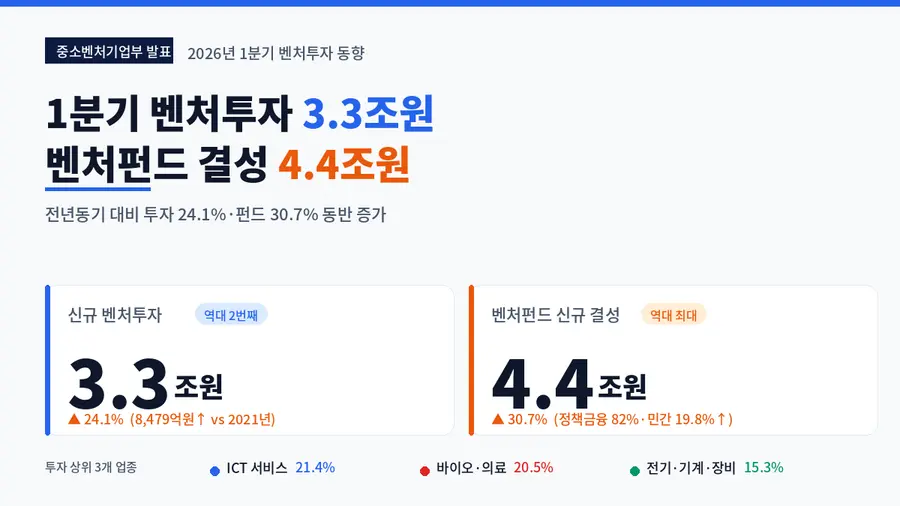
On the 17th, the Ministry of SMEs and Startups announced the Q1 2026 trends in new venture investments and venture fund formation, covering the details above. In Q1, new venture investment increased by 24.1% year over year, while the amount of newly formed venture funds rose by 30.7%. By type of investor, public policy finance grew 82.0% and the private sector grew 19.8%, indicating that both policy capital and private capital expanded in tandem. Even compared with 2021, when a low-interest-rate stance was maintained, investment amounts were 34.3% higher and fund formation amounts were 57.2% greater. In addition, when the Q1 investment scale of conglomerate financial investment business operators—entities subject to obligations to supply venture capital—is added, it is analyzed that more than KRW 5 trillion in growth capital flowed in during only this first quarter this year.
By industry, ICT services, biotech and healthcare, and electricity, machinery, and equipment took the top three spots for investment. ICT services saw growth driven by increasing investments related to artificial intelligence, and for the past five years, it has consistently accounted for the largest share of venture capital in the first quarter. In the electricity, machinery, and equipment industry, the growth momentum in new technology areas such as robotics, fuel cells, and aerospace stood out. In particular, venture capital investment in the biotech and healthcare sector grew 85.5% year over year; there were eight companies that attracted large investments of KRW 10 billion or more, and cases of attracting KRW 100 billion or more also emerged.
The fastest-growing area was the ICT manufacturing segment, which surged 99.5% compared with the same period last year. This is attributed to the concentration of large investments in the artificial intelligence semiconductor field. As an example, Bose Semiconductor, an AI semiconductor design company for mobility, has continued its steep growth by attracting large investments in this first quarter as well since being selected for the Ministry of SMEs and Startups’ “super-gap startup project” in 2023.
Capital inflows into companies located outside the Seoul metropolitan area were also active. Of the 26 companies that attracted large investments of KRW 10 billion or more, 10 were identified as companies based outside the Seoul metropolitan area. In Daejeon and North Chungcheong, large investments concentrated in biotech and healthcare, while in Gyeongnam, they concentrated in the electricity, machinery, and equipment industry, channeling funds into local flagship industries. In the Gyeongnam region, Songwol Technology attracted large investments by manufacturing aircraft and satellite parts using composite materials such as carbon fiber, leading investment flows in defense, space aviation, and the maritime sector.
On the other hand, for early-stage companies with three years of operating history or less, even though the number of invested companies increased by 8.9%, the investment amount actually decreased by 9.5%. The Ministry of SMEs and Startups explained that this was influenced by the fact that deep tech—the area currently leading venture capital flows—has a higher proportion of companies with more than seven years in operation. In response, the government has introduced policy enhancements, including allocating KRW 356.2 billion in the early-stage fields in the first regular allocation program for the 2026 Fund of Funds (MOTHER FUND) and giving preferential treatment to funds that invest a certain percentage or more in early-stage companies.
Han Sung-sook, Minister of SMEs and Startups, assessed that after 2025 recorded the second-highest venture capital investment ever on an annual performance basis, the fact that both investments and funds also increased significantly in the first quarter of 2026 is a very positive sign. She also emphasized that the government will push ahead, without delays, with expanding investments through the MOTHER FUND and institutional improvements to create incentives for private investment, so that promising small and venture firms can make the leap to unicorn status.
Search
RECENT PRESS RELEASES
Related Post