Ionian Sea Gas: Greece’s Energy Dream or Environmental Nightmare?
December 1, 2025

Gas exploration in Greece’s Ionian Sea, due to start by US energy giant ExxonMobil, in partnership with Energean and HelleniQ Energy, could offer Greece an energy bonanza for decades to come.
Critics, however, charge that the deal’s terms are heavily skewed toward corporate profits and pose an unacceptable risk to the Mediterranean’s fragile marine environment. The core of the debate lies in “Block 2,” a sprawling offshore concession northwest of Corfu, where a substantial natural gas reserve is believed to exist.
Block 2 lies approximately 30 kilometers (18.6 miles) northwest of the Greek island. Its western edge is adjacent to the maritime border (Exclusive Economic Zone or EEZ) between Greece and Italy, and covers an area of approximately 2,422.1 square kilometers (about 935 sq mi).
Related: “Historic Deal” Between Energean, HelleniQ Energy, and ExxonMobil for Offshore Drilling in Greece
Gas reserves in the Ionian Sea could cover Greece’s needs for half a century
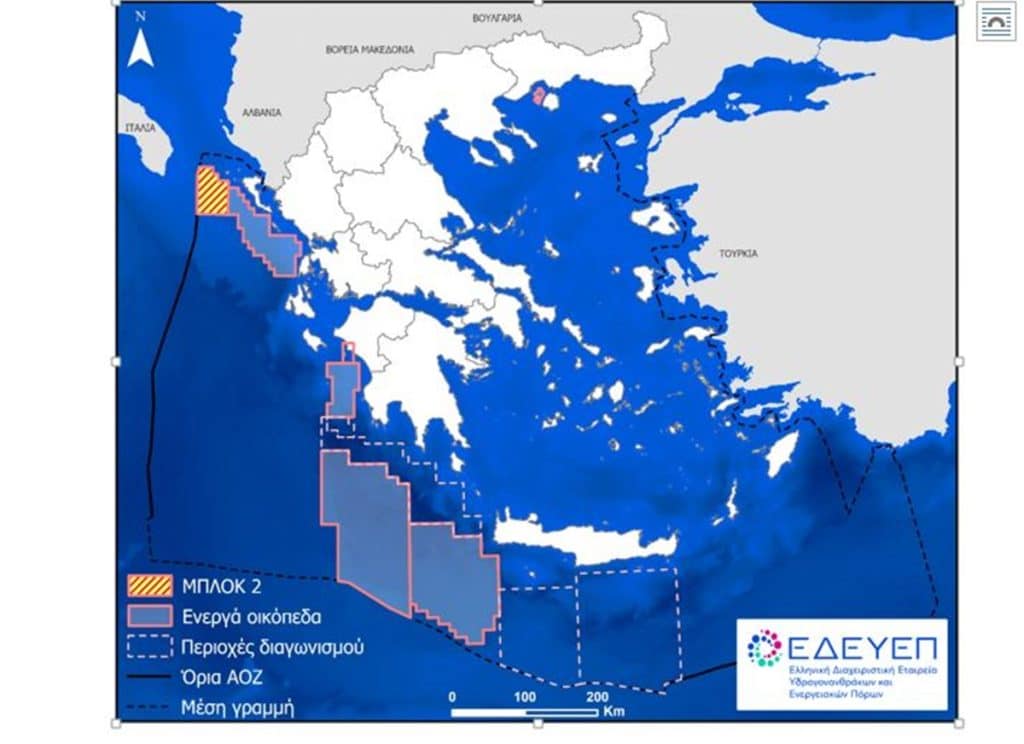
Initial estimates, fueled by promising 3D seismic surveys, suggest Block 2 could hold up to 200 billion cubic meters (bcm) of natural gas. To put this into perspective, Greece’s total annual natural gas consumption is currently around 4 to 5 bcm. Therefore, if this estimate is confirmed and commercially exploited, the reserves in Block 2 alone could potentially cover Greece’s domestic consumption for 40 to 50 years.
“This is a moment of profound national importance,” stated Prime Minister Kyriakos Mitsotakis. “Domestic gas production from the Ionian Sea offers us not just energy independence, reducing our reliance on costly imports, but also a crucial bridge to our green energy future, replacing dirtier fuels like lignite. It will bring substantial revenues to the state, create jobs, and strengthen Greece’s geopolitical standing as a regional energy hub.”
Ionian Sea Gas: Benefits for Greece

According to the government, Greece would benefit from substantial revenue streams through royalties, taxes, and profit-sharing agreements with the consortium. Early estimates for the broader region’s reserves suggest potential state earnings in the tens to hundreds of billions of euros over the project’s lifespan.
ExxonMobil’s entry and initial investment, estimated to be between $50 million and $100 million for the exploration phase, represents a significant Foreign Direct Investment (FDI) and is seen as a “vote of confidence” in the Greek economy. Greece stresses that the project would result in the creation of jobs in exploration, drilling, development, and related industries (e.g., shipping and manufacturing), providing a much-needed boost to local economies.
A successful discovery would strengthen Greece’s position as a regional energy hub and a crucial corridor for diversified energy supplies to Southeastern Europe and the wider continent. The gas could potentially feed into existing infrastructure such as the Trans Adriatic Pipeline (TAP) or new interconnectors. The involvement of a major US company such as ExxonMobil strengthens Greece’s strategic energy cooperation with the United States and enhances its geopolitical standing in the Eastern Mediterranean.
Profit allocation
The initial investment, high risk, and vast expertise required for deep-water exploration typically mean that the majority of the direct, net profits from hydrocarbon production go to the operating consortium, especially the majority partner, which, in this case, is the US company, ExxonMobil.
The most direct way profits are distributed is through the Working Interest in the concession, which defines the percentage of costs and net profits each partner is responsible for. ExxonMobil holds the majority stake with 60% of the Working Interest. As the US-based major, it will assume Operatorship during the high-investment development and production stage.
Energean holds 30%. This London-listed company, with Greek roots and a Mediterranean focus, will remain the Operator during the initial exploration phase. HelleniQ Energy (formerly Hellenic Petroleum), the Greek publicly listed company, holds the remaining 10% as the local partner. 60% of the consortium’s net profit (revenue minus operational costs) will go to ExxonMobil. The remaining 40% will be split between Energean (30%) and HelleniQ Energy (10%).
Greece’s revenue streams from the Ionian Sea gas

The Greek state does not participate in the Working Interest (meaning it does not pay the massive exploration and development costs), but it generates its income through legislated mechanisms applied to the gross revenues of the project. This means the state’s share is separate from and in addition to the consortium’s profits.
The primary revenue streams for the Greek state are:
- Royalties: A percentage of the gross revenue (total income before costs are deducted) comes from the sale of the hydrocarbons.
- Taxation: Consortium’s profits are subject to the standard Greek corporate tax rate.
- Bonus payments: Payments are made to the state upon the signing of the agreement and upon achieving certain production milestones.
- Profit sharing: The concession agreement likely includes a mechanism for additional state participation in the profits. This crucial mechanism ensures that the state receives a much larger share of the profits once the companies have recovered their initial massive capital investment (known as “cost recovery”).
While the exact final revenue split depends on specific contract terms, experts often cite figures where the state’s total share of the resource value over the project’s lifetime is estimated to be around 50% to 60% of the net value of the resources extracted.
Political opposition: “Handing over wealth to monopolies”
Greek leftist opposition argues the deal’s financial terms are heavily weighted in favor of the international operators. SYRIZA-Progressive Alliance has raised serious questions as to the country’s energy security and the actual profits that Greece will see from the agreement.
Sources from the party indicated:
“The possible renunciation of public interests is a very serious matter. With Mr. Mitsotakis’s choices, a strategy of being a ‘given ally’ is expressed even in energy matters, benefiting the US, while in the end, it favors the cartels and the citizens pay dearly.”
Dimitris Koutsoumpas, the Secretary-General of the Communist Party of Greece (KKE), delivered a scathing critique, arguing:
“You are handing over the energy wealth of the country to the monopolies, particularly to the American monopoly ExxonMobil, with the well-known logic that this will protect the country’s sovereign rights, but the exact opposite will happen.”
Adding to the chorus of condemnation, Alexis Haritsis, President of the New Left party, was equally critical of the expected financial returns and geopolitical exposure. “What national plan are we discussing? The revenues will be taken by a multinational and not by the country. The geopolitical risks from such procedures are enormous,” he stated.
The ecological fury: “Alliance of destruction” in a biodiversity hotspot

The strongest and most organized opposition comes from environmental groups, who see the Block 2 concession as a direct contradiction to Greece’s declared commitment to climate action and marine protection. Greenpeace Greece has condemned the agreement as a “historical moment of regression,” accusing the government of sacrificing the environment for short-sighted economic interests.
A spokesperson for Greenpeace Greece stated:
“The government, the US, and ExxonMobil are forming an ‘alliance of destruction,’ playing with our future. While Greece suffers from intensifying climate crisis impacts—from devastating wildfires to heatwaves—the government is performing ‘acrobatics’ by claiming it will protect marine life while allowing long-term operations in a critical biodiversity hotspot like the Hellenic Trench. They are incapable of planning an economy for the 21st century.”
Environmentalists highlight that the Ionian Sea is a critical habitat for endangered species, including the Mediterranean monk seal, loggerhead sea turtles, and various cetaceans (whales and dolphins). They warn against:
- Seismic surveys: The noise from airgun blasts used in exploration can deafen and disorient marine mammals.
- Oil spill risks: Any accident, given the deep-water location and strong currents, could lead to an irreversible disaster for coastal ecosystems and the vital tourism sector of the Ionian Islands.
ExxonMobil’s defense of standards
Despite the political and environmental attacks, ExxonMobil maintains that the operation adheres to the highest global standards. “Our commitment to Greece is long-term, bringing significant foreign direct investment and high-tech jobs,” an ExxonMobil spokesperson commented. “We operate with the highest environmental and safety standards globally, ensuring that any resource development is done responsibly and to the benefit of all stakeholders.”
The Asopos-1 exploratory well, anticipated for late 2026 or early 2027, will not only seek to confirm the resource but also likely intensify national discussion on Greece’s energy destiny.
Search
RECENT PRESS RELEASES
Related Post