Saudi Arabia Innovates to Support Renewable Energy Goals
December 1, 2025
The growing global shift toward renewable energy has intensified the pursuit of high-efficiency photovoltaic (PV) systems, with triple-junction solar cells emerging as a leading technology due to their superior energy conversion capabilities. However, these advanced cells face significant operational challenges, particularly in high-temperature environments, where issues such as thermal degradation, non-uniform heat distribution, and thermal runaway can drastically reduce performance and reliability.
Effective thermal management, therefore, is not merely a supporting function but a critical enabler of sustained efficiency and longevity in PV systems. In alignment with Saudi Arabia’s Vision 2030, which prioritizes sustainability, economic diversification, and the development of clean energy solutions, this study holds significant national relevance. As Saudi Arabia intensifies investments in renewable energy infrastructure, particularly solar energy, ensuring the durability and efficiency of advanced PV systems becomes vital given the region’s vast solar irradiance potential.
Saudi Arabia’s Vision 2030 is a strategic framework aimed at reducing dependence on oil, diversifying the economy, and developing public service sectors. A cornerstone of this vision is the expansion of renewable energy sources, with a target of generating 50% of the country’s electricity from renewables by 2030. This ambitious goal includes plans to develop 130 GW of renewable energy capacity, with approximately 58.7 GW from solar energy and 40 GW from wind energy.
Integrating active cooling systems into PV installations aligns with Vision 2030 by enhancing the efficiency and reliability of solar energy generation. In the region’s arid climate, high ambient temperatures can significantly reduce PV performance. Active cooling mitigates this issue, ensuring that solar installations operate closer to their optimal efficiency levels. Furthermore, the adoption of advanced technologies like active cooling supports the objectives of fostering innovation and developing a knowledge-based economy. By investing in project and development of efficient cooling solutions, Saudi Arabia can position itself as a leader in renewable energy technologies, contributing to global sustainability efforts and economic diversification.
Fundamentals of Active Cooling in Photovoltaics
The first law of thermodynamics, also known as the law of energy conservation, states that energy cannot be created or destroyed but only transformed from one form to another. In the context of PV systems, this principle is directly applicable to the process of converting solar radiation into electrical energy. However, not all of the solar energy is converted into electricity; a significant portion is dissipated as heat.
 |
|
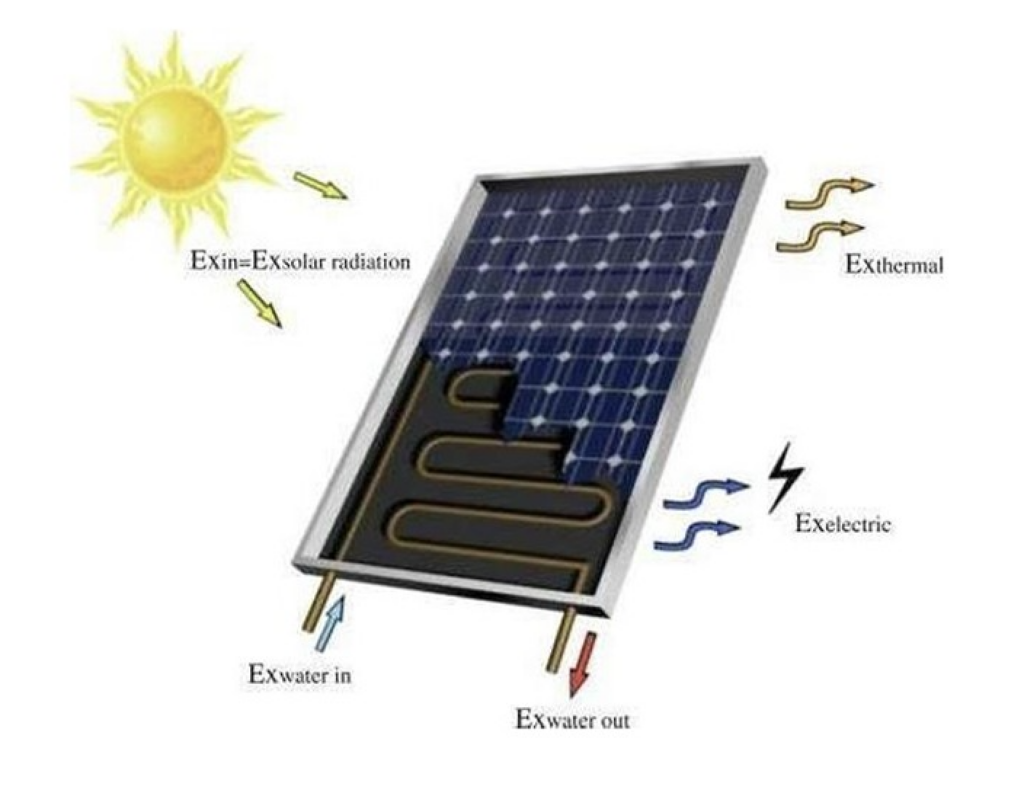
1. Active cooling systems allow for a more efficient conversion of sunlight into electrical energy, improving the overall performance of the solar cells. Courtesy: Yousef Al-Manzalawi, Mechanical Engineering Department, Taibah University |
In PV systems, the increased temperature due to excessive heat build-up can lead to a reduction in efficiency and damage to the materials. Thus, active cooling systems are employed to reduce the temperature of the PV cells, ensuring that more energy is converted into electricity rather than being lost as heat. Active cooling systems such as liquid cooling, forced air cooling, and thermoelectric cooling are designed to reduce Q out —the heat energy rejected or lost from a system—by enhancing heat dissipation, thereby lowering the temperature of the module. These systems (Figure 1) allow for a more efficient conversion of sunlight into electrical energy, improving the overall performance of the solar cells.
Convective Heat Transfer Coefficients in Solar Cells
Convective heat transfer plays a significant role in the dissipation of heat from the surface of a photovoltaic cell. Convective heat transfer occurs when heat is transferred from the solid surface of the solar cell to the surrounding fluid (typically air or water), which then carries the heat away. The convective heat transfer coefficient (h)—which quantifies the rate of heat transfer between a solid surface and an adjacent fluid—is influenced by various factors such as air velocity, fluid properties, and the orientation of the solar panel.
For forced convection systems, the heat transfer coefficient is typically higher than that for natural convection, making forced convection systems more effective in cooling PV modules. Cooling methods like air blowers or liquid pumps can significantly enhance the convective heat transfer coefficient, leading to more efficient heat dissipation.
Understanding the factors that influence h is essential for designing efficient cooling systems. Parameters such as the roughness of the surface, the flow regime (laminar or turbulent), and the temperature gradient between the cell surface and the cooling medium all play a critical role in optimizing convective cooling.
Analysis of Cooling Techniques
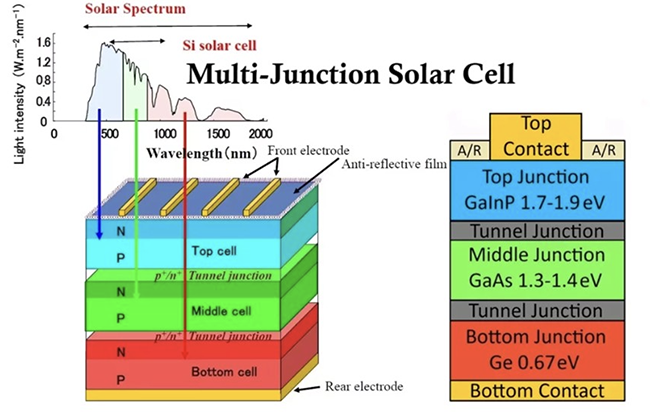
Active cooling systems are critical for maintaining optimal operating temperatures in high-efficiency PV cells, especially for advanced technologies like triple-junction cells (Figure 2). The following paragraphs examine key active cooling approaches and their mechanisms for optimizing cell operating temperatures.
 |
|
2. This image details the inner workings of a multi-junction solar cell, in this case a triple-junction cell. Courtesy: Yousef Al-Manzalawi, Mechanical Engineering Department, Taibah University |
Liquid-Based Cooling (Water). In water cooling systems, water circulates through pipes attached to the back of the PV module. Heat is transferred from the module’s surface to the water through convection, and then the heated water is directed to a heat exchanger or cooling tower where the heat is dissipated. Water has a high specific heat capacity, meaning it can absorb a large amount of heat for a given temperature increase, making it an effective coolant.
Forced Convection Dynamics. Forced convection is one of the most widely used mechanisms for heat removal in active cooling systems. It involves the use of an external force (such as a fan or pump) to move a fluid (air or liquid) across a surface, enhancing the transfer of heat from the solar cell to the cooling medium. In the context of PV cells, forced convection helps prevent overheating, which would otherwise degrade the performance of the cell.
As an example, in a forced-air cooling system for a triple-junction cell, a fan or blower is typically used to circulate air over the cell’s surface. If the air velocity is high, the convective heat transfer coefficient increases, leading to more efficient heat removal. This is especially important when the PV system operates under high insolation conditions, where excessive heat buildup can quickly degrade efficiency. Similarly, for liquid-based forced convection (such as water cooling), the thermal properties of the coolant, such as high specific heat capacity, allow for more effective heat absorption.
Optimization via Active Cooling. By utilizing active cooling systems, such as forced convection or liquid cooling, the temperature of the solar cell can be regulated, preventing the temperature from reaching levels where the temperature coefficient results in significant power loss. Cooling systems help maintain the operating temperature close to optimal levels, thus minimizing the reduction in power output associated with temperature increases.
—Hassanein Abdelmohsen Hassanein Refaey, a professor of mechanical engineering at Taibah University in Saudi Arabia, is the lead author of this article. Co-authors include mechanical engineering students Yousef Ahmad Al-Manzalawi, Mohammed AlJohani; Omar AlJohani, Mohammed AlDossary, and Faisal Akili.
Search
RECENT PRESS RELEASES
Related Post