States That Cut Environmental Agencies Face Crisis as Trump Deregulation Unfolds
December 11, 2025
States that have slashed funding for environmental regulation over the last 15 years have put themselves in a tough position to handle the fallout of the Trump administration’s pro-polluter agenda, according to a new report from the Environmental Integrity Project (EIP).
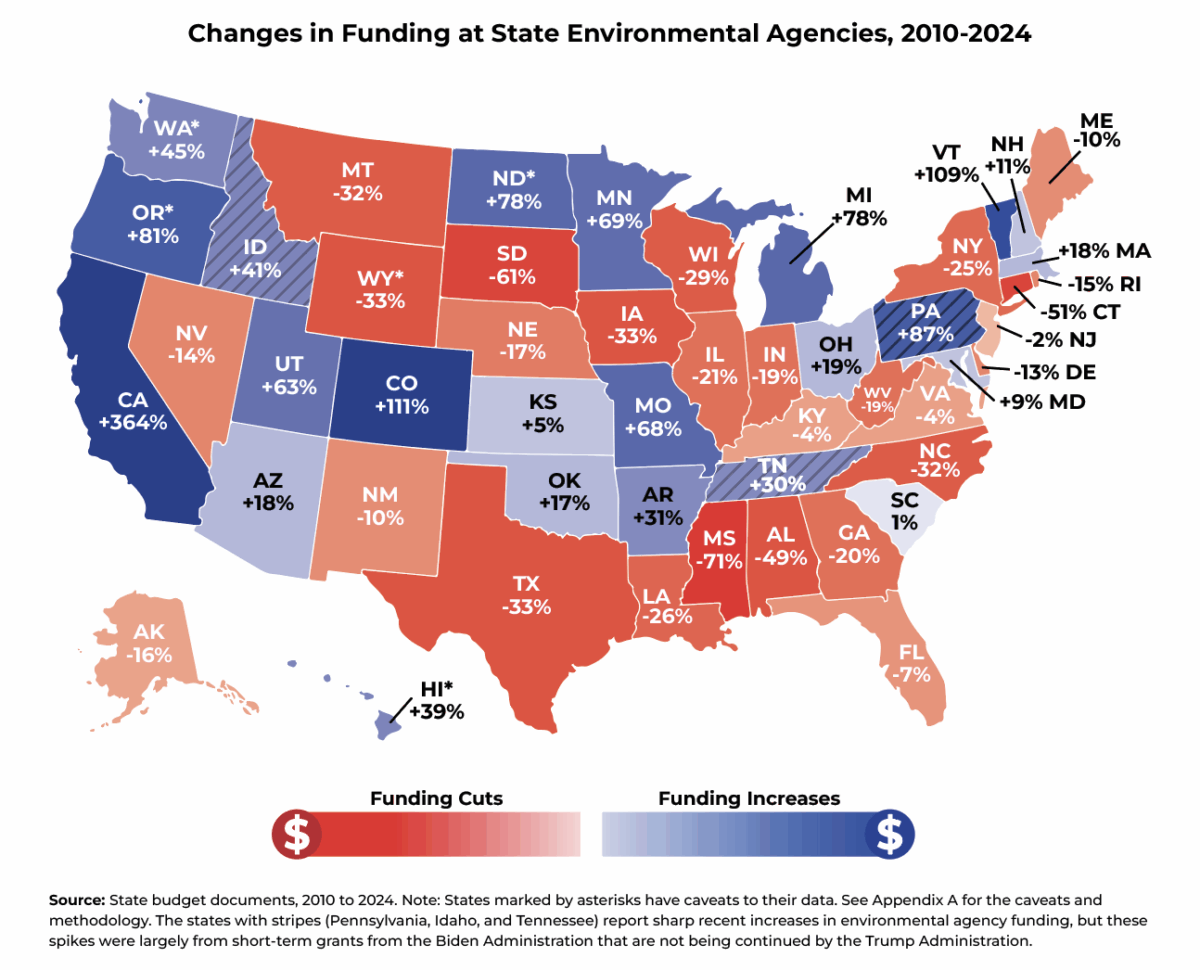
Since 2010, 27 states have slashed budgets and 31 have cut staff at their own public health and environmental agencies that partner with the federal Environmental Protection Agency (EPA), increasing the risk of industrial accidents and potentially exposing already vulnerable communities to levels of pollution not seen in decades, the report found.
Collectively, states cut about $1.4 billion from their environmental agencies, or about 33 percent of the nation’s spending on state-level environmental regulation, since 2010.
Red states tended to see the most dramatic cuts to state environmental agencies over the past 15 years, particularly in the South and Midwest. But some blue states also adopted sizable cuts, with New York reducing agency funding over the same time period by 25 percent, while Connecticut reduced it by 51 percent.
A handful of forward-looking states, including California, Vermont, and Colorado, are going in the opposite direction by investing in public health and climate initiatives, while other states saw budgets grow with Biden-era infrastructure and clean energy funding that is expected to dry up under President Trump.
“It really means there are less people on the ground to make sure companies are following the law.”
EPA Administrator Lee Zeldin and other Republicans have argued that state governments are better positioned to enforce clean air and water laws, a line the GOP has pushed for years while conservative lawmakers continuously slashed funding for environmental enforcement at the state level.
But EIP executive director Jen Duggan said that the Trump administration’s alarming proposal to cut the EPA’s budget by 55 percent, alongside efforts to systematically roll back clean air and water protections for the benefit of the fossil fuel industry and other polluters, has further weakened the regulatory capacity of states.
“The Trump administration is attempting to dismantle the EPA and roll back commonsense federal pollution rules, claiming that the states can pick up the slack and protect our communities — but that’s not the case,” Duggan told reporters on Wednesday. “Our research found that many states have already cut their pollution control agencies, and so more cuts at the federal level will only put more Americans at risk.”
Less funding and staff at state environmental agencies means fewer inspections of industrial facilities to prevent accidents, more air and water pollution released under outdated permits, and a slower response to chemical accidents, oil spills, and complaints from residents about foul orders or dirty drinking water, according to Duggan.
“When agencies have fewer resources to do their job, that means there are less inspectors that are able to do routine inspections or respond to community complaints, and it may take longer from the time a violation is identified to resolve that violation,” Duggan said. “It really means there are less people on the ground to make sure companies are following the law.”
Consider North Carolina, where an explosion in industrial meat production across the state, combined with intensifying storms and flooding, has contaminated streams and groundwater with animal waste that can contain dangerous pathogens and chemicals — not to mention the foul air pollution emitted by factory farms. North Carolina’s population has also grown alongside industrial development in recent years, but state leaders made some of the deepest cuts to environmental and public health oversight in the United States.
From 2010 to 2024, the North Carolina Department of Environmental Quality (DEQ) suffered the largest staffing cuts by percentage of any state environmental agency in the nation, losing nearly a third of its staff or about 386 jobs, according to the report. State lawmakers and governors from both parties voted to slash the agency’s budget by 32 percent over the same time period.
Drew Ball, the southeast campaigns director for Natural Resources Defense Council in Asheville, North Carolina, said the DEQ saw some improvement under former Gov. Roy Cooper, a Democrat whose term ended earlier this year. However, after facing years of attacks from Republicans, the state agency no longer has the capacity to keep up with the rapid growth of factory farms.
“DEQ has still been forced to operate with one hand behind their back, because lawmakers in Raleigh have treated environmental and public health protections as political targets … by weakening water pollution standards, and restricting people’s ability to hold industrial farms accountable when they are harmed,” Ball told reporters on Wednesday.
“It’s like dismantling the fire department when the fire is already burning.”
Ball said the cuts to North Carolina’s environmental office came as the number of factory farms known as Concentrated Animal Feeding Operations (CAFOs) grew rapidly in the eastern end of the state, where 8 million hogs and 1 billion chickens have been living in cramped conditions since March 2025. The huge amounts of manure produced by CAFOs can leach pollution into streams and groundwater and is often stored in massive lagoons, some of which have ruptured or overflowed during hurricanes.
Ball said North Carolinians worry about what the next storm will wash into their yards.
“And now the federal government is making the deepest cuts to EPA in 40 years … it’s like dismantling the fire department when the fire is already burning,” Ball said.
With the EPA facing massive cuts under Trump, Duggan said that states will also have fewer if any federal regulators on the ground to respond to localized accidents, spills, pollution violations, and cleanups. If both federal and state lines of defense fail, Duggan said, communities will face greater risk of exposure to dangerous pollution.
“This uneven trend underscores that any effort to further weaken the federal EPA will have disproportionate impacts across the country,” Duggan said. “Communities could face an increase in pollution risks, while other states are better protected by a robust secondary defense for public health.”
After passing a short-term funding bill in November to reopen the government after the longest shutdown in U.S. history, Congress is expected to vote on funding for the EPA and other federal agencies in January.
Truthout
Search
RECENT PRESS RELEASES
Related Post