Scotland’s energy – election common ground or battleground?
December 14, 2025
Scotland’s energy – election common ground or battleground?
 Getty Images
When you look out across the vast Grangemouth industrial complex, it appears more like a monument to Scotland’s economic past than a vision of the future.
The closure of the oil refinery earlier this year with the loss of 400 jobs was a stark reminder of the challenges posed by the transition from fossil fuels to a more renewable energy-based economy.
There was a notable moment of common purpose between the UK and Scottish governments this week.
Ministers from Westminster and Holyrood came together in Grangemouth at a ceremony to break ground for a new biotech plant.
The Edinburgh-based firm MiAlgae plans to produce Omega 3s from the by-products of whisky distilling instead of from fish.
 PA Media
This project, which is presented as a more sustainable form of production, is receiving financial support from both governments.
It’s one example of an alternative industry for Grangemouth.
Others – from hydrogen production, to breaking down plastics that are hard to recycle – are proposed in the Project Willow report.
While Labour and the SNP are cooperating on this agenda as Scotland’s two parties of power, it’s worth remembering that they are also ferocious political rivals.
Together with an array of other parties they are about to contest the 129 seats in the Scottish Parliament.
It’s increasingly clear that tensions over how best to manage the wider energy transition will feature prominently in the Holyrood election campaign.
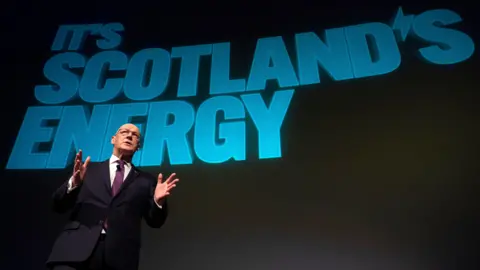
First Minister John Swinney made clear his intention to make energy an important element of the SNP’s campaign this week.
Revising the party’s 1970s slogan “It’s Scotland’s oil” Swinney declared that in the era of wind, wave and solar, “It’s Scotland’s energy”.
Essentially his argument is that with Scottish independence these resources could be better managed to reduce bills for households and businesses by a third.
An SNP paper on the subject does not show exactly how the price cuts are calculated or how any loss of contributions from UK bill payers to upgrading the Scottish transmission system could be offset.
Given that any reforms are linked to the creation of a Scottish state following a “yes” vote in a future referendum, the timescale for any household savings is unclear.
It is obviously not a policy proposal that is designed to ease the cost of living pressures faced by electricity consumers right now.
It does however highlight that energy policy is currently under Westminster rather than Holyrood control.
The SNP may consider that a useful way of pointing out that electricity bills are going up on Labour’s watch even if the Chancellor Rachel Reeves has announced plans to take the edge off increases by cutting certain surcharges.
By returning to the issue of independence, the Conservatives said John Swinney was pursuing his “lifelong obsession” and Labour said he was “stuck in the past”.
It so happens both these parties were promoting health-related policies on the same day, believing this to be an area where the SNP is more vulnerable.
This is not the only energy-related argument that is likely to develop during the campaign.
The Conservatives are already making the case for the UK to “maximise extraction” of oil and gas from the North Sea. Reform UK takes a similar position.
Both parties want the energy profits levy on oil and gas producers to end.
 Getty Images
That position is also advanced by the SNP.
They have yet to clarify if the “presumption against” new oil and gas developments articulated when Nicola Sturgeon was first minister will be retained in the next version of the Scottish government’s energy strategy.
The prime minister Sir Keir Starmer has defended the continuation of the energy profits levy and highlighted the relaxation of rules on drawing more oil and gas from areas close to existing fields as a concession to the industry.
To be clear, North Sea taxation and licensing is a UK government responsibility.
The Scottish government that is formed after next May’s election cannot change the policy but that does not prevent parties arguing their positions in the Holyrood campaign.
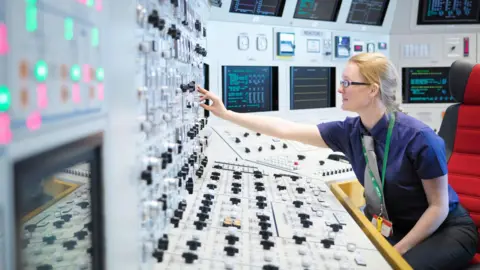
Another energy divide exists over the potential for a new generation of nuclear power in Scotland.
Labour and the Conservatives are in favour, the Liberal Democrats are equivocal and the SNP and Greens are against.
While new nuclear plants require UK government approval, any proposed developments in Scotland could be blocked by the Scottish government using its planning powers.
Pro-nuclear parties argue that new plants would create jobs and provide electricity when the wind’s not blowing.
Anti-nuclear parties criticise the cost of nuclear developments and their legacy of radioactive waste.
Where there is broad agreement is that there are valuable new industrial opportunities to be secured in the renewable energy sector but these are not without controversy.
The location of wind farms and the infrastructure needed to get the electricity they produce to market is a source of considerable tension.
Then there’s the offer of Chinese investment in a major wind turbine production facility at Ardersier, near Inverness, which is receiving extra careful consideration on security grounds.
To repeat, many of these matters are subject to UK decision making or an interplay between Westminster and Holyrood powers. But there are no limits to what can be discussed in any election campaign.
Expect the Holyrood 2026 contest to be animated by debate over Scotland’s energy future as well as those issues over which the Scottish Parliament has full control.
Search
RECENT PRESS RELEASES
Related Post