As Bolivia enters a new era, will economy trump the environment?
December 23, 2025
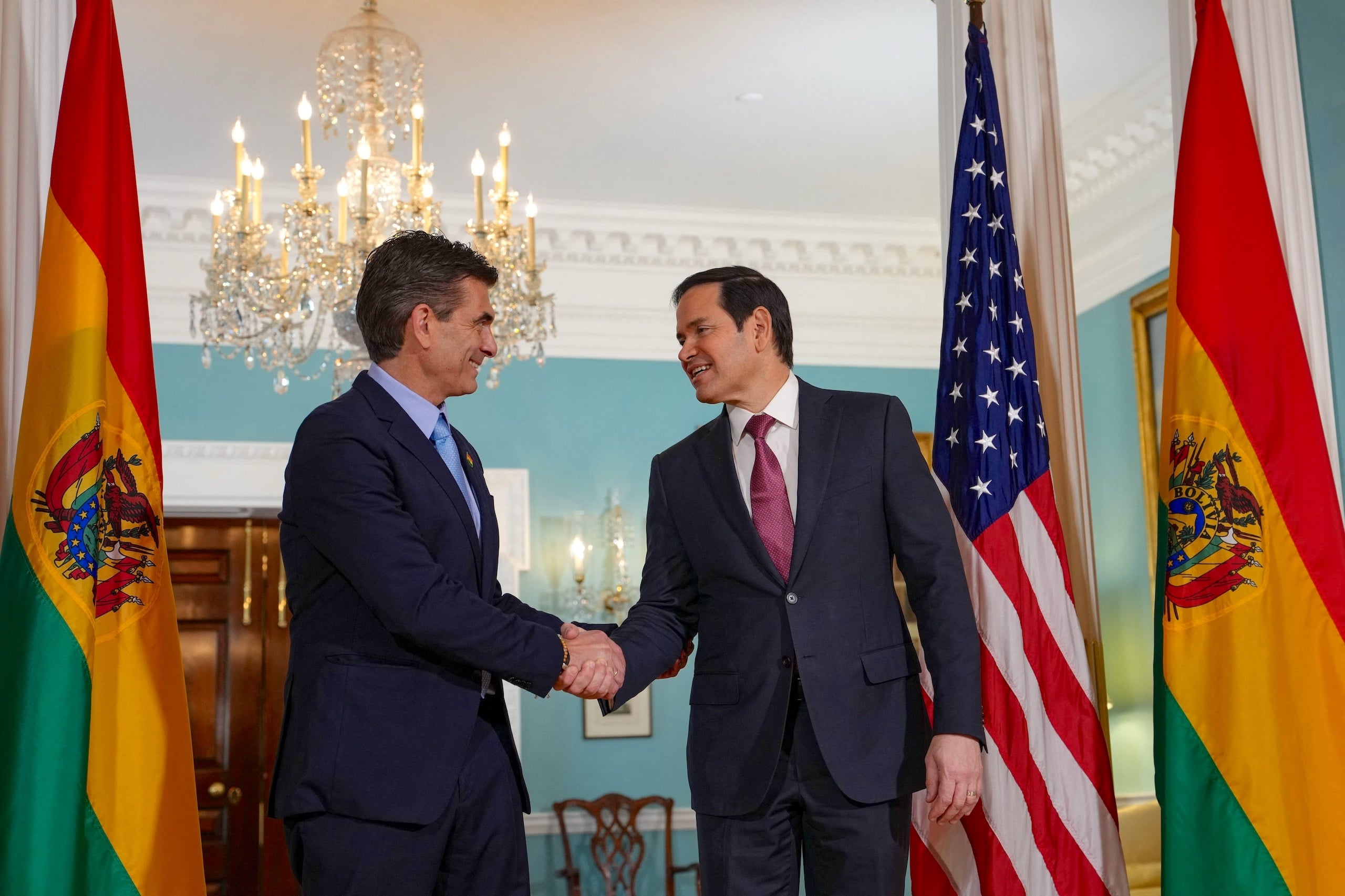
On the night of 19 October, Rodrigo Paz was celebrating his victory in the second-round runoff of the Bolivian elections when he received a call. Christopher Landau, the United States deputy secretary of state, representing Donald Trump’s government, had called to congratulate the new president.
Paz himself drew attention to this communication during his first public appearance, after the announcement of a win for his centre-right Christian Democratic Party, with 54% of the votes, over Jorge “Tuto” Quiroga’s Libre alliance.
That night, several world leaders and heads of state contacted Paz. But the message from the senior US official was clear: after almost two decades of estrangement between Washington and socialist governments in Bolivia, a new political, commercial and diplomatic era had begun.
The new president said this would be “a close relationship”. In the weeks before taking office on 8 November, Paz made a visit to the United States in search of support to resolve an economic and energy crisis that has gripped Bolivia since early 2023. Upon returning from his trip, he told Bolivian business leaders that his team had “already secured the dollars, petrol and diesel that we so desperately need”.
Washington has seen the change of government as an opportunity to rebuild diplomatic ties that had been strained since 2008, when then-president Evo Morales declared former US ambassador Philip Goldberg persona non grata, accusing him of leading the “division of Bolivia”. In a statement from the US Embassy on 20 October, secretary of state Marco Rubio said that his country “is ready to partner with Bolivia on shared priorities”.
On the other side of global geopolitics, China – Bolivia’s main trading partner during the leftist governments of Evo Morales (2006-2019) and Luis Arce (2021-2025) – also congratulated Paz, days after the election results were announced. On Friday, 24 October, Chinese leader Xi Jinping sent a message to the president, in which he said that since the establishment of their diplomatic relations 40 years ago, bilateral ties “have maintained good momentum for development”.
Parsifal D’Sola, director of the Andrés Bello Foundation, which studies relations between China and Latin America, said he was sure a call with Chinese officials would also have taken place on the night of Paz’s victory. “I have no proof, but I have no doubt that one of the first calls received by the new government was from China, precisely to initiate a new conversation, develop a new relationship, and find out exactly what the positions are,” he told Dialogue Earth.
Paz has taken office in a context of deep economic crisis, reflected in a 2.4% fall in GDP in the first half of 2025, and on 17 December declared the country to be in an “economic emergency”. The new president is seeking to move beyond the long-standing socialist ideology that has governed Bolivia, pursue international support, and set a new direction for his government. Having campaigned with promises of “capitalism for all”, Paz has said this new era is “going to open Bolivia to the world and the world to Bolivia”.
But this “opening up”, combined with shifting geopolitics in the region, have left some observers fearful that environmental protections could be loosened in pursuit of economic development.
“We are in a very complex economic situation, the result of economic decisions taken over the last decade,” said Óscar Campanini, a sociologist specialising in environment and development, and director of the Bolivian Centre for Documentation and Information (Cedib), an NGO. “In this context it is possible that environmental and social requirements could be relaxed, under the pretext of facilitating foreign investment.”
Bolivia in the spotlight
Bolivia and China have had diplomatic relations since 1985. In 2006, with the arrival to power of Evo Morales and his Movement for Socialism, those ties began to grow from simple exchanges of ambassadors and helped contribute to making China, today, Bolivia’s main trading partner.
“From 2010 onwards, it is clear that investments involving Chinese cooperation intensified,” said Marco Gandarillas, a senior researcher at the environmental organisation Latinoamérica Sustentable (LAS). China is Bolivia’s main bilateral creditor, with loans mainly for infrastructure. In addition, its companies – state-owned, private and mixed – have become the main contractors for road works. Gandarillas, who is soon to publish a report focused on Chinese investments in the country, told Dialogue Earth that according to his calculations, more than 1,466 kilometres of roads and bridges have been built by Chinese companies in the Bolivian Amazon alone. He said that these are key to connecting rivers, which also serve as important routes for transit and trade in these often remote regions.
According to data collected by Gandarillas, between 2010 and 2019, Bolivia signed 38 bilateral agreements with China. Citing research on economic cooperation agreements and national ratification laws, he counts 16 Chinese loans totalling over USD 2 billion and during that period; other sources tracking Chinese overseas finance have put this figure even higher, at over USD 3 billion. Alongside significant support for a planned hydroelectric dam and a vast steel project, much of this financing went towards three major road infrastructure projects: the Rurrenabaque–Riberalta highway, the El Sillar dual carriageway and the Espino–Charagua–Boyuibe highway.
The latest data available on the official website of the Central Bank of Bolivia refers to a debt with China of USD 1.37 billion as of June 2024.
In the name of saving the crisis, we will end up raffling off or sacrificing areas, ecosystems and communities that subsist on very valuable resources
Óscar Campanini, director of the Bolivian Centre for Documentation and Information
Ning Leng, a professor of political science at Georgetown University whose research has focused on China and its overseas finance, told Dialogue Earth that China has three key interests in Bolivia: minerals such as lithium; agriculture, especially soybeans; and infrastructure, which is the area where it has had the greatest impact.
Analysts agree that the arrival of a new government, far from generating suspicion in China due to economic and geopolitical rivalry with the United States, is an opportunity to reaffirm ties.
“The pragmatic approach that Beijing has adopted with centre-right or right-wing leaders – Bolsonaro in Brazil, or Milei in Argentina – is an example of how China can adapt to political changes in the region without affecting or compromising its foreign policy objectives,” said Carlos Piña, a political scientist specialising in China-Latin America relations.
In the case of Argentina, Javier Milei recently received new financial support from the Trump administration, amounting to USD 20 billion, without this interfering with previous projects and initiatives that his left-wing predecessors, Cristina Fernández and Alberto Fernández, had established with China.
The same thing happened with Brazil. At present, relations between China and President Luiz Inácio Lula Da Silva are “comprehensively strategic”, researcher Gandarillas said, but he added that they had also largely been so when the far-right Jair Bolsonaro was in power from 2019 to 2022.
In Bolivia, the letter sent by Chinese leader Xi Jinping to his counterpart Rodrigo Paz indicated a similar consistency, and goes further, offering to take the China-Bolivia strategic partnership “to a new level” of “comprehensive strategic”, an official designation in Chinese diplomacy. This is the level of relations China has determined with other South American countries, including Brazil and Venezuela, explained Gandarillas.
From necessity to environmental flexibility
Construction projects led by Chinese companies in Bolivia, and across Latin America, in recent decades have often met with environmental and social concerns, although in 2024 China accepted a number of recommendations from the UN Human Rights Council in relation to its overseas investments, including to consider more robust legislation incorporating the right to a clean, healthy and sustainable environment.
Analysts such as Campanini of Cedib and Gandarillas from Latinoamerica Sustentable are concerned that the new Bolivian government has so far shown a great imbalance between its emphasis on economic and environmental issues. “In the name of saving the crisis, we will end up raffling off or sacrificing areas, ecosystems and communities that subsist on very valuable resources,” said Campanini.
Indigenous peoples of the Bolivian Amazon and civil society organisations have voiced similar concerns, particularly following the recent dissolution of the Ministry of the Environment, which has been merged into a unified Ministry of Development Planning and the Environment. Furthermore, the appointment of agro-industrial businessman José Fernando Romero Pinto as minister for the new department prompted the Block of Peasant and Indigenous Organisations of the Northern Amazon of Bolivia (Bocinab) to declare a “state of alert”, further describing their concern on the changes to the environment ministry, and around a reported “strengthening of the Ministry of Mining and Metallurgy”.
Speaking to Dialogue Earth, Bocinab founder Luis Rojas Mogrovejo said they would not allow further mining activity in their territories, which have already been affected by mercury pollution. At a time when the new government is seen to be organising itself to try to lift the country’s economy, Jenny Duri, president of the Yaminahua-Machineri Indigenous Peasant Territory, told Dialogue Earth that “mining in our territory is a danger”.
The Paz administration has rejected initial criticisms around its environmental prospects, emphasising that it sees development and environment as complimentary rather than opposing forces, and pitching its ministry reshuffle as breaking down a disconnect between conservation and production.
In an interview with Dialogue Earth, Jorge Ávila, vice-minister of environment, biodiversity, climate change and forest management and development, said that Bolivia “is not in a position to abandon development, because the country is bankrupt, which doesn’t mean we’re going to disregard the environmental aspect”.
An attorney with experience in environmental, forestry and public policy issues, Ávila argued that Bolivia needs to abandon an approach that sees certain sectors forced to comply with environmental regulations “as if it were a punishment”. On the contrary, “we have to persuade and demonstrate that by doing things right from an environmental perspective, we are creating better conditions for development in our country”.
Search
RECENT PRESS RELEASES
Related Post