Turning Our Back on Clean Energy
February 16, 2026
Why does MAGA hate the planet?
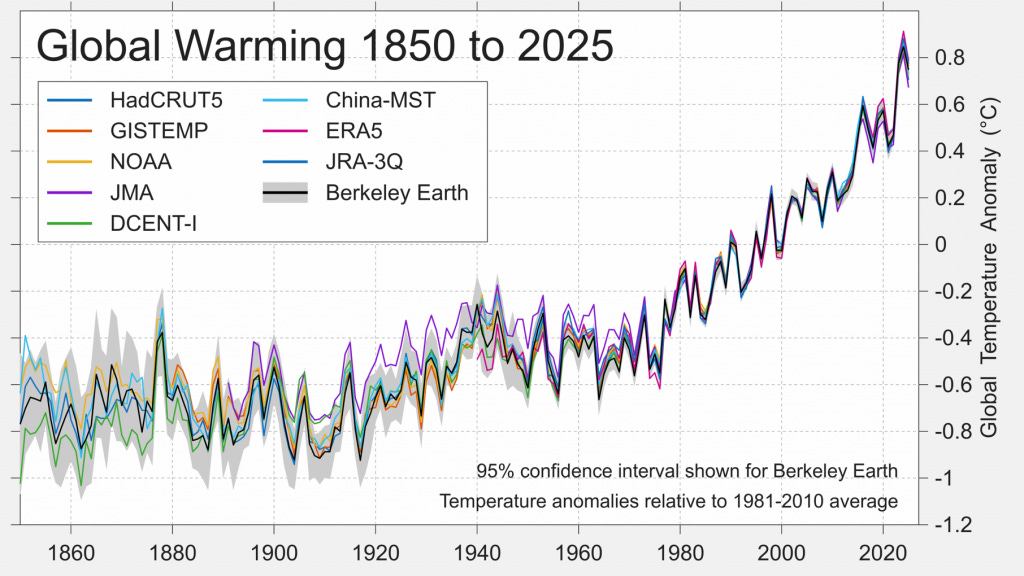
Source: Berkeley Earth
It has been a brutal winter in much of the United States. Weather is a chaotic system in which extreme events are always happening somewhere. But as I am sure you have noticed, extreme weather events — catastrophic storms and flooding, punishing droughts, and yes, extreme cold snaps — are becoming more common as a result of climate change.
For climate change is not just continuing: it’s accelerating. Multiple estimates find that 2025 was one of the warmest years on record for the planet, exceeded only by 2024 and 2023. Indeed, Berkeley Earth reports that “The warming spike observed in 2023 to 2025 has been extreme and suggests an acceleration in the rate of Earth’s warming.”
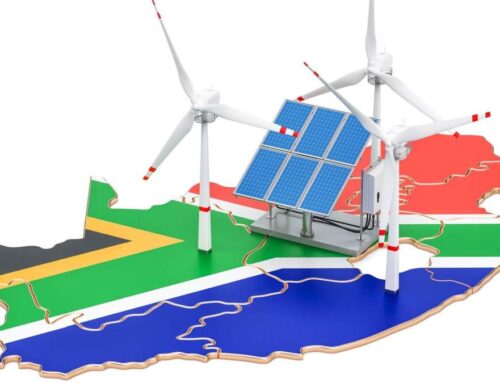
In other news, the Trump administration has gone to war against any and all efforts to limit climate change. The administration is also imposing a “blockade” against wind and solar projects, delaying or even revoking permits, whether or not these projects have received federal subsidies.
Now, there isn’t a genuine scientific dispute about the reality of global warming and its causes. There isn’t even a serious dispute about the costs of fighting climate change: the economics of green energy are more favorable than they have ever been.
So what’s going on? The Trump administration hates science and science-based policies in general; look at its war on vaccines, which will end up causing an enormous number of deaths. Its assault on universities threatens the best scientific research centers in the world. Its irrational treatment of immigrants means the best and brightest from the around the world no longer want to come here. But in the case of energy, its destructive policy largely reflects the corrupting influence of big money.
I’ll explain in a minute. First, some background.
Almost 40 years have passed since James Hansen’s landmark Senate testimony warning about global warming. He was right. Climate science has been overwhelmingly vindicated by reality.
However, the economics and politics of climate policy have played out very differently from what almost anyone expected.
As late as the 2010s, many observers — myself included — would have said that the big problem in addressing climate change was who would bear the cost. Policies to limit greenhouse gas emissions, everyone believed, would slow the growth of the economy and of real incomes. True, anti-environmentalists were grossly exaggerating these costs. In 2009 I wrote that
[T]he best available economic analyses suggest that even deep cuts in greenhouse gas emissions would impose only modest costs on the average family.
But what we knew at the time nonetheless said that there would be significant costs to slowing global warming. And this was problematic, because the costs of limiting emissions would be incurred right away, while the benefits of reduced warming would accrue decades later — and many of them would go to other countries. So action on climate appeared to require (a) international cooperation (b) persuading voters to accept costs now in exchange for a better world many years in the future.
And it was all too easy to be pessimistic about the prospects both for cooperation and for persuading voters to accept even modest future-oriented sacrifices.
Then came the renewable energy revolution. Solar and wind power have become cost-competitive with fossil fuels — they are, in particular, clearly cheaper than coal. Huge progress in batteries has rapidly reduced the problem of intermittency (the sun doesn’t always shine, the wind doesn’t always blow.) There’s now a clear path for a transition to an “electrotech” economy in which renewable-generated electricity heats our homes, powers our cars, and much more.
This transition would make us richer, not poorer. In fact, nations that for whatever reason fail to take advantage of electrotech will be left behind in global competition.
And at this precise moment — a moment in which acting to accelerate the energy transition would increase, not reduce, economic growth — the U.S. government has been taken over by people who want us to go backward on energy. The Trump administration has even introduced a mascot, “Coalie,” in an attempt to make an extremely dirty fuel cute. But coal isn’t cute. Even if we ignore the role of coal in climate change, coal-burning power plants caused hundreds of thousands of excess U.S. deaths between 1999 and 2020.

What explains this extraordinary rejection of progress and embrace of energy know-nothingism?
Money may not be the whole story, but it’s a lot of the story.
Indeed, much of what is happening to American democracy has its origins in the long-term strategy of the billionaire Koch brothers. The Kochs spent decades promoting right-wing politics in general, with a special role in the takeover of the Supreme Court by the Federalist Society. But an important part of their agenda, and hence that of the right-wing movement as a whole, has always been to keep America burning the fossil fuels on which their wealth rested. If you want to know more, read Lisa Graves’ book on the Roberts Supreme Court, “Without precedent”.
At this point, moreover, it’s not just about normal channels of political influence, nor it just about domestic billionaires. We now live in a time in which U.S. policy is shaped by sheer, naked corruption (enabled in part by the Koch takeover of the courts). Notably, Middle Eastern petrostates, which have a strong interest in blocking the energy transition, have played a huge role in enriching the Trump family.
It’s somewhat surprising that other big-money interests haven’t pushed back. After all, crippling the development of renewable energy is bad for business, and especially bad for the electricity-hungry crypto and AI industries, which ordinarily have a great deal of sway with the Trump administration. But maybe they have decided that special treatment, and especially a green light for their own unethical behavior, matters more than affordable energy.
If there’s any good news here, it is that from a global point of view this malignancy may not matter very much. America is not the world. In fact, at this point we’re responsible for only a small fraction of global greenhouse gas emissions:
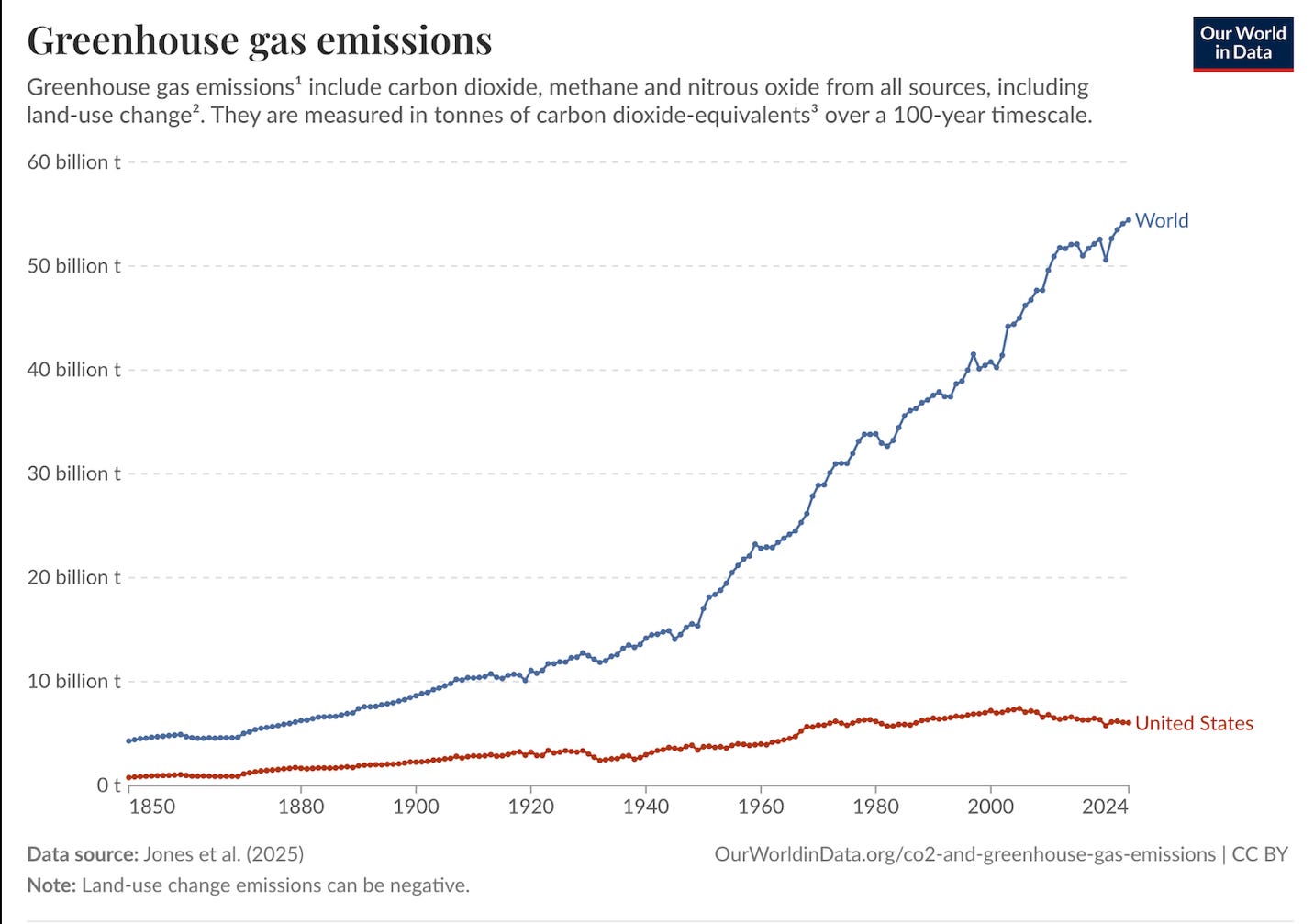
So America’s hard turn against renewables and climate action won’t be decisive for the climate future as long as other countries continue to move ahead on green energy, which they are. For the most part, all MAGA will do is help make the United States backward, poorer, sicker and irrelevant.
MUSICAL CODA
Search
RECENT PRESS RELEASES
Related Post