City staff to gather feedback from Commission on whether to repeal clean energy ordinance,
January 25, 2026

photo by: Douglas County
Solar panels installed at Douglas County Public Works.
Lawrence has already fallen short of its 2025 goal for fully powering municipal operations with renewable energy, and city staff say this, along with other targets, is unrealistic and lacks a clear path on how to achieve them.
Now, staff want to recommend repealing an ordinance passed in 2020 outlining all of these goals.
A goal in the ordinance was to have renewable energy in municipal operations by 2025, and Kathy Richardson, the city’s sustainability director, said during a meeting on Thursday that the city hasn’t come close to meeting that goal. She said the amount of clean energy providing power to the city’s facilities currently amounts to about 3%.
The Connected City and Environmental Sustainability Advisory boards held a joint work session on Thursday to discuss the city’s climate goals and why staff want to recommend repealing the city’s ordinance, which also outlines the goal of having 100% renewable energy citywide by 2035 with a new goal – to be “climate-neutral” by 2050.
“That is really truly saying that every residential and commercial business would be powered 100% by clean and renewable energy (by 2035),” Richardson said. “I don’t know anybody in this field that would say that is in any way doable.”
Climate neutrality is balancing all human-caused greenhouse gas emissions with removals or offsets, and it’s intended to result in no net impact on the climate system. It requires reducing emissions as much as possible across all sectors, like government, industry, transportation, households and balancing any remaining, unavoidable emissions with equivalent removals.
Richardson said the City Commission asked staff to work on revisions to the existing ordinance and to work with both advisory boards after they adopted the Adapt Douglas County: A Climate Action & Adaptation Plan in 2024 – the countywide plan aiming to help the community adapt to the risks of climate change. Instead, staff want to align their greenhouse gas reduction goals with the plan, which includes the 2050 goal.
“(What) the Commission adopted in 2020, (the ordinance), there was no roadmap on how we were going to get there,” Richardson said. “For the resolution, the roadmap is the Climate Action and Adaptation Plan.”
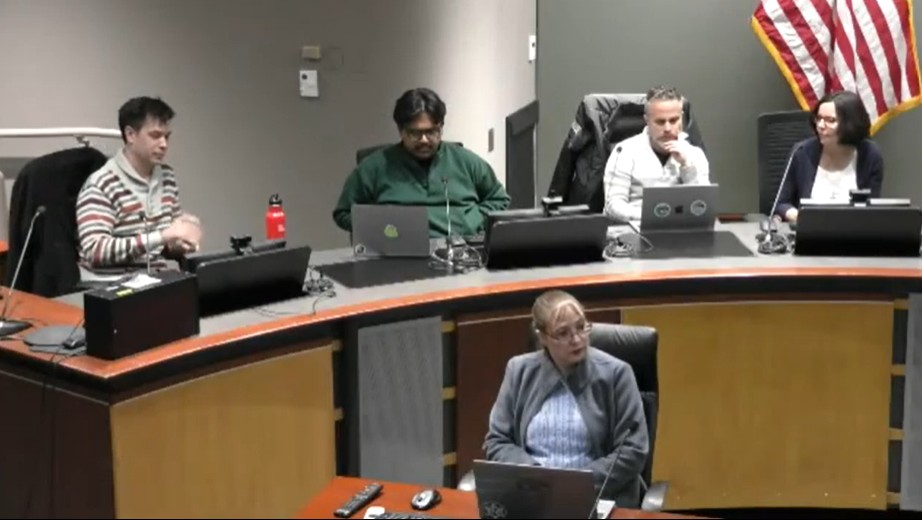
photo by: YouTube screenshot
The Connected Cities and Environmental Sustainability Advisory Boards held a joint work session on Thursday, Jan. 22, 2026 to discuss the city’s climate goals and whether to recommend repealing a city ordinance on renewable energy.
Richardson added that goals often fall under resolutions and not ordinances, so moving forward, city staff would like to make this recommendation to the City Commission and adopt a new resolution outlining the goal of climate neutrality by 2050.
Nancy Muma, chair of the Environmental Sustainability Advisory Board, asked if the new resolution will simply communicate the overarching goal, or if it will also include milestones the city wants to reach.
Richardson said it will outline the strategies and goals included in the Climate Action and Adaptation Plan, and those are anticipated to change over time. She said the resolution will not be changing, and it is anticipated to just communicate the 2050 goal.
“This document, the Climate Action and Adaptation Plan, is set so it’s not set in stone,” Richardson said. “Every few years we’re reviewing and potentially changing some of the strategies or the goals and we’re going to be doing new inventories.”
Ryan Reza, a member of the Connected City Advisory Board, said this ordinance was only passed six years ago, and if it was passed several decades ago, repealing it would make a lot more sense.
“I think naturally there’s going to be a lot of negative feedback to completely overdoing an ordinance passed less than a decade ago with claims that it just wasn’t possible in the first place,” Reza said.
Nick Kuzmyak, a member of the Connected City Advisory Board, said if there was no way the previous ordinance was achievable, he wanted to make sure the new goal would be achievable as well.
“Because I feel like the patience of the public and the governing body may start to wear thin if it has to be updated every five years because it couldn’t be done it turns out,” Kuzmyak said.
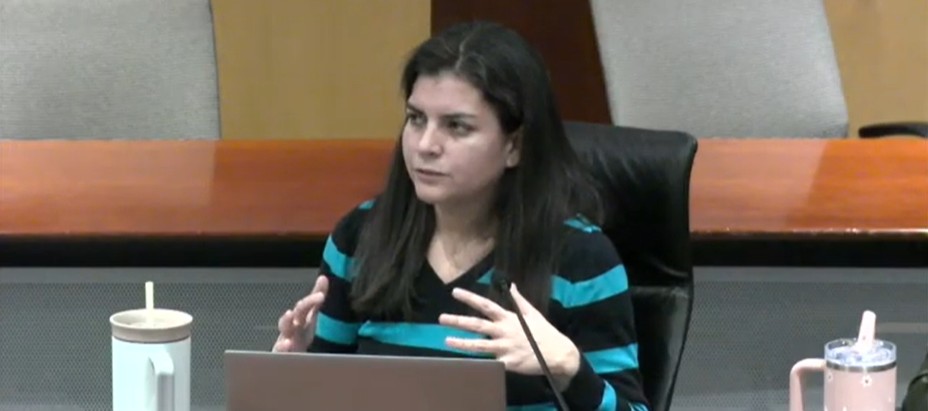
photo by: YouTube screenshot
Kathy Richardson, sustainability director of the City of Lawrence, is pictured on Thursday, Jan. 22, 2026.
Josh Roundy, vice-chair of the Environmental Sustainability Advisory Board, said the Climate Action and Adaptation Plan does a good job of outlining the more detailed goals that are actually achievable and things the community can actually measure and do.
“When you’re (writing) the resolution, I think it would be nice to have some statement or something similar to the other one where it’s like an annual review, but actually going further and saying the city will post an annual review of the different goals and how they are mapping and working towards the Douglas County plan,” Roundy said. “Because that’s the one thing I feel like could get lost in this.”
Richardson said a resolution has not yet been drafted, but sustainability staff will meet with commissioners during a work session or another way to gather feedback from the commission, to see if they are interested in pursuing the resolution or not. If they are, Richardson said she will task staff to begin writing one. Staff will also schedule meetings with the advisory board for updates.
Richardson said the sustainability team has identified three key priorities in the last year, outlined in the city’s strategic plan.
“The three (priorities) were established or prioritized last year with the hope that the next couple years is the time frame of us working on moving the needle and working on these three,” Richardson said.
The first priority is to reduce the amount of trash people generate per day. She said the city wants to work toward waste reduction efforts, recycling, composting, etc. The second goal is to reduce the amount of greenhouse gas emissions, and the final goal is to increase the percentage of city-used electricity to be powered by on-site renewable energy.
Federal climate grant award
During Tuesday’s meeting, the City Commission chose to enter into an agreement with the Kansas Department of Health and Environment to participate in a program that allows eligible entities to explore work aiming to reduce ambient air pollution. Richardson said this work could go toward helping achieve that final goal for on-site renewable energy for the city buildings.
The KDHE is the lead agency for the State of Kansas for purposes of planning and outreach for the program, called the Climate Pollution Reduction Grants program. The city has been awarded $200,000 from the state in these grant funds, and it will be exploring ways to reduce greenhouse gas emissions and other harmful air pollution. These grant funds will be available for the city to use through June 30, 2027.
Across the U.S., the federal program is set to provide $5 billion in funding for climate action as a part of the Inflation Reduction Act of 2022, created under the Biden Administration. The act created and funded the program as part of the largest federal investment in climate action in U.S. history.
Richardson said this money will be used for planning work, where the City of Lawrence will work to help advance the local Climate Action and Adaptation Plan.
“The additional planning work specific to Lawrence will include updated greenhouse gas emissions inventories and emissions reduction projections based on local actions we can take into the future,” Richardson said in an email. “The inventories for greenhouse gas emissions will be for (1) community-wide (all of Lawrence) and (2) city-operations.”
Richardson added via email that other potential planning work the city has discussed with the State of Kansas has been the development of an Energy Plan for municipal buildings, a renewable energy study/analysis of municipal buildings and an electrification study/analysis of municipal buildings.
She said the city plans to continue using the group ICLEI – Local Governments for Sustainability, formerly the International Council for Local Environmental Initiatives, as the expert guide and strategist on greenhouse gas emissions inventories and emissions reduction projections.
Richardson said via email that initial greenhouse gas inventories were established in 2005 as the baseline year for the greenhouse gas emissions reduction goals. The city has updated greenhouse gas emissions inventories a few times with 2018 being the last year data was collected up until the city reported data needed for the 2021 greenhouse gas emissions inventory included in the Climate Action and Adaptation Plan.
“We very desperately need new data, and that conversation about greenhouse gas emissions and what is most important and what the city really needs to be focusing on, it’s a lot of work,” Richardson said. “With the help of ICLEI, we hope to get there.”
Search
RECENT PRESS RELEASES
Related Post