Proposed Senate bill would make plug-in solar easier to own
February 3, 2026
Kate Kampner is a reporter with the Community News Service, part of the University of Vermont’s Reporting & Documentary Storytelling program.
Sen. Anne Watson, D/P-Washington, wants Vermonters to generate their own power. She said S.202, a bill that would loosen the reins on solar plug-in installation, would do just that. Last Wednesday, the bill passed the Senate by unanimous vote.
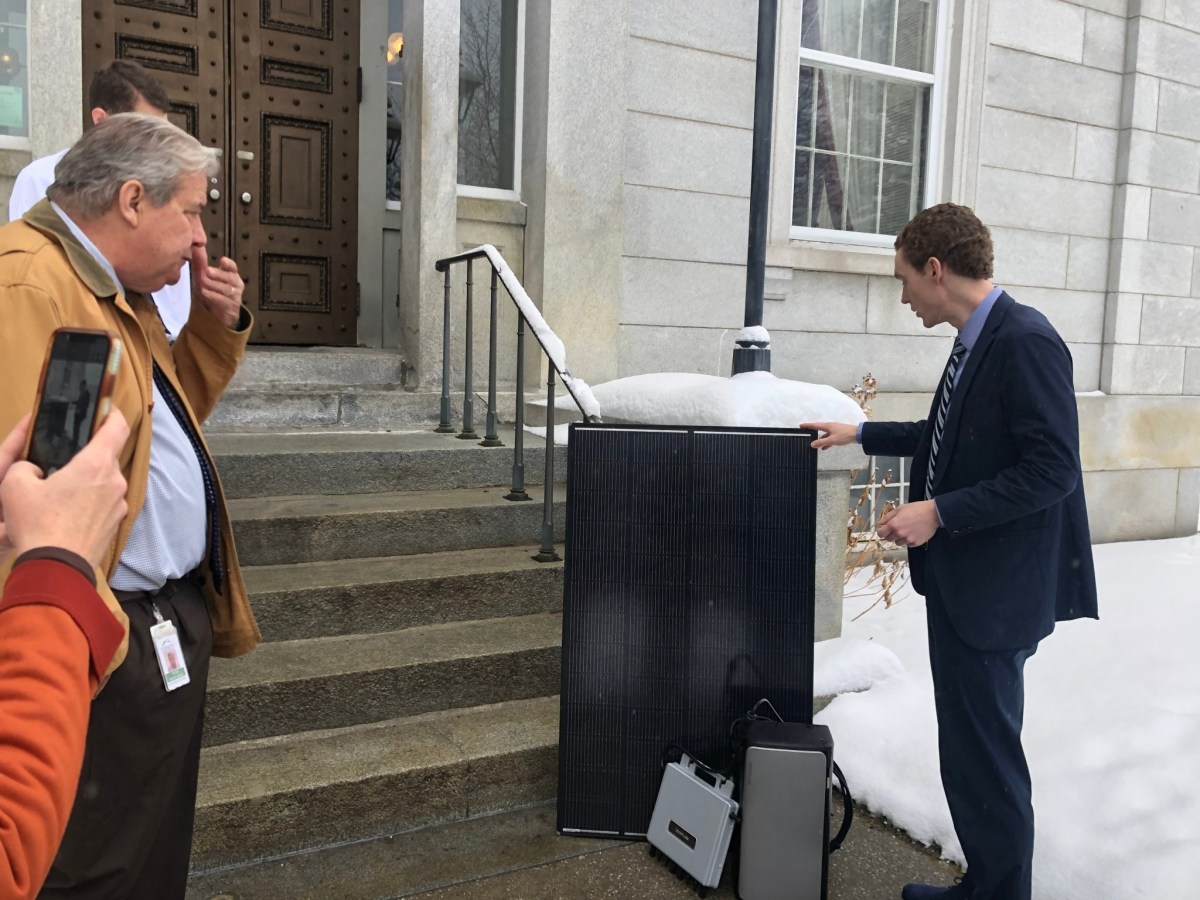
S.202 is directed towards small, plug-in solar devices, which were originally popularized in Europe, and that can be inserted into a wall outlet or battery, like any at-home appliance. Instead of drawing power from the grid, the solar plug-ins supply power throughout the home.
Under the proposed bill, plug-in solar devices would no longer need an interconnection agreement, a contract between customer and utility which ensures technical compatibility when connecting a new energy system to an existing grid.
Ben Edgerly Walsh, the climate and energy director at Vermont Public Interest Research Group, said the interconnection agreement can lead to soft costs and contribute to long wait times before the system gets up and running.
Watson, who chairs the committee that first reviewed the bill, echoed the outlook. “It’s enough of a pain that the average Vermonter isn’t going to want to do that on their own for an individual panel,” Watson said. “Who doesn’t want to generate their own power?” she added. “It’s very Vermont to be contributing and self-sufficient.”
That’s the goal of Bright Saver, an organization working to promote the usage of plug-in solars. Co-founder Cora Stryker testified on behalf of the nonprofit to the Senate Committee on Natural Resources and Energy in early January. “We see this as a way to empower people who have been shut out of adoption of rooftop solar across the board,” she said.
Stryker and her team have been working with states — including Pennsylvania, Maryland and Utah — to produce similar bills across the country. Utah’s bill was passed by a bipartisan coalition in March 2025, waiving the interconnection agreement.
“We need to update the interconnection regulations so that these small systems are not bound to the same standard as rooftop systems five to 20 times as large,” she said.
Walsh also testified in front of the Senate Natural Resources and Energy Committee in support of the product and the bill. He said there are many people who cannot go solar, including renters, people in condominiums, homeowners surrounded by trees, mobile home owners and low-income Vermonters who may not be able to afford traditional solar in their home.
Walsh told legislators that the plug-ins have no hidden costs, which lowers the total price. He added that the plug-ins can be installed by the consumer and don’t require any limited electrical work to set up.
Walsh said renters can take the solar plug-in system with them when they move due to its smaller and portable size. “This is about giving people, who, right now, have literally no option to go solar, something that they can do,” he said.
TJ Poor, the director of Regulated Utility Planning for the Public Service Department, thinks advocates are underplaying the price and, thus, scale of potential adoption. “These products are really expensive to consumers, and so this is a niche solution for people who can afford to do it,” Poor said.
In testimony in mid January, he crunched the numbers based on rates given for legislators and found the cost for a Vermonter using plug-in solar equipment could still amount to about $2,000 if the system produces 1200 watts.
“It is not a solution for low-income Vermonters,” Poor said. “It has the potential to help renters, but again, for low-income renters, it’s an expensive way for them to provide electricity.”
Since the draft review, the language has now been changed to 1200 watts per electric meter. This update allows for an expanded limit on how many plug-in systems can be applied to multi-residential buildings. To Poor, the change seemed appropriate, but he continued to remain neutral on the bill.
For those looking to make a climate impact, Poor said, plug-in solar devices won’t lessen Vermont’s greenhouse gas emissions or help reach the state’s mitigation requirements as Vermont pursues a 100% Renewable or Clean Energy Standard.
Poor asked legislators to ensure consumer and electrician safety in the event of an outage, and urged for consumer protection requirements in the event that a customer is misinformed of the product. He also said the plug-in devices should not be able to export to the grid, as it would reduce safety hazards.
If exportation is allowed, Poor recommended it be directed directly to the grid, rather than users be compensated when they put extra energy — also known as surplus energy — back into it grid, consistent with the structure of legislation in Utah.
“It’s one thing for our consumer in real time to lower their usage, right?” Poor said. “But in any given hour, if they’re actually exporting to the grid, they’re using the grid, and the power generated turns into just any other power supply resource.”
“If you’re paying 20 cents a kWh at retail rate, that’s a really expensive way to procure power for utilities,” he said.
Other utility officials shared Poor’s sentiment. Ken Nolan, Vermont Public Power Supply Authority general manager, told the committee Jan. 15 that the department has concerns surrounding utility worker safety, compensation of exportation and language revisions needed in the bill’s draft.
“I think in general the bill is in a good starting place,” he said.
Even if the bill passes, only so much can be done until UL Solutions — a global testing laboratories company which approves appliances for the American electric grid — gives the green light for plug-in solar to be used.
S.202 says that some of these plug-in devices may require some work done by electricians as determined by UL 3700 compliance. This is due to wiring systems that could make plug-in solar devices unsafe, and to avoid the customer running into electrical touch hazards.
“It is not the plug-in and play technology that we had hoped it to be,” Watson said. “(It) feels like a solvable problem, might take some innovation.”
Search
RECENT PRESS RELEASES
Related Post