Rivian R2 vs Tesla Model Y spotted side-by-side: Detailed size comparison
April 13, 2026
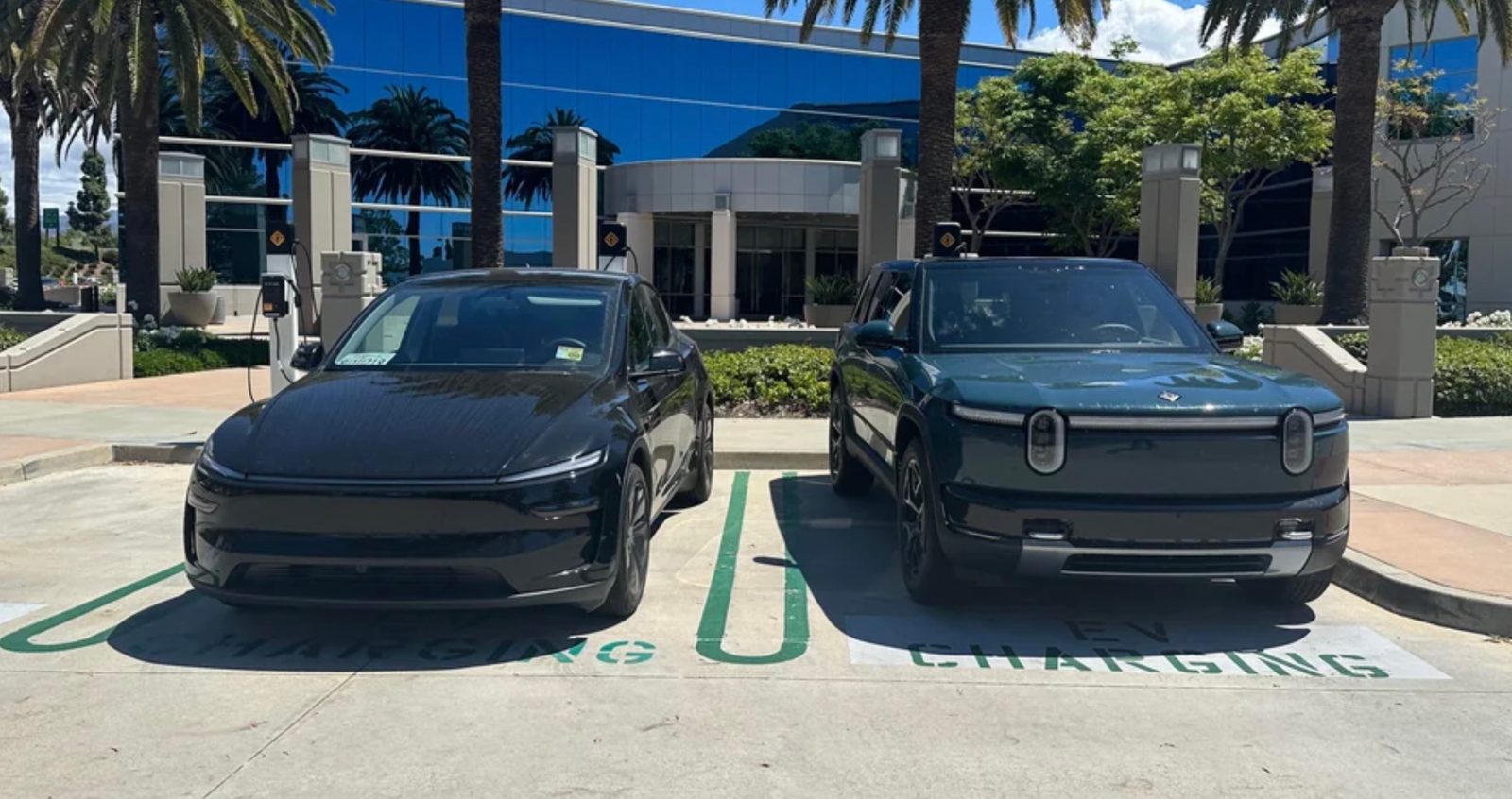
New photos of the Rivian R2 parked next to the Tesla Model Y are making the rounds on social media, and they offer a great look at how these two critical electric SUVs actually compare in size. The R2 is shorter in length but noticeably taller, with a boxier, more rugged profile.
We decided to dig into the numbers and put together a full dimension-by-dimension breakdown — and the efficiency comparison is where things get really interesting.
A Redditor posted photos showing both vehicles side by side, giving us one of the best real-world visual comparisons yet. The images confirm what the spec sheets suggest: these two vehicles occupy roughly the same footprint but take very different design approaches to that space.
The Model Y prioritizes aerodynamic efficiency with its sleek, sloped roofline. The R2, meanwhile, opts for a taller, boxier shape with a more upright rear end — a design that sacrifices some aerodynamic slipperiness in exchange for more headroom, better off-road capability, and that distinctive Rivian look.
Advertisement – scroll for more content
Here’s how the two vehicles stack up across every major dimension:
| Dimension | Rivian R2 | Tesla Model Y | Difference |
|---|---|---|---|
| Length | 185.9 in (4,722 mm) | 188.6 in (4,790 mm) | R2 is 2.7 in shorter |
| Width (excl. mirrors) | 75.0 in (1,904 mm) | 75.6 in (1,920 mm) | R2 is 0.6 in narrower |
| Height | 66.9 in (1,700 mm) | 63.9 in (1,624 mm) | R2 is 3.0 in taller |
| Wheelbase | 115.6 in (2,935 mm) | 113.8 in (2,890 mm) | R2 is 1.8 in longer |
| Ground clearance | 9.6 in (245 mm) | 6.0 in (152 mm) | R2 has 3.6 in more |
| Curb weight (Performance) | ~4,850 lbs | ~4,480 lbs | R2 is ~370 lbs heavier |
| Cargo behind 2nd row | 28.7 cu ft | 30.2 cu ft | Model Y has 1.5 cu ft more |
| Total cargo volume | 90.1 cu ft | 76 cu ft | R2 has 14.1 cu ft more |
| Frunk | 5.2 cu ft | 4.1 cu ft | R2 has 1.1 cu ft more |
| Approach angle | 25° | N/A | — |
| Departure angle | 26° | N/A | — |
| Breakover angle | 20.6° | N/A | — |
The most striking difference is ground clearance. The R2’s 9.6 inches represents 60% more than the Model Y’s 6.0 inches — a gap that tells you everything about Rivian’s design priorities. That extra clearance, combined with 25° approach and 26° departure angles, makes the R2 genuinely trail-capable in a way that the Model Y simply is not.
In terms of width, the two vehicles are virtually identical without mirrors — just 0.6 inches apart, with the Model Y actually being slightly wider. But the R2’s taller profile and boxier greenhouse translate into significantly more total cargo space. At 90.1 cubic feet with the seats folded (including the frunk), the R2 offers 19% more total storage than the Model Y’s 76 cubic feet.
The R2’s slightly longer wheelbase (115.6 vs. 113.8 inches) helps interior space, particularly second-row legroom, which Rivian lists at 40.4 inches.
With the R2’s EPA numbers now public, we can do a direct efficiency comparison. Here’s the Performance-to-Performance matchup:
| Spec | Rivian R2 Performance | Tesla Model Y Performance | Difference |
|---|---|---|---|
| EPA range | 328 mi (21″ all-season) | 306 mi | R2 has 22 mi more |
| MPGe (combined) | 109 | 104 | R2 is 5% more efficient |
| Battery (usable) | ~88.7 kWh | 84 kWh | R2 has 4.7 kWh more |
| Horsepower | 656 hp | 618 hp | R2 has 38 hp more |
| 0-60 mph | 3.6 sec | 3.3 sec | Model Y is 0.3 sec quicker |
| DC fast charge (peak) | 217 kW | 250 kW | Model Y charges faster |
The R2 Performance achieves a 109 MPGe combined rating versus the Model Y Performance’s 104 MPGe. That means the R2 is about 5% more efficient — despite being roughly 370 pounds heavier, 3 inches taller, and designed with significantly more ground clearance and off-road capability.
With all-terrain tires and 20-inch wheels, the R2’s efficiency drops to 99 MPGe and range falls to 310 miles — still competitive with the Model Y Performance.
It’s worth noting that when you compare base-to-base, the Model Y’s RWD variants are considerably more efficient. The Model Y Standard RWD achieves 139 MPGe and 321 miles of range on a smaller battery — the advantage of rear-wheel drive and Tesla’s ultra-efficient single-motor drivetrain. The R2 Standard RWD hasn’t yet received EPA testing, but Rivian estimates 345 miles of range.
The R2 Performance Launch Edition starts at $57,990, while the Tesla Model Y Performance starts at $51,490. The R2 Premium (450 hp, AWD) will arrive at $53,990, and Rivian has committed to a base R2 at $45,000 with rear-wheel drive — though that won’t arrive until 2027.
The dimension comparison confirms what the side-by-side photos suggest: these two vehicles are remarkably close in overall footprint but use that space very differently. The Model Y is the aerodynamic road car. The R2 is the boxier, trail-ready SUV. Both are about the same width, about the same length, but the R2 stands 3 inches taller with 60% more ground clearance.
What genuinely impresses us is the efficiency story. Tesla has historically held a significant lead over nearly every automaker when it comes to energy efficiency — it’s been one of the company’s core technical advantages since the original Model S. Seeing Rivian achieve 109 MPGe in a vehicle with this form factor — boxier, taller, heavier, with real off-road geometry — is remarkable.
The R2 Performance is 5% more efficient than the Model Y Performance despite carrying an extra 370 pounds and presenting a much less aerodynamic shape to the wind. Rivian’s powertrain engineering and the R2’s new platform are clearly doing serious work here. It suggests Rivian has made major strides in motor efficiency, thermal management, and overall energy optimization since the R1 generation, which was not exactly known for its efficiency.
We’re curious to see how the R2 Standard RWD performs when it gets EPA-tested. If Rivian can achieve anywhere near its 345-mile estimate on a smaller battery, it would confirm that the R2 platform is genuinely competitive with Tesla on efficiency — something no other automaker has managed at this price point.


Search
RECENT PRESS RELEASES
Related Post