Smart EV 2026 | Cui Dongshu: Domestic Auto Demand Under Pressure, Urgent Need for Long-Term Policies to Stabilize Growth
April 15, 2026
Gasgoo Munich- The auto industry’s days as a “cash cow” are over.
That was how Cui Dongshu, secretary-general of the China Passenger Car Association (CPCA), described the sector’s current plight at the Smart Electric Vehicle Development High-Level Forum (2026) on April 12.
His data paints a stark picture: the auto industry’s profit margin slipped to 2.9% in the first two months of this year, down from 8% in 2017. By contrast, upstream non-ferrous metals producers saw margins surge from 9% back then to 39.4%, while the oil sector jumped from 5% to 30%. The auto sector is effectively making a “massive contribution” to upstream industries, Cui noted, even as its own burden grows increasingly heavy.
Uneven Growth: Exports Heat Up While Domestic Demand Cools
The domestic market got off to a gloomy start this year. From January to March, internal combustion engine vehicle sales fell 9%, while new energy vehicles also faced mounting pressure to grow. This strain isn’t new, Cui pointed out; it began surfacing in the fourth quarter of last year. Historically, NEV retail sales get a lift in Q4, but last year they plateaued.
Regarding easing cutthroat competition, Cui argued the industry has done its part. Incentive levels have held steady at around 10% overall, with discounts on internal combustion engine vehicles at roughly 22%—slightly lower than last quarter. Prices, he noted, have remained largely stable.
With the 2026 purchase tax exemption policy set to adjust to 5%, product structures are shifting. Data for March shows the share of standard hybrids (HEV) rose 0.5 percentage points from a year earlier. Plug-in hybrids (PHEV) fell 1.4 points—a sign of a “transition from plug-in to standard hybrids.”
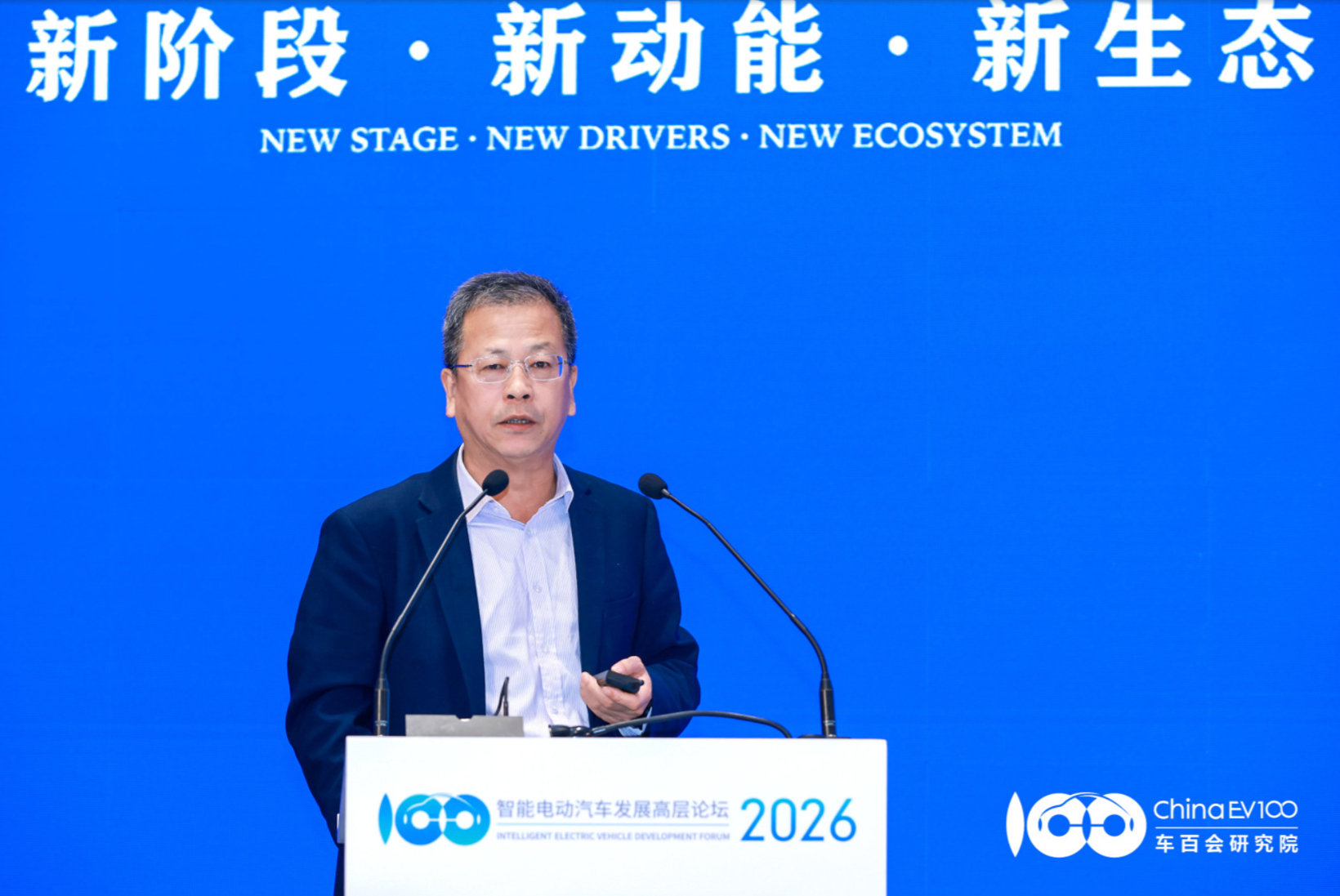
Image source: China EV 100 Institute
This year’s consumption policies shifted to subsidies based on a percentage of vehicle price, replacing previous fixed-amount incentives. Because no minimum subsidy floor was set, “mini and micro electric vehicles are facing growth pressure,” Cui said. The A00 segment, which expanded rapidly last year, is now under significant strain and confronting steep downward pressure.
Cui also noted that the Chinese market has entered a new phase where “scrappage and replacement drive development.” According to Ministry of Public Security statistics, 21.69 million vehicles were registered in 2025, of which 13.19 million were replacements—leaving a net increase of just 13 million. Trade-ins and scrappage, in other words, have become the dominant forces.
Exports, by contrast, are booming. With first-quarter exports surging 124%, Cui has raised his 2026 export growth forecast from an initial range of 18–25% to 35%. The CPCA’s outlook for the full year 2026 is this: domestic sales will fall. Rapid export growth will offset the decline, leaving total wholesale volumes roughly flat—between 0 and 1% year-on-year.
“The total volume looks passable, but domestic consumption is under immense growth pressure and remains highly volatile,” Cui said.
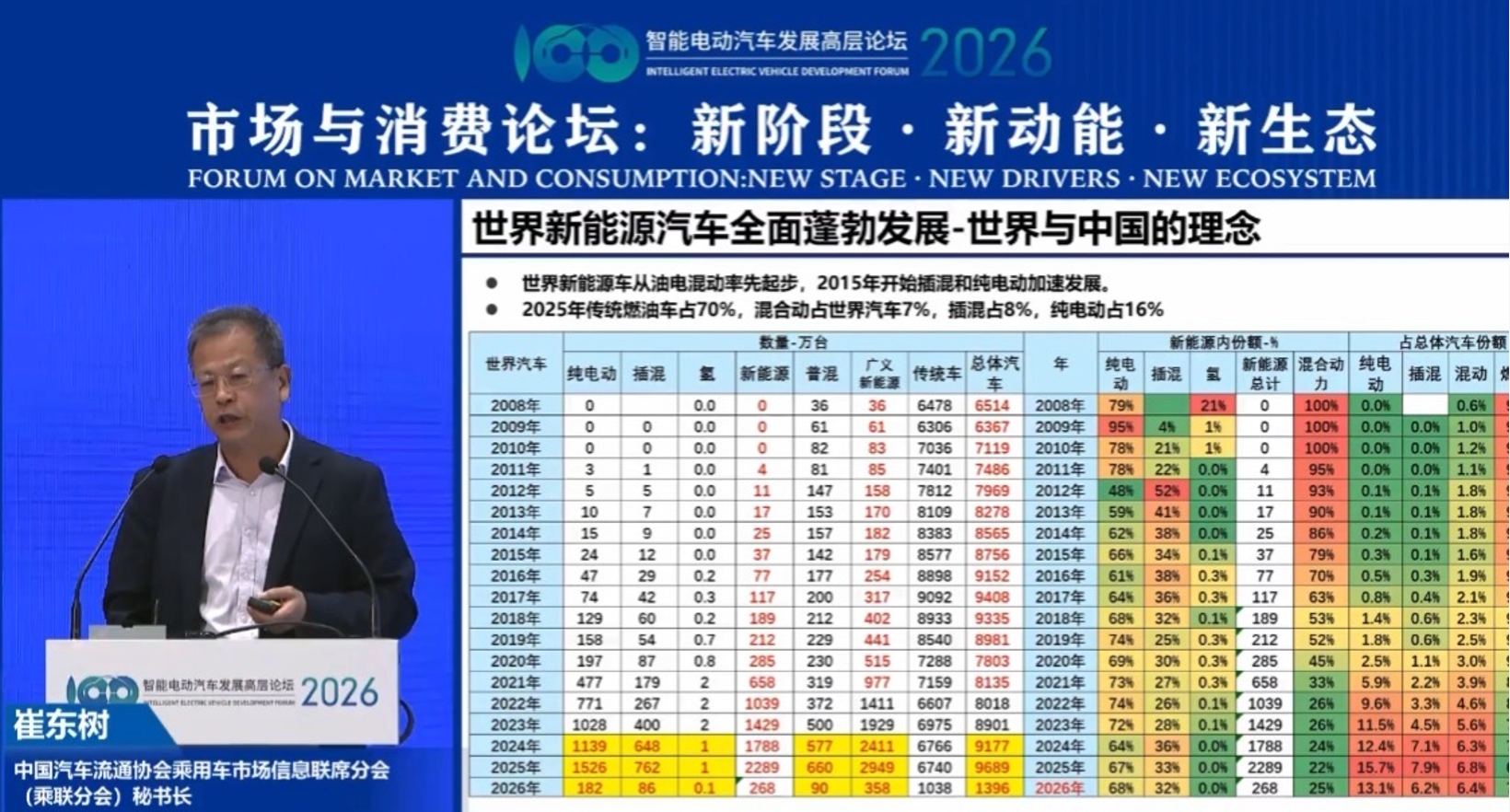
Image source: China EV 100 Institute
He also observed that export prices for lithium batteries are sliding. In dollar terms, the average export price was about $17,000 per ton last year, but has fallen to roughly $15,000 this year—a 12% drop. Combined with a shift in the exchange rate from 7.3 to 6.8, these lower prices are helping drive Chinese products into global markets.
From a global perspective, Cui believes Chinese automakers are in the midst of a comprehensive ascent. China now commands a 60% share of the pure electric vehicle market worldwide and a staggering 75% of the plug-in hybrid segment. In contrast, Europe’s PHEV share has plummeted from 65% in 2020 to just 18% today. Cui attributes this decline directly to the region’s ICE ban timelines, which have stunted plug-in hybrid development.
The Consumer Base is Shifting, and Long-Term Policies Can’t Wait
Cui also highlighted a critical demographic shift: the primary car-buying force is moving away from young people and toward middle-aged and older adults. In China and Europe, buyers are predominantly from the 1965–1980 generation, while young consumers are concentrated in markets like Africa and India. “If you’re counting on 20-to-30-year-olds, they only make up 10% of the population, whereas those aged 60 to 70 account for 13%,” he noted.
Regionally, vehicle penetration remains low in the central, western, and northern parts of the country. While ownership is high in metropolises like Beijing and Shanghai, it is noticeably lacking in remote areas. One practical barrier is driver’s license penetration—roughly 500 million people in China currently hold a license, yet many middle-aged and elderly residents do not. Instead, they turn to low-speed electric vehicles, creating safety hazards. Cui suggested lowering the barrier to obtaining a license to create a compliant space for small and micro vehicles.
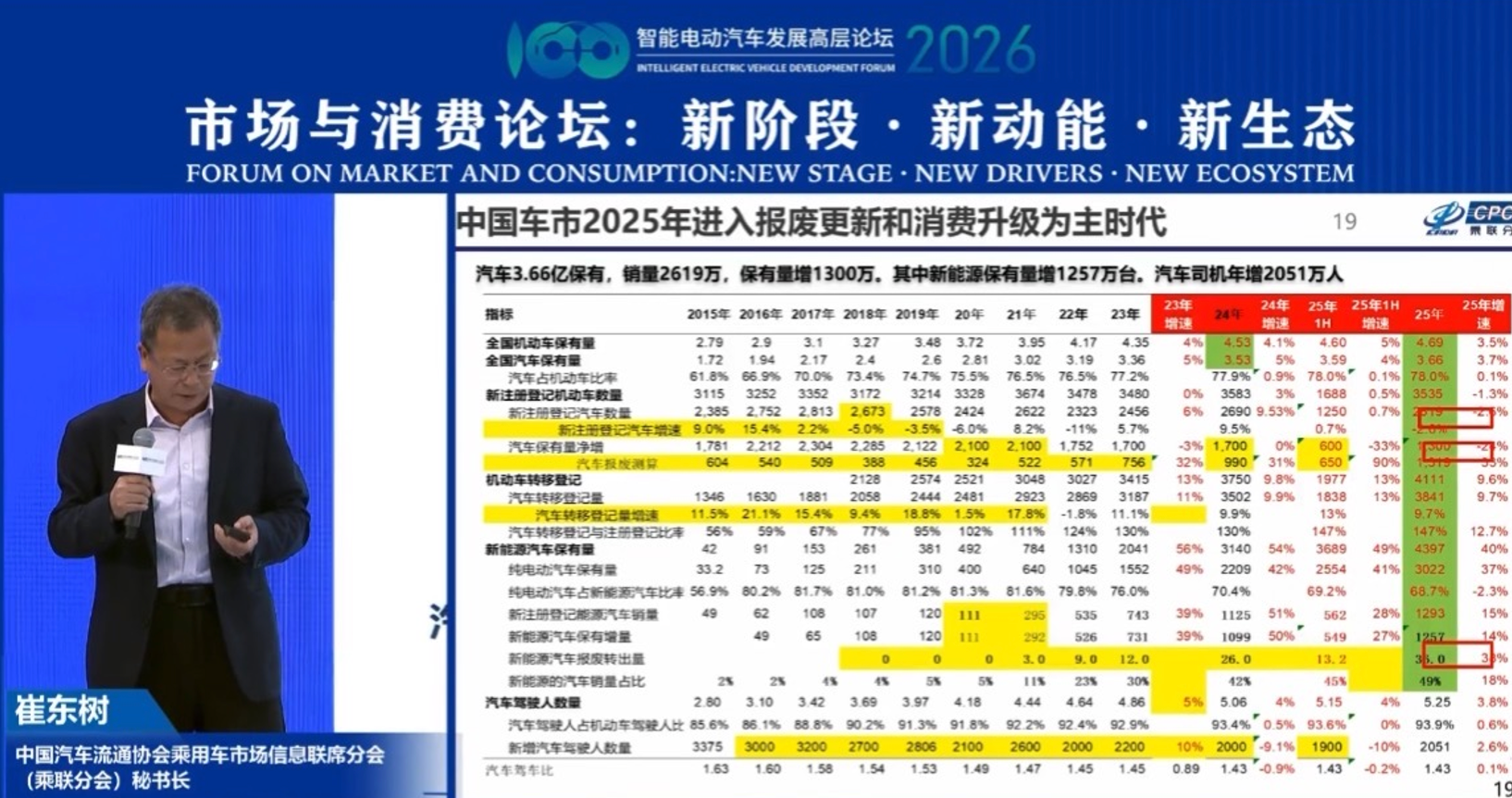
Image source: China EV 100 Institute
He added that although China’s total population has begun to decline from 1.42 billion, the number of drivers continues to grow by 20 million annually—suggesting there is still untapped potential for auto consumption.
On the financial front, Cui observed a shift in household loan structures. Since the second quarter of last year, both short- and long-term household loans have slipped, leaving banks in need of new lending avenues. “Auto loans will be the most critical area of development moving forward,” he said.
Cui also suggested tapping into the potential of vehicle-to-grid (V2G) interactions for new energy vehicles. By using peak-valley pricing policies to allow parked EVs to feed power back to the grid, cars can be transformed from consumer goods into “resource assets.” Citing statistics from the power battery alliance, he noted cumulative battery installations from January to February were only about 20% of production. “80% of batteries are becoming energy storage”—a potential well worth exploring.
Facing these pressures, Cui emphasized that relying solely on short-term stimulus is unsustainable—”giving 20 million this year, 300 billion last year, 150 billion the next, and then nothing.” He called for the establishment of long-term policy support, offering four specific recommendations.
First, incorporate vehicle purchases into special individual income tax deductions. If policy incentives can encourage consumers to replace their cars every five years instead of seven, it would effectively accelerate consumption frequency.
Second, allow interest on auto loans to be deducted before tax. Cui believes that as banks find it increasingly difficult to profit from mortgage spreads, auto lending represents a vital growth area. Interest deductions would meaningfully lower the cost of ownership.
Third, provide guaranteed trade-in support for multi-child families, particularly for large and high-end vehicles. Citing statistics from the Beijing Municipal Education Commission, he noted that families with two or more children now account for more than half of the total. Nuclear, stem, and three-generation households are driving stronger demand for larger vehicles.
Fourth, support car purchases among middle-aged and elderly groups. Cui pointed out that the core buying demographic is now Generation X and older adults—”many may lack formal degrees, but they still have a need to buy cars.” Encouraging purchases among the 50-to-70 age group would provide a significant boost to the market.
Cui concluded by reiterating his key points: tax deductions for purchases and loan interest, support for multi-child families, relaxed licensing for older adults, and unlocking the value of vehicle-grid interaction. If these areas are fully developed, China’s future domestic auto consumption could reach 40 million units—offering “immense potential and opportunity.”
Search
RECENT PRESS RELEASES
Related Post