When Automotive Production Lines Meet Embodied AI
April 22, 2026
Gasgoo Munich-Embodied AI has become the tech industry’s hottest buzzword. Global giants are racing to enter, startups are emerging in droves, and humanoid robots are taking center stage in the capital markets.
The pace of technological breakthrough—from proof of concept to engineering prototypes—has been nothing short of rapid. But where will such cutting-edge technology actually land first?
The answer is industrial manufacturing—and specifically, automotive production.
This assessment is far from speculative. On one hand, automotive plants naturally offer highly structured environments, standardized workflows, and clear metrics for efficiency gains. On the other, the global wave of new-energy vehicles has drastically shortened product iteration cycles, making flexible manufacturing a necessity rather than an option.
The “Smart Driving Future, Linking the World” Automotive Intelligent Manufacturing and Embodied AI Ecosystem Conference, held in Tianjin on April 17, reflects a profound shift in the auto sector from “mass manufacturing” to “mass customization.”
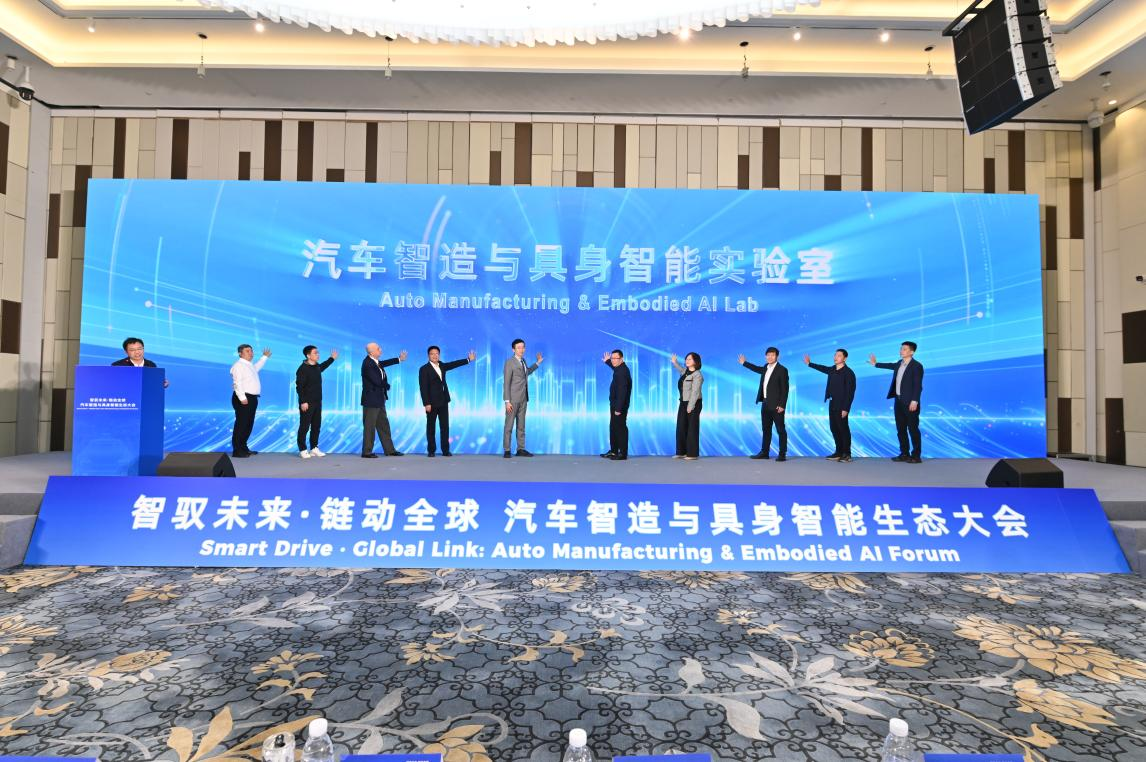
Unveiling of Mecharm’s “Automotive Intelligent Manufacturing and Embodied AI Laboratory”
Behind this lies a clear, progressive logic chain: industry pain points are driving the need for flexibility; flexibility relies on intelligence; and embodied AI is becoming the core vehicle for achieving that intelligence.
Automotive Lines: The Most Pragmatic Training Ground for Embodied AI
According to data from Gasgoo Automotive Institute, global shipments of humanoid robots exceeded 14,000 units in 2025, with Chinese companies accounting for over 80% of that total. However, about 70% of China’s humanoid robot shipments in 2025 were concentrated in non-commercial scenarios like R&D, education, and data collection. Orders actually landing in industrial or logistics fields accounted for less than 3%.
Consequently, the embodied AI industry remains in the sampling and testing phase throughout 2025. Undoubtedly, 2026 will be the pivotal year for moving from the laboratory to the market. Against the backdrop of mass production and delivery, mature scenario applications are particularly critical.
According to Gasgoo Automotive Institute, automotive plants are inherently highly structured scenarios that emphasize flexible operations—spanning final assembly, parts disassembly, and quality inspection. Therefore, automotive manufacturing lines are becoming the most pragmatic testing ground for embodied AI.
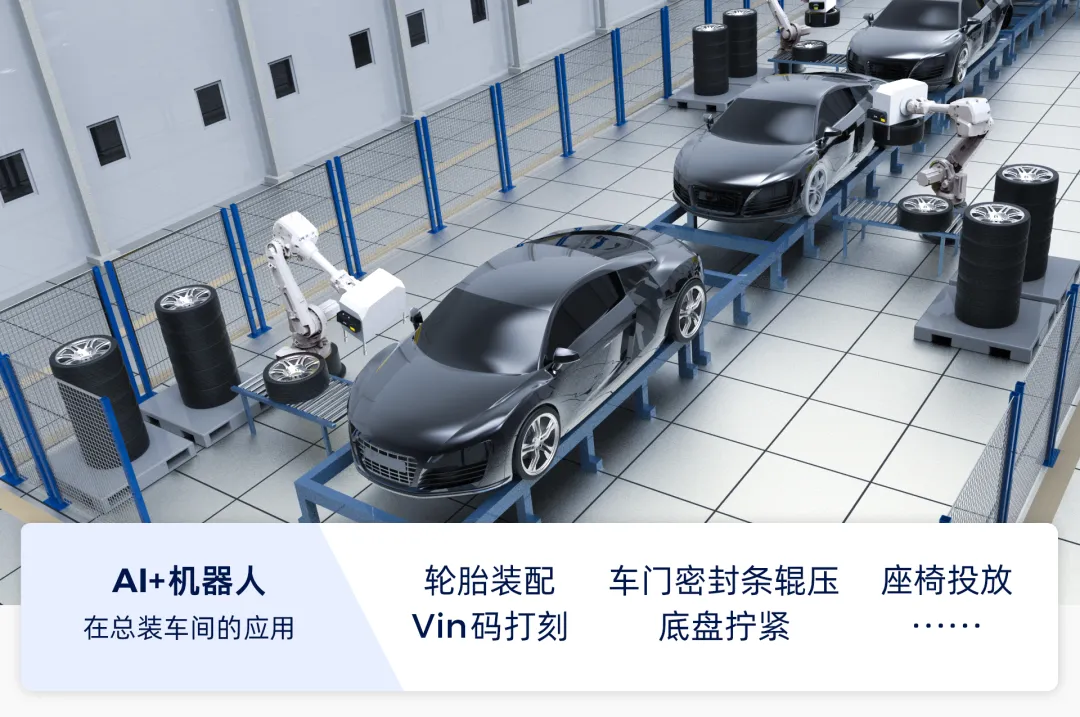
Application of Mecharm AI + Robotics in the General Assembly Workshop
Progress from leading enterprises has been encouraging. In early March, Xiaomi’s humanoid robot worked continuously for three hours in an automotive factory, completing nut installation tasks with a 90.2% success rate while matching the 76-second takt time of the production line.
UBTECH’s Walker S series has logged thousands of hours in factories at NIO, ZEEKR, and others, achieving a completion rate of up to 99% for simple tasks. Through a three-minute autonomous battery swap technology, it enables 24-hour uninterrupted vehicle operations.
Meanwhile, policymakers are sending strong signals: the deep integration of artificial intelligence and advanced manufacturing has entered a critical window for industrialization, moving beyond mere technological foresight.
In January 2026, the Ministry of Industry and Information Technology, together with the Cyberspace Administration of China and the National Development and Reform Commission, officially issued the “Special Action Implementation Plan for ‘AI + Manufacturing’.” The plan explicitly proposes promoting the deep application of 3 to 5 general large models in manufacturing by 2027, launching 1,000 high-level industrial agents, creating 100 high-quality industry datasets, and promoting 500 benchmark AI application scenarios in the manufacturing sector.
The convergence of automotive manufacturing and embodied AI is, in fact, being driven by the current pace of the new-energy vehicle market.
There is no doubt that China’s new-energy vehicle sector has achieved a “rate of acceleration” that captures global attention. Yet compared to the replacement cycles of the internal combustion engine era, which often spanned more than five years, “rapid iteration” has become the norm for NEVs—and consumer purchasing logic is shifting accordingly.
Under these conditions, every link—from R&D and supply chains to production—must operate and respond with extreme speed. Consequently, the entire automotive industry, encompassing stamping, welding, painting, final assembly, and battery production, faces a critical question: Is the return on investment cycle for equipment far longer than the lifecycle of the product itself?
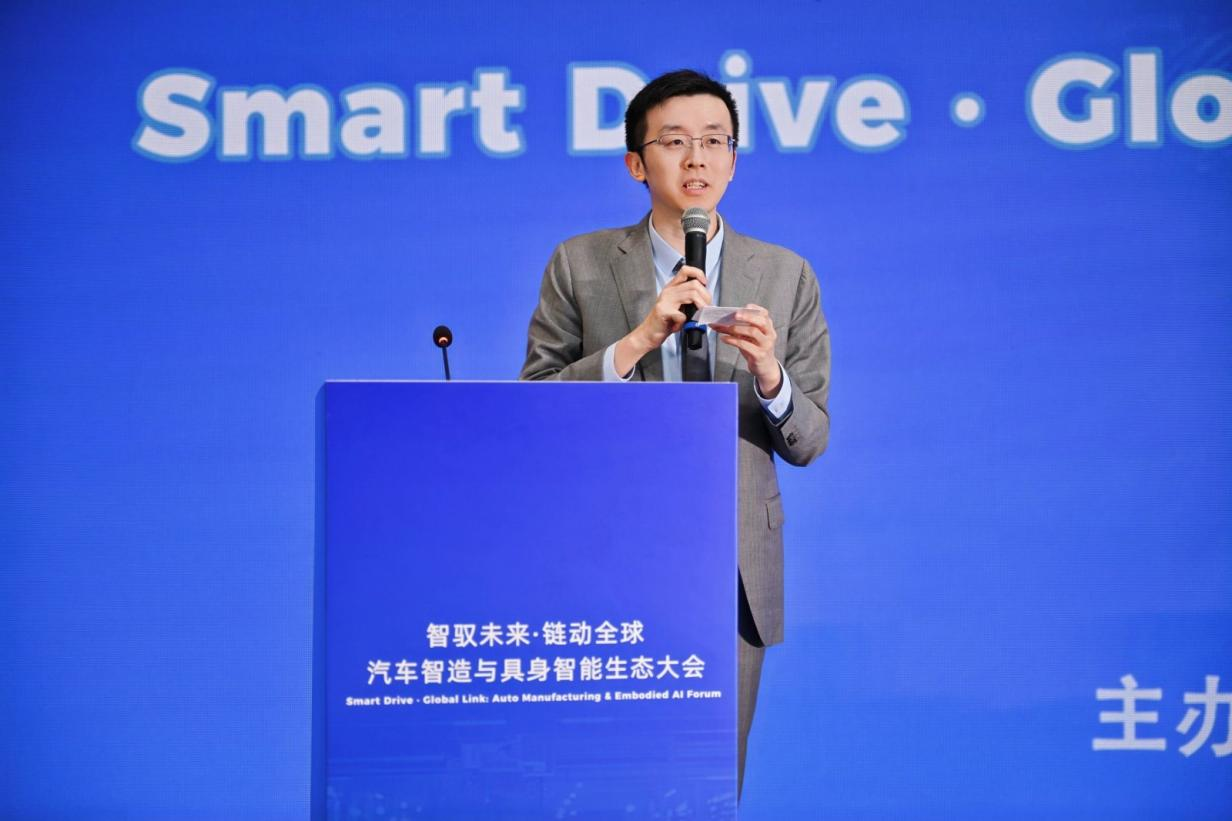
Mecharm Founder and CEO Shao Tianlan delivers a keynote speech
“It is difficult today to find any car model or component that can be produced stably for five or eight years without any change, as in the past.” As a benchmark enterprise for embodied AI entering automotive production lines, Mecharm Founder and CEO Shao Tianlan pinpointed the crux of the issue at the conference: “When equipment is added to a production line today, it must be prepared for products that have not yet been designed five or even eight years from now.”
How to resolve this pain point? The answer is embodied AI. In other words, enterprises require flexibility, and the means to achieve it is intelligence.
Form Doesn’t Matter—Intelligence Defines Embodiment
At the forum, Shao proposed an intriguing perspective: intelligence defines embodiment, and the most critical aspect of embodied AI actually lies not in its specific physical form.
“Whether the form is humanoid, canine, or something else, that is merely its external manifestation; the most critical thing is its intelligence.” In his view, intelligence supersedes form. Intelligence can exist beyond various robotic morphologies and should not be confined to a humanoid shape or any specific form.
In Mecharm’s laboratory, one can see mobile humanoid robots as well as fixed dual-arm and single-arm robots, all freely adapted to meet scenario demands.
So, why pursue embodied AI? And how does it serve traditional automation?
For the past few decades, the logic of automation in automotive factories has been linear: first design the product, then solidify the process flow, and finally deploy automation equipment to the line.
Today, automotive manufacturing is undergoing an unprecedented paradigm shift. Embodied AI enters as an enabler: allowing equipment to actively adapt to production, thereby significantly shortening changeover cycles and reducing costs.
Currently, embodied AI has been deployed at scale across multiple stages of automotive manufacturing: from the final assembly, painting, welding, and stamping workshops of OEMs to integrated die casting, and from parts casting, forging, and assembly to final inspection.
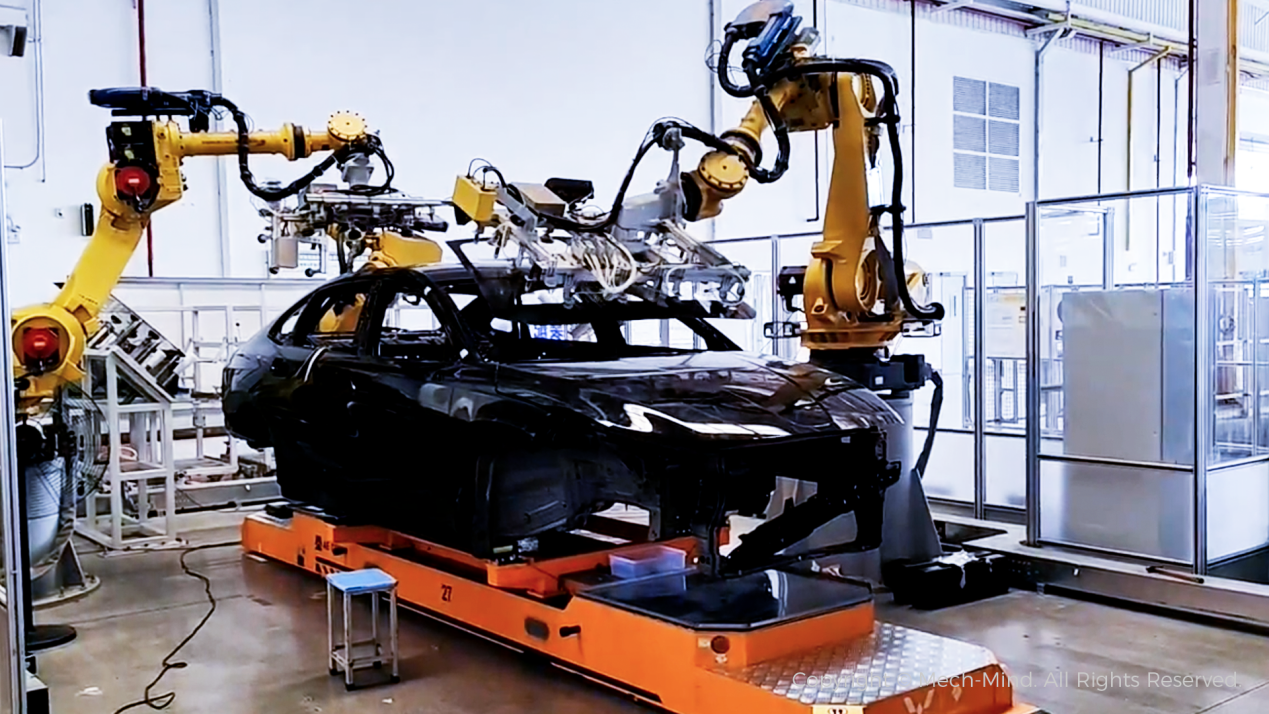
Mecharm AI + Robotics performing windshield installation
In the components sector, the value is even more direct. Take the production of internal combustion engine parts like crankshafts and connecting rods: traditional solutions rely on pure mechanical tooling for positioning, with model changeover cycles measured in months or even quarters. Embodied AI solutions based on intelligent vision, however, can compress that cycle to hours or even days.
In the new-energy “three-electrics” sector (battery, motor, and electronic control), processes such as cell loading, module assembly, and battery disassembly and inspection face challenges including heavy workpieces, high safety requirements, and frequent model switching. The intervention of intelligent robots has significantly enhanced the flexibility and safety of these lines.
Additionally, final assembly has long been a “lowland” of automation. According to Shao, assembly automation is now becoming a reality. Mecharm has already achieved breakthroughs in the most challenging scenarios, such as windshield and tire installation, offering reliable automation solutions for both high-precision alignment and complex assembly tasks.
It is worth noting that behind this paradigm leap lies the support of two pillars: standardization and intelligence.
As Shao Tianlan remarked: “If a piece of equipment is no longer needed here tomorrow and is switched to another production line, many of its standardized components can be reused. If it truly cannot be repurposed, it can still be sold as a package because it is a standard product. Non-standard equipment obviously cannot do this; it can only be sold as scrap iron, which would mean serious impairment for the enterprise.”
In the future, if embodied AI is to achieve large-scale industrial implementation, the standardization of core components is an inevitable trend. Gasgoo Automotive Institute points out that standardizing core components addresses the core pain points of high costs and difficult implementation by unifying interfaces and performance specifications. Today, Mecharm’s practice offers an excellent case study.
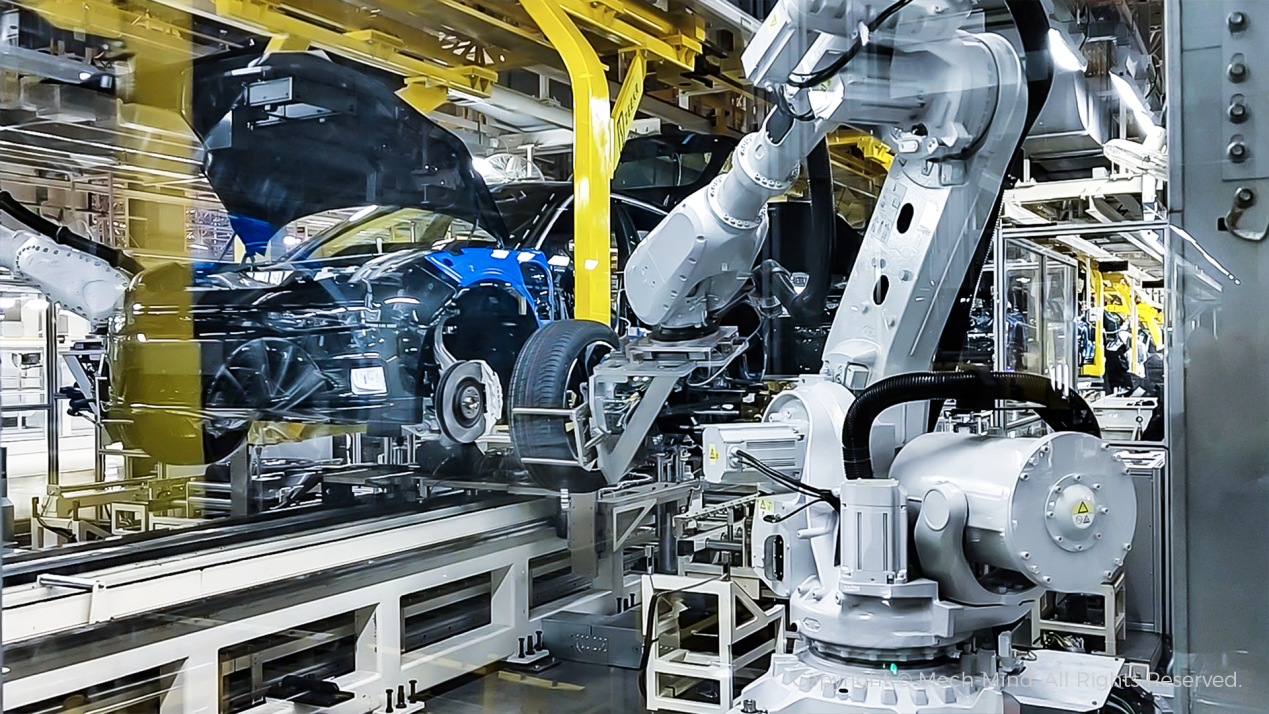
Mecharm AI + Robotics performing passenger vehicle tire assembly
Mecharm’s technology roadmap revolves around the trinity of “eye, brain, and hand.” Its self-developed embodied AI platform integrates core products such as the Mech-GPT multimodal large model, Mech-Eye high-precision 3D cameras, and Mech-Hand dexterous hands. Possessing powerful understanding, recognition, and operation capabilities with strong generalization, it can adapt to various robot forms and application scenarios.
This system enables robots to perceive and understand their environment, make autonomous decisions, and calmly handle frequent product changes. Its highlights are high universality and high standardization: the general-purpose “eye-brain-hand” components are compatible with 40 robot body brands and over 1,000 models.
It is reported that Mecharm has already achieved scaled delivery, expanding into OEMs, components, and new-energy sectors. Clients include FAW Group, Toyota, FAW-Volkswagen, Beijing Hyundai, Beijing Benz, BYD, NIO, and Li Auto. By 2025, cumulative deployments in the global market exceeded 10,000 units.
From “Capable” to “Useful”: The Supply Chain Breaks Through in the “Last Mile”
The blueprint for embodied AI is inspiring, but the “last mile” from the laboratory to the actual production line has never been a smooth path. Achieving the leap from “capable” to “useful” requires far more than just technological breakthroughs; it demands deep collaboration across every link of the supply chain. This issue was the central concern of the conference’s two roundtable forums.
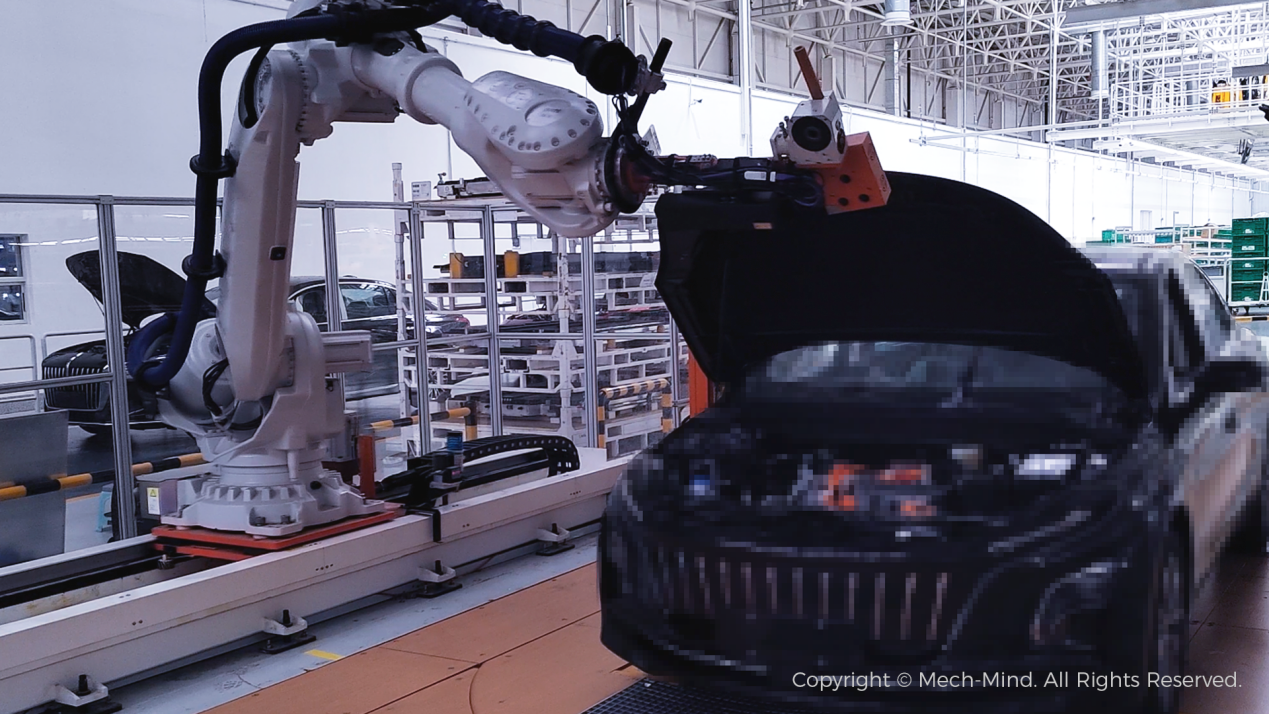
Mecharm AI + Robotics performing vehicle body positioning
During the roundtable discussions, speakers conveyed a clear signal: the embodied AI supply chain involves multiple technological levels—including perception, decision-making, execution, and interaction—and encompasses numerous links such as chips, sensors, robot bodies, algorithms, and system integration. A shortcoming in any link can affect the user experience of the final product, and a break at any node could stall the industrialization process. Achieving the leap from “capable” to “useful” requires breaking down barriers, deep collaboration, and co-creation of value.
It is reported that current bottlenecks in embodied AI include several aspects: Computing power. Industrial robots possess far less computing power than intelligent vehicles and lack the hardware conditions for complex reasoning. Model bottlenecks. Large model parameters are massive, making direct deployment difficult. Safety bottlenecks. No authoritative body can yet certify the legal and ethical boundaries of robots. Talent bottlenecks. Related majors have only recently been established in universities, and interdisciplinary talent is extremely scarce.
At the business model level, pain points persist. It is reported that the ROI model between solution providers and clients is currently distorted. Clients consider a one-year payback acceptable for a purchased solution; however, from the supplier’s perspective, even with an order in hand, investment often exceeds 100%. Clients are dissatisfied with the perceived low ROI, while suppliers are losing money to build reputation, preventing scaled replication.
At the conference, Mecharm’s “Automotive Intelligent Manufacturing and Embodied AI Laboratory” was officially unveiled, injecting new physical support into this ecosystem construction. The laboratory will leverage Mecharm’s technical accumulation in industrial-grade 3D vision, AI algorithms, and intelligent robot operations, partnering with upstream and downstream collaborators to tackle frontier technologies in embodied AI and accelerate the transfer of technology from the laboratory to the factory floor.
This layout is not only an active response to the national “AI + Manufacturing” strategy but also a significant step for Mecharm as it upgrades its role from a technology supplier to an industrial ecosystem builder.
When Century-Old Assembly Lines Meet Embodied AI, Automotive Production Gains New Vitality
A century of automotive industry has accumulated the deepest craftsmanship wisdom, the most stringent quality standards, and the most complex supply chain systems in human manufacturing. From the Ford Model T assembly line to Toyota’s lean production, from German engineering precision to Japanese quality philosophy, every leap in automotive manufacturing has crystallized the hard work of generations of engineers. As a latecomer, embodied AI must learn with humility and embed itself with a service mindset to truly become a driving force for industrial paradigm shifts, rather than stopping at superficiality and hype.
Every revolution in automotive manufacturing has never been about the fragmented application of technology, but about a whole new paradigm addressing new efficiency models. When intelligent robots, capable of perception, decision-making, and execution, walk into stamping workshops, welding lines, and final assembly lines, they change not just production efficiency, but the very way the manufacturing industry responds to new products, new processes, and new efficiency models.
As Shao Tianlan stated in his speech: “Embodied AI is not a distant vision for the future, but a product that can help manufacturing and logistics improve efficiency, reduce changeover costs, and enhance quality right here, right now.”
This transformation has quietly begun. Automotive intelligent manufacturing and embodied AI are converging, and the next chapter of the century-old automotive industry is gaining new vitality thanks to this new species of technology.
Search
RECENT PRESS RELEASES
Related Post