What it’s like to drive Route 66 in an EV
April 26, 2026
What it’s like to drive Route 66 in an EV
 Serenity Strull/ BBC/ Getty Images
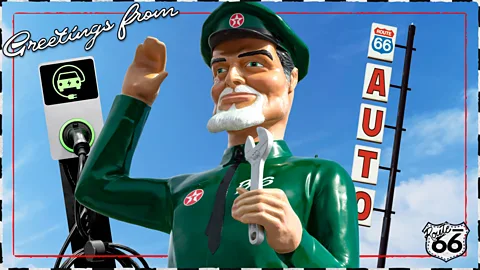
As Route 66 turns 100, a growing charger network is making the Mother Road drivable by EV. But does the classic American road trip still feel the same without petrol?
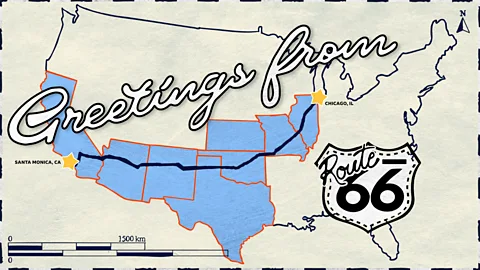
On a rainy Chicago morning, my friends and I stared down one of the world’s most mythologised roads: Route 66. We were about to join the legions of dreamers who’ve driven this 2,500-mile ribbon of highway – a vehicular timeline stretching from the Ford Model T to the Honda Civic. But unlike our petrol-guzzling predecessors, we would tackle the Mother Road in an electric car.
When the highway opened in 1926, such a journey would have been unthinkable. But over the past decade, Route 66 has welcomed a string of EV charge points along the route that now, just in time for its 100th birthday, reach all the way to its endpoint of Santa Monica.
We calculated that travelling by e-car would save between 150 and 180g of CO2 per kilometre, and the soaring cost of petrol made our decision a no-brainer. But how would an electric journey compare to the traditional experience?
We’d soon find out. My friend pressed his e-car’s start button, and we were off to take our place in Route 66 history.
 Serenity Strull/ BBC
The first miles of an American myth
Since I was visiting from London we had just three days to sample a route that generally takes weeks. We would cover roughly 300 miles from Chicago through Illinois to St Louis, following the opening stretch of the old highway, eating at roadside diners, soaking up the centennial buzz and chasing freedom – all while trying not to run out of battery.
Route 66 goes electric
The route’s electric revolution has been brewing since the mid-2010s when the first EV chargers appeared along the eastern portion of the road and solar roadway panels were erected. In 2024, the US Senate called for infrastructure expansions so that the route was fully drivable by e-car by the route’s 100th birthday, inspiring a flurry of new charge points. Though gaps in the network still exist, notably in rural areas, an electric version of the iconic road trip is easier than ever.
It wasn’t a route marker that announced our arrival in the city of Wilmington. It was the first roadside icon of our trip: the Gemini Giant, an 8.5m-tall fibreglass astronaut in a green jumpsuit, holding a silver rocket in both hands.
First erected in 1965 outside the Launching Pad restaurant, he is one of Route 66’s famous “muffler men” – giant figures once used to lure motorists off the road and into diners, garages and gift shops. Sparkling from a recent restoration, he now stands at Wilmington’s South Island Park as a reminder of the US’s role in the Space Race, when Route 66 served as the country’s “Cosmic Highway“. Could those cosmonauts ever have imagined that one day travellers would travel the highway in cars that plugged into a socket, I wondered?
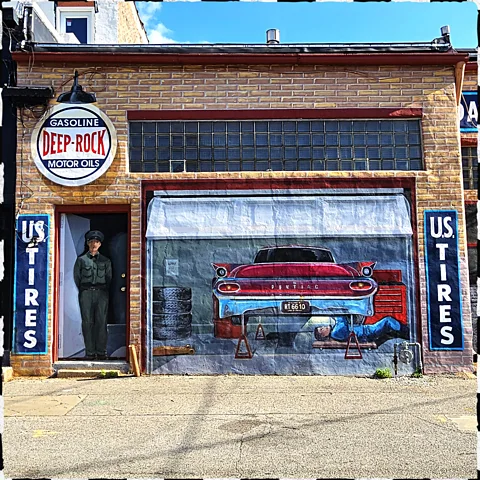 Demi Perera
While previous generations travelled with the constant fear of running out of petrol along the way, our car’s electric battery has the capacity to carry us up to 300 miles on a single charge. Drivers of petrol cars will readily find petrol stations, so an electric-powered journey requires forethought, and can result in a slower pace. But this allows you to pick up on little details – throughout our trip, we found ourselves veering off our carefully mapped route to follow a sign to a quirky café, or pause in front of a kitsch road sign.
After stopping at Nelly’s drive-through café for deep-fried corndogs and root beer, we headed towards the town of Dwight, home to Ambler’s Texaco Petrol Station. Like other Depression-era filling stations along the route, it no longer sells petrol and functions as a volunteer-run museum. Its vintage pumps and cottage-style exterior make it an iconic stop. We parked our plug-in vehicle in front and took photos – an old petrol shrine framed by a car that needed none.
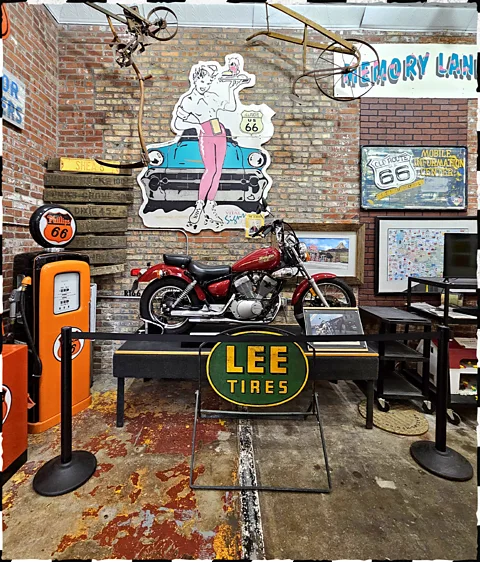 Demi Perera
But after nearly two hours on the road, we were already down to less than half battery.
The closest charge station was just a few minutes away, at Casey’s General Store. When we pulled in, we immediately saw that we weren’t the only electric vehicle in town: all seven superchargers were in use, with several cars waiting their turn.
“Oh, [chargers are] everywhere around here,” said a local driver. “There are four more just six blocks away inside the park.”
Filling your car with petrol is generally a speedy transaction, but charging an electric vehicle at a roadside stop can take anywhere from 20 minutes to an hour. This gave us plenty of time to chat with locals. One told us the story of a family whose car had broken down close by. They’d waited for hours until a farmer stopped to help. The next day, the farmer got delivery of a brand-new TV. The note attached read: “Thank you for fixing my car. Nat King Cole.”
“The Nat King Cole?” I gasped.
“The very same.”
I would hear a variation of this tale at almost every stop we made – along with warnings about not getting stuck out on the lonely, sprawling road that was once nicknamed “Bloody 66” due to its sharp curves and poorly lit rural areas. After all, for us there would be no friendly saviour. Only a specialist can fix an electric car.
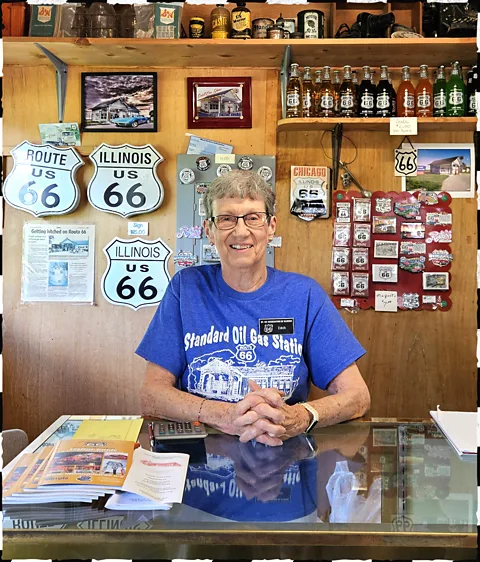 Demi Perera
100 years of legends
Since its decommissioning in 1985, Route 66 is no longer one continuous road. Some parts have been lost to urbanisation while others have been rerouted to multi-lane interstates.
Plan your trip:
• Map out your route and mark all the EV charging routes along the way. Work out a plan B of secondary EV stations around your stops.
• Plan your time as well as your route – note estimated times of arrival at destination points calculated with your car’s battery power.
• Download the PlugShare app to easily find chargers and check their real-time availability. A Better Route Planner helps you organise your electric journey, calculating stops based on your exact car model, the weather and more.
• Enjoy Illinois, Visit California and atripinfo offer detailed EV-friendly Route 66 itineraries.
• When all else fails, go analog – carry hard copies of route maps.
At one point, we left modern tract and followed the hefty historical portion that cuts through Illinois, spanning the towns of Joliet and Pontiac, referred to as the Pontiac Trail. Turning onto a protected vintage section near Odell, I was reminded of country lanes in Britain, so narrow that two modern vehicles would struggle to pass each other.
All along the way we were treated to magical moments of Americana, from the statues of Marilyn Monroe and James Dean outside the Polk-A-Dot drive-in, or the VW campervan of Route 66 artistic legend Bob Waldmire parked in Pontiac, the end of the Pontiac Trail and our first overnight stop. When we rolled in, the town was busily preparing for its centennial celebrations, kicking off on 30 April and running throughout the year. Workers were putting up new neon signs in the Centennial Plaza, while visitors posed in front of its painted Route 66 shield – the country’s largest.
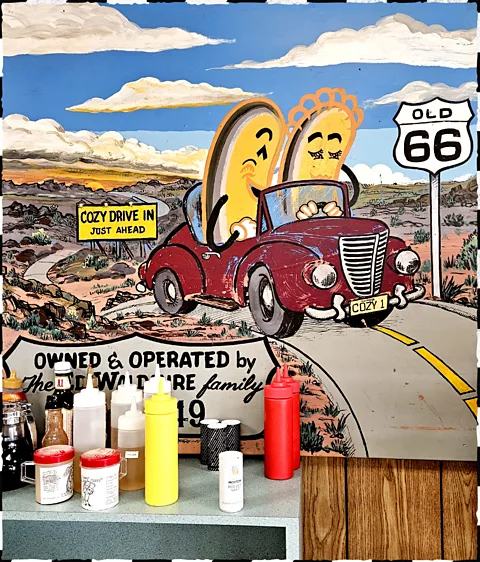 Demi Perera
On the final morning of our trip, we headed to Edwardsville, Illinois, planning to visit the Litchfield Museum & Route 66 Welcome Center along the way. But here we met our first EV hurdle – our car’s screen showed several petrol stations but no EV charging points for almost 60 miles (97km) in between.
So far, searching for EV charging locations had been simple, even fun. On our second day, we found ourselves on a detour that led to joining an entire town for an outdoor concert.
This was the first time we felt uncertain since leaving Chicago.
The PlugShare phone app showed a charge point at a Walmart Supercentre – 20 miles (32km) out of our way. With dwindling battery power, the warnings we’d heard came flooding back to us. Those stories ended with helpful strangers bringing petrol in a can. Our anxiety was high as we made the detour to Walmart – and made it just in time.
The obstacles are different on an electric road trip – running too low on battery power, not being able to complete the journey in time. But just like our plucky, petrol-powered predecessors, we powered through. Literally.
More on Route 66 at 100:
• The Native American story behind the US’s most famous highway
• Meet the 98-year-old ‘Angel of Route 66’
• Route 66’s glowing mystery orb
In the morning, we would cross the Missouri border to St Louis and go back to our daily lives. My friends would return to their banking jobs; I would head home to London.
Throughout our trip – fuelled by corndogs and root beer, rapt against a backdrop of neon signs – we felt the Spirit of Route 66 at every turn, even without the throaty soundtrack of a petrol engine.
Back at the petrol station in Odell, I’d overheard a guide say that in 1966, a gallon of petrol cost 49 cents. Today, the cost is $4.11 (£2.95). In 2026, the sheer expense of driving Route 66 could lead to another decline. But as this iconic road turns 100, electric infrastructure is a new roadside giant calling a new kind of traveller – one that leaves a lighter footprint.
—
If you liked this story, sign up for The Essential List newsletter – a handpicked selection of features, videos and can’t-miss news, delivered to your inbox twice a week.
For more Travel stories from the BBC, follow us on Facebook and Instagram.
Search
RECENT PRESS RELEASES
Related Post

![Electric haul trucks could save Fortescue over $400 million in fuel per year [update]](https://stockwatchindex.com/wp-content/uploads/2026/04/liebherr-t264-PVnOOS-500x383.jpg)