Kospi surges past 6,300; President Lee flags ‘Korea premium’
April 27, 2026
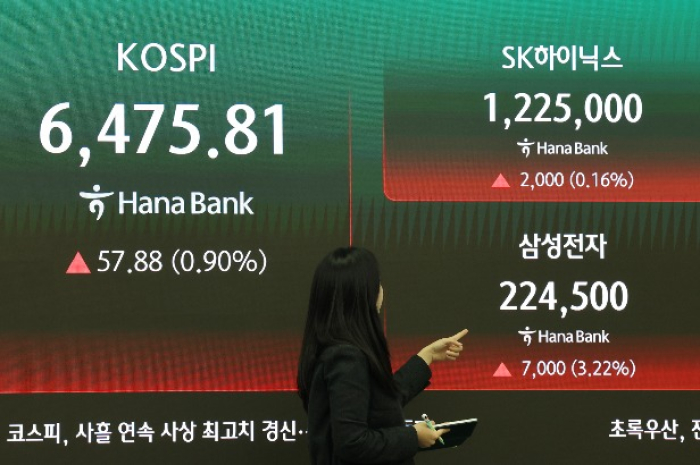
The benchmark Kospi jumped 2.2% to a record 6,615.03 after briefly touching 6,657.22 in afternoon trading. It was the index’s first close above 6,600. The smaller Kosdaq rose 1.9% to 1,226.18.
Together, the Kospi and Kosdaq reached 6,101.1 trillion won in market value, according to Korea Exchange data, with the main board accounting for 5,421.6 trillion won and the Kosdaq 679.5 trillion won.
The rally marks a dramatic turn from last year’s trough. When the Kospi hit 2,293.70 on April 9, 2025, the two markets were worth less than 2,211 trillion won combined. They have since expanded 2.76 times.
South Korea’s market capitalization topped 3,000 trillion won last July, 4,000 trillion won in January and 5,000 trillion won in February before crossing the 6,000 trillion won mark Monday.
Foreign and institutional investors drove the advance, buying a net 888.0 billion won and 1.1 trillion won of Kospi shares, respectively.
Retail investors sold a net 1.9 trillion won, taking profits after the market’s rapid climb.
CHIPS DRIVE THE ADVANCE
Semiconductors again led the rally.
Samsung Electronics Co. rose 2.3% to 224,500 won, while SK Hynix Inc. jumped 5.7% to 1,292,000 won.
The gains followed strength in US technology and semiconductor shares on Friday, lifting sentiment toward Korean chipmakers.
The advance has left the market increasingly concentrated. Samsung Electronics, its preferred shares and SK Hynix were valued at about 2,361.8 trillion won at Monday’s close, equal to 43.6% of the Kospi and 38.7% of all listed Korean stocks.
That concentration has sharpened debate over whether the AI-driven semiconductor supercycle can keep lifting the market – or whether investors are vulnerable to a reversal if the chip cycle cools.
The semiconductor rally has become too strong to be viewed as a routine early-cycle rebound, said Huh Jae-hwan, an analyst at Eugene Investment & Securities. Still, he stopped short of calling it a bubble.
He said the current move more closely resembles the post-pandemic technology boom of 2020 and 2021, when new digital demand fueled chip stocks. This time, he said, the structural shift behind the rally appears stronger, driven by AI-related demand.
BEYOND THE TWO CHIP GIANTS
Other strategists say the rally isn’t only about Samsung Electronics and SK Hynix.
“In terms of earnings forecasts, Samsung Electronics and SK Hynix have an overwhelming influence, but not to the point that other sectors can be ignored,” said Lee Kyung-min, an analyst at Daishin Securities.
He said Kospi-listed companies’ operating profit totaled 221.5 trillion won in 2024 and 270.9 trillion won in 2025, and is forecast to rise to 778.9 trillion won this year and 968.3 trillion won next year.
Excluding Samsung Electronics and SK Hynix, operating profit is expected to climb from 165.3 trillion won in 2024 and 180.8 trillion won in 2025 to 233.6 trillion won in 2026 and 274.3 trillion won in 2027, he said.
“Even without Samsung Electronics and SK Hynix, companies are doing well enough,” Lee said.
“The two chipmakers are performing at such historically strong, almost unimaginable levels that the rest of the market only looks weak by comparison.”
Still, caution is rising.
The Kospi 200 Volatility Index, South Korea’s so-called fear gauge, closed up 2.6% at 54.95 on Monday after rising as high as 55.60 intraday. It had fallen to 46.54 on April 14.
The rise suggests investors are becoming more wary of the rally’s pace after the Kospi erased its Iran-related losses and closed above 6,600 for the first time.
Jennifer Nicholson-Breen edited this article.
Search
RECENT PRESS RELEASES
Related Post