Auto China 2026 Insight | Does Ignoring Physical AI Mean Falling Behind?
April 27, 2026
Gasgoo Munich- At Auto China 2024, “Transformer” was a frequent topic. End-to-end autonomous driving models had swept the industry. BEV plus Transformer became standard jargon for smart driving companies. Mentioning anything less meant exclusion from the conversation.
Two years later, the keywords defining the Auto China 2026 have undergone a generational leap.
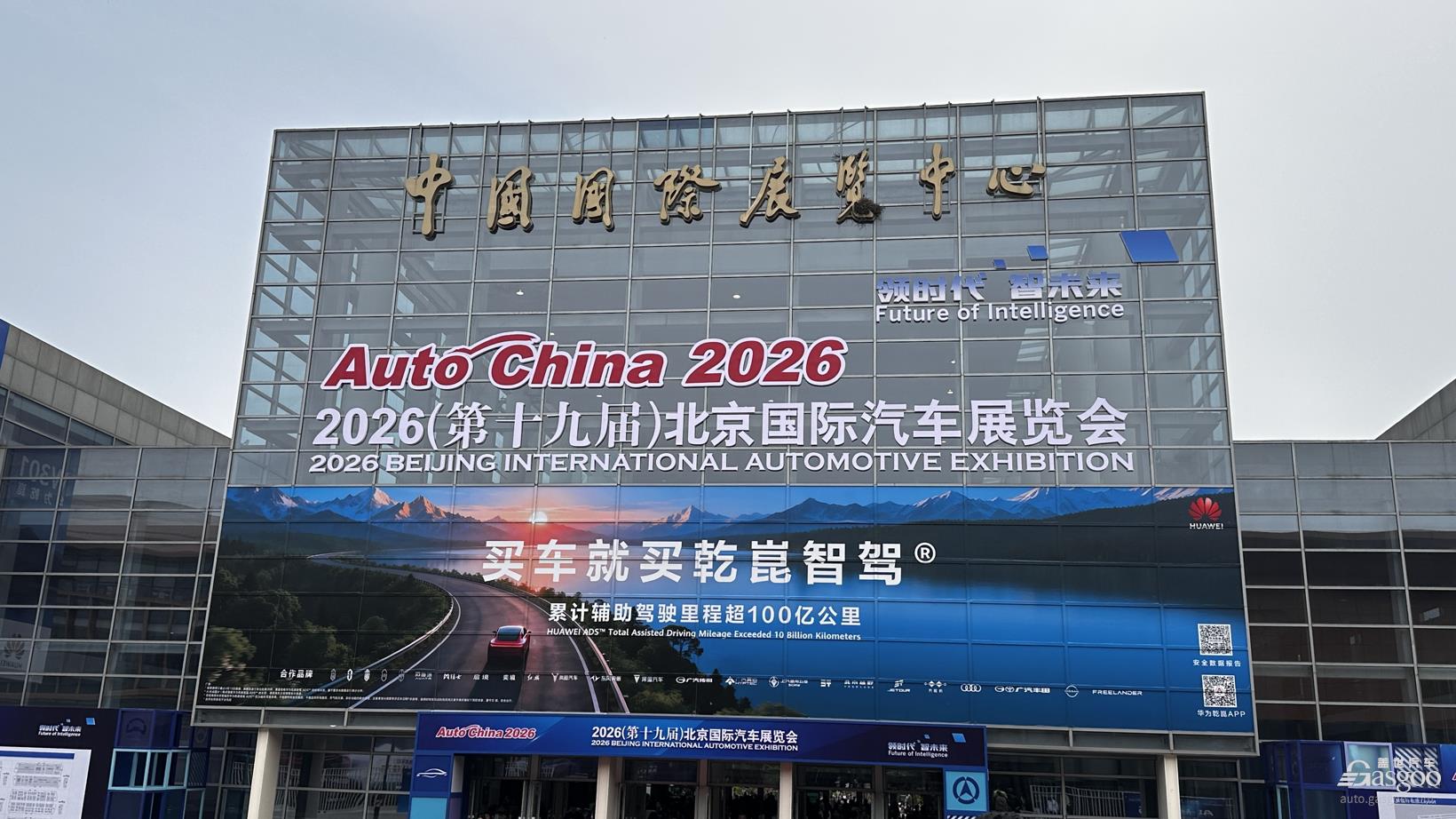
Visitors to this year’s show immediately encounter a term: Physical AI. From startups to legacy giants, OEMs to Tier 1 suppliers, nearly every booth conveys one message. AI is stepping out of the digital world and entering the physical one.
QCraft themed its press event “Physical AI: QCraft Has Arrived.” XPENG, appearing as XPENG Group, displayed “AI Changes the World” prominently. Geely Auto Group unveiled China’s first native Robotaxi prototype, highlighting “Physical AI capabilities.” Chery announced a partnership with Nvidia to build a Physical AI ecosystem. Seres’ AITO Cube platform proclaimed an evolution toward vehicle-level L4 embodied intelligence. Seres Auto President He Liyang stated: “We are turning the car from a tool of transport into an embodied intelligent agent.”
Organizers report a total exhibition area of 380,000 square meters. Over 2,000 companies from 21 countries and regions participated. A total of 1,451 vehicles are on display, including 181 global debuts and 71 concept cars. Technologies like Physical AI and embodied intelligence form the “invisible main thread” of the event.
Why has “Physical AI” become the industry consensus? Why does failing to mention it in the spring of 2026 feel like falling behind?
XPENG: The “Ecosystem Ambition” Behind a Matrix Portfolio
XPENG Aeroht’s production timeline is approaching. The new-generation humanoid robot IRON has sparked public debate. XPENG’s mobility scene has expanded beyond cars. It is now a smart ecosystem covering land, air, and robotics.
The IRON robot and “Land Aircraft Carrier” flying car shared the stage. New models included the XPENG GX, 2026 MONA M03, all-new P7, and 2026 X9. XPENG defined its presence as a display of frontier achievements in Physical AI.
The XPENG GX is positioned as China’s first mass-producible Robotaxi prototype. It brings Robotaxi-level intelligent driving to the consumer market. It carries up to four Turing chips with 3,000 TOPS of computing power. It runs XPENG’s second-generation VLA system, built for the L4 era.
XPENG Group Chairman He Xiaopeng stated the company will transform from an automaker to a tech group. The layout covers car manufacturing, flying cars, embodied intelligence, and Physical AI. He revealed the IRON robot will enter mass production this year. Commercial sales will begin in 2027.
A striking investment figure emerged. XPENG plans to increase its R&D spending on Physical AI to 7 billion yuan in 2026.
The second-generation VLA intelligent driving report was a highlight. Data shows intelligent driving was activated on 98.52% of days during the first week for Ultra users. NGP trips in Ultra models climbed 115.9% month-over-month. Takeovers per 100 kilometers dropped by 25.9%. High-end intelligent driving is becoming a core purchase factor. Orders for Ultra models jumped 118% in March. Transaction volume for Ultra or Ultra SE trims surged 129.3% month-over-month.
XPENG Group’s strategy is clear: build a Physical AI technology base, then replicate it across carriers. From smart cars to flying cars and robots, shared AI capabilities build a barrier in the ecosystem.
The “Arms Race” Between Native Architecture and Physical AI Engines
If XPENG’s approach is an “ecosystem matrix,” Geely and QCraft represent a different line of thinking. They are redefining the core technical architecture of Physical AI. One works at the vehicle level; the other builds an “engine” at the solution level.
Geely Auto Group debuted Eva Cab, China’s first natively developed Robotaxi prototype. “Native” means the vehicle was designed for unmanned driving. It is not a retrofit of a mass-produced model. It has no steering wheel or pedals. It uses electric sliding doors and a facing seat layout. This marks a shift from “driver-centric” to “passenger-space-centric.”
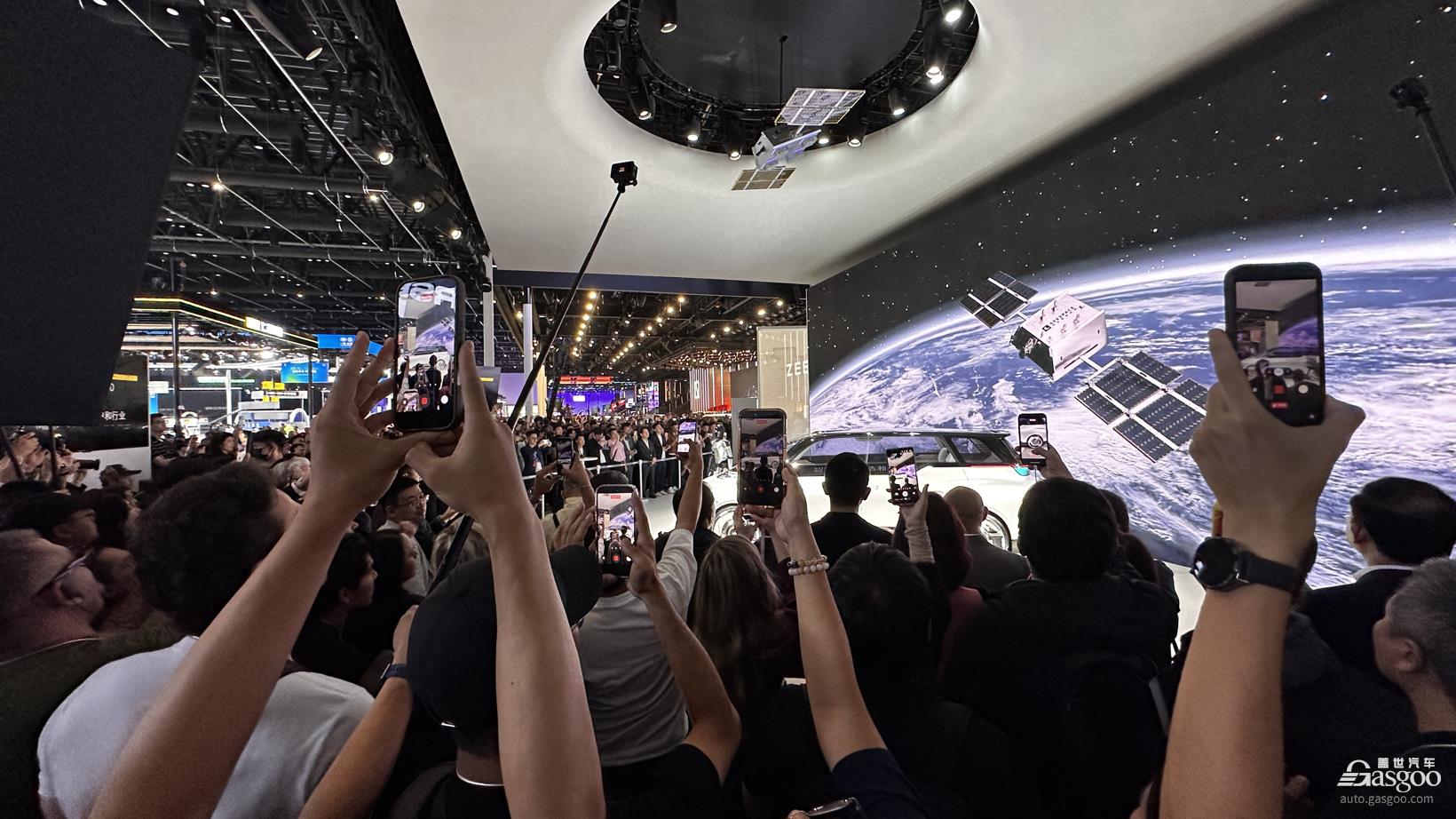
Technically, Eva Cab is the masterpiece of Geely’s Domain-wide AI 2.0 system. It carries the “Quantum-level AI EEA 4.0.” This architecture uses quantum encryption. It integrates three flagship chips: Nvidia’s SuperChip, Thor U, and Qualcomm’s Snapdragon 8797. Total computing power exceeds 3,000 TOPS. Eva Cab features “2160-line digital lidar.” It is capable of ultra-high imaging at 25.92 million points per second. The maximum detection range is 600 meters.
Beyond the specs, the core concept is the WAM (World Action Model). It is a vehicle-level decision-making base with self-evolving capabilities. On-board parameters increased sevenfold compared to traditional solutions. Inference frame rates tripled. The core value of WAM is enabling the vehicle to “understand” the physical world, not just identify objects. Paired with the Qianli Haohan G-ASD L4 solution, Eva Cab achieves unmanned shuttling on open roads.
The commercialization path is clear. A deep-custom version for Cao Cao Mobility is planned for mass production in 2027. Commercial operations will begin after road testing in Hangzhou and Suzhou. Geely has built a closed loop from “native architecture definition” to “mobility platform operations.”
Unlike Geely’s “native car manufacturing” philosophy, QCraft is taking a focused path. It aims to become an underlying technology supplier for the Physical AI era. QCraft used this show to present its technology, products, and strategy.
The press conference theme, “Physical AI: QCraft Has Arrived,” served as a strategic manifesto. The company unveiled a Physical AI model based on a unified architecture. It covers dual-engine deployment for cloud and vehicle. The World Model predicts dynamic changes in the physical environment. Reinforcement learning handles trial and error in virtual environments to train strategies.
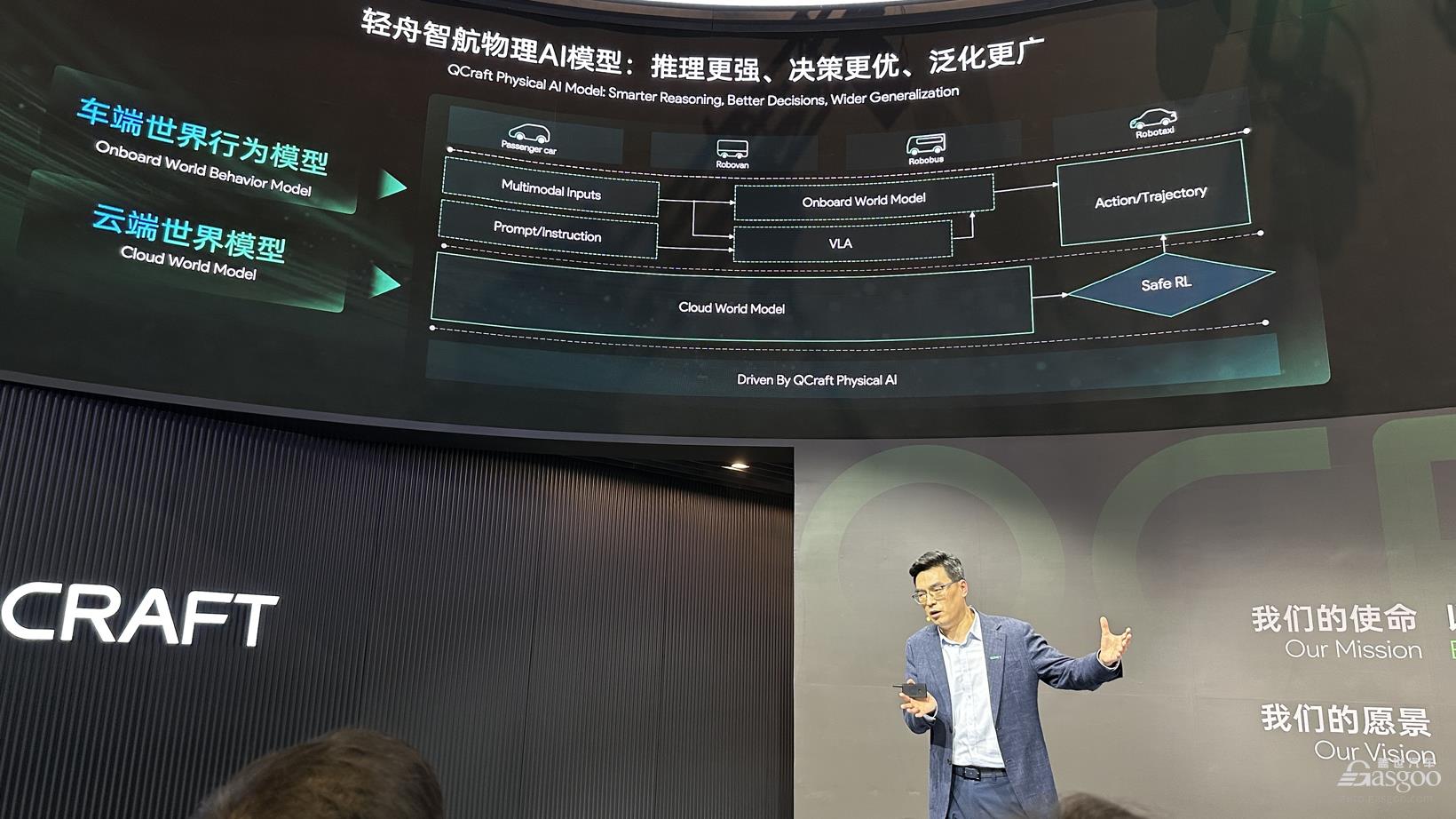
QCraft launched the “Chengfeng MAX” assisted driving solution. It features computing power over 500 TOPS and an 11V1L sensor configuration. It integrates VLA with the World Model for high-end city NOA. It covers roads from urban arteries to rural paths. It handles complex intersections, roundabouts, and U-turns. QCraft disclosed results for L4 Robotaxis and Robovans. It is advancing in public mobility and logistics.
QCraft is pursuing a “gradient” strategy. The Chengfeng solution is divided into AIR, PRO, and MAX product lines. This meets needs ranging from highway NOA to city NOA. This approach allows for exploration of Physical AI capabilities. It also adapts to deployment needs of different price points.
QCraft announced an upgrade to its mission and vision: “Physical AI for a Better Future.” This marks a shift from unmanned driving to general Physical AI. The repositioning is significant. It moves from a tool supplier to a builder of infrastructure.
From “Building Cars” to “Building Humans”: The Next Battlefield for Physical AI
The concentrated debut of humanoid robots made the media feel “the era is changing.” When robots draw more eyes than concept cars, it signals a shift. The boundaries of the automotive industry are dissolving.
Over a dozen automakers have announced robotics layouts. These include XPENG, Li Auto, Xiaomi, Chery, BYD, GAC, Chang’an, Geely, and China FAW. XPENG’s IRON and Honor’s “Lightning” robot had the longest lines on opening day.
Why are automakers “building humans”? It verifies if Physical AI capabilities can be generalized. A car is a four-wheeled robot. A Robotaxi is an embodied intelligent agent with perception and decision-making capabilities. Automakers’ algorithms and platforms can be reused for robots. Conversely, robot R&D can feed back into autonomous driving. Both share the same Physical AI core.
Li Auto Chairman Li Xiang defined 2026 as a key year for evolution. The company plans to release a two-wheeled robot for factories. Xiaomi’s CyberOne robot entered its car factory as an “intern.” Lei Jun announced a 60 billion yuan investment in AI. GAC spun off Guangdong Huilun Technology to handle robotics business, pursuing an in-house route.
The industry is shifting from “means of transport” to “embodied intelligent agent.” This involves a rewrite of competition logic. The core of past shows was the “car.” This year, the core is the “intelligence” driving the car and the world. Physical AI is a consensus now. The industry is moving from function stacking to capability fusion. Defining the core paradigm of Physical AI secures the entry ticket for the next decade.
The supply chain landscape is accelerating its reconstruction. Core suppliers entered main halls for the first time. They displayed alongside OEM brands. CATL shares the W4 hall with BMW and Porsche. WeRide, Horizon Robotics, and iFlytek are in the B3 hall with Toyota. Behind “shared halls” lies a trend. Physical AI is a valuable barrier. The voice of suppliers is rising.
Conclusion:
The “Physical AI” fever at the 2026 Beijing Auto Show is not a marketing slogan. It is a concentrated outbreak of industrial consensus. It follows years of exploration in intelligence.
Historical trends clarify the shift. The 2019 show discussed L2 and sensors. 2021 focused on chips and computing power. 2024 centered on Transformer and large models. By 2026, the industry realized something. Breakthroughs need integration into a larger framework. This framework lets AI understand the physical world. Physical AI is this framework.
Its rise answers three industry anxieties:
First, breaking the ceiling. L2+ features have permeated models costing over 100,000 yuan. The industry needs a new anchor point. The leap to L3/L4 must be built upon Physical AI.
Second, escaping homogeneity. Sensor and computing configurations are similar. Physical AI offers differentiation at the foundational capability level.
Third, unlocking imagination. From Robotaxis to robots, and flying cars to manufacturing, Physical AI is key. It opens trillion-level markets. The redistribution of influence gives those mastering Physical AI the power to define standards.
Moving from consensus to implementation, Physical AI faces challenges. How can world models simulate environments accurately with limited power? How can virtual scenarios bridge the “simulation-to-reality” gap? These challenges remain. However, the direction is clear. The path is laid out. The competition has begun.
When a car “understands” gravity and friction, the era has begun. When a robot “predicts” a pedestrian’s trajectory, the era has begun. When the busiest booth displays more than steel and rubber, the era has begun. AI is stepping into the physical world. The 2026 Beijing Auto Show is the prologue.
Search
RECENT PRESS RELEASES
Related Post