Policy Problems Aside, Solar Continues to Shine
May 1, 2026
Industry analysts say faster construction timelines, along with lower energy costs, are fueling consistent growth in a sector increasingly constrained by regulators.
Solar energy continues to drive new electricity generation capacity. The U.S. Energy Information Administration (EIA) in one of its forecasts earlier this year said utility-scale solar is the fastest-growing source of power generation in the U.S., and expects solar generation capacity will increase from last year’s 290 TWh to 424 TWh by 2027. The EIA said there are nearly 70 GW of new solar power generating capacity projects scheduled to come online this year and next.
The Solar Energy Industries Association (SEIA) recently said a new residential solar project was installed every 59 seconds in 2025, which brings the total number of residential solar energy systems in the U.S. to nearly 6 million. The group said that by 2030, it projects that about 11% of all U.S. homes will have rooftop solar. Energy analysts continually point out that solar continues to grow despite U.S. government policies that aim to curtail deployment of renewable energy resources.
 |
|
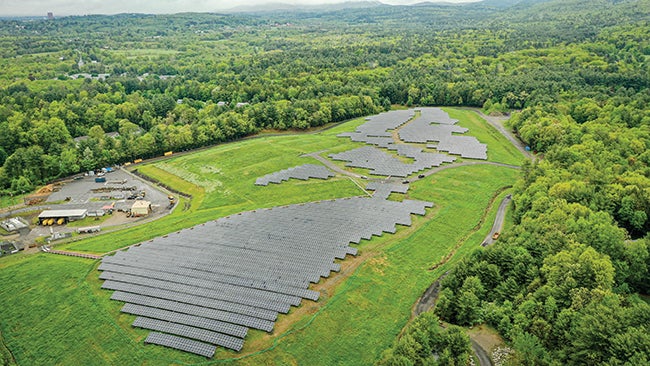
1. Camelot Energy Group, a clean energy infrastructure investment company, serves as a technical and strategic advisor to owners and investors in clean energy and energy storage projects, programs, and infrastructure. Among the company’s projects is this 4-MW ground-mount solar array, installed on a landfill in Amherst, Massachusetts. Courtesy: Camelot Energy Group |
Shawn Shaw, CEO and co-founder of Camelot Energy Group, a clean energy infrastructure investment and advisory company (Figure 1), told POWER, “While the policy landscape in some key markets has indeed become less favorable to solar, the reality is that solar PV [photovoltaic] remains the fastest to build and cheapest form of energy generation. More to the point, as the grid increasingly relies upon energy storage to balance more complex load and generation relationships, solar remains the cheapest way to charge a battery on the modern grid.
“Furthermore, solar provides a distributed and resilient source of electricity that can help consumers and governments weather fossil fuel price hikes and international supply disruptions,” said Shaw. “Even with a hostile policy landscape, the market fundamentals for solar power remain strong, and the increasing global electricity demand will be hungry for more solar-generated electricity for years to come.”
Jonathan Eastwood, senior vice president of U.S. Sales and Global Sales Support for Nextpower, said, “Solar’s growth story is increasingly driven by economics and execution rather than policy alone. Global demand for power is accelerating at a pace not seen in decades, driven by AI [artificial intelligence] infrastructure, electrification, and industrial expansion. In that context, solar remains the fastest and lowest-cost form of new power generation in most markets.
“Even if policy support fluctuates, the underlying economics are compelling,” said Eastwood. “A 1-GW utility-scale solar plant can be deployed in roughly 18 months, with the industry pushing to compress build cycles down even further. That compares to three to four years for gas and significantly longer for nuclear. This speed matters in today’s environment not only for hyperscalers to get their projects energized and online but also for utilities, surrounding towns, and ratepayers that could be impacted as new data centers crop up at record speed.”
China continues to dominate the global solar power market; the country controls more than 80% of the world’s supply chain for solar equipment, and government data shows China has about 1,300 GW of solar power generation capacity. China last year added more than twice as much solar power generation capacity as the rest of the world combined, accounting for about two-thirds of the global total for new solar generation capacity.
Bruce Anderson, CEO of 247Solar, a solar power and energy storage company, told POWER, “Given that global solar installations jumped by well over 50% year‑on‑year in 2025, with China and India still expanding rapidly, a U.S. slowdown on its own is not enough to signal that worldwide solar growth is peaking. In that sense, the U.S. looks more like an outlier wrestling with policy changes and interconnection queues than a bellwether for the end of the solar boom. The structural drivers—cheap solar energy, rising electrification, and corporate decarbonization—are so strong that the market will keep growing despite policy speed bumps.”
Anderson said that even with policy headwinds for solar power in the U.S., the move toward more domestic manufacturing of components will continue to lessen dependence on China. “Yes, it is absolutely possible for the U.S. and Europe to build solar supply chains that aren’t dependent on Chinese technology, especially if they lean into solar solutions that can be made elsewhere, such as emerging solar thermal solutions,” said Anderson.
“Standardized components manufactured under license with the ability to be made in multiple countries, sourced from multiple suppliers, are the type of technology that gains an edge in this environment,” he said. “Modularity is another perk of this system, which allows projects to be customized to fit the needs of the buyer. As tariffs, sourcing rules, and domestic-content incentives continue to evolve, technologies that can be manufactured flexibly across multiple regions allow projects to keep building even when policy headwinds pick up.”
U.S. Manufacturing
Several companies continue to work to expand domestic solar power infrastructure manufacturing. Nextpower, which was featured prominently at the recent Intersolar and Energy Storage North America event in San Diego, California, recently announced it had entered into a multi-year steel-frame supply agreement with Jinko Solar (U.S.) Industries. Nextpower said it will supply more than 1 GW of steel frames, scalable to up to 3 GW over a three-year period, to support module manufacturing at Jinko Solar’s Jacksonville, Florida, facility. The U.S. Department of the Treasury has issued guidance that said U.S.-made steel frames can add 6% to a tracker project’s domestic content calculation.
“This agreement with Jinko Solar represents clear market validation of steel frames as a reliable and cost-effective solution that supports both module durability and U.S. manufacturing priorities,” said Dan Shugar, founder and CEO of Nextpower, formerly known as Nextracker. “It also reinforces how the U.S. solar industry is industrializing, aligning domestic manufacturing, policy incentives, and proven technology at gigawatt scale.”
 |
|
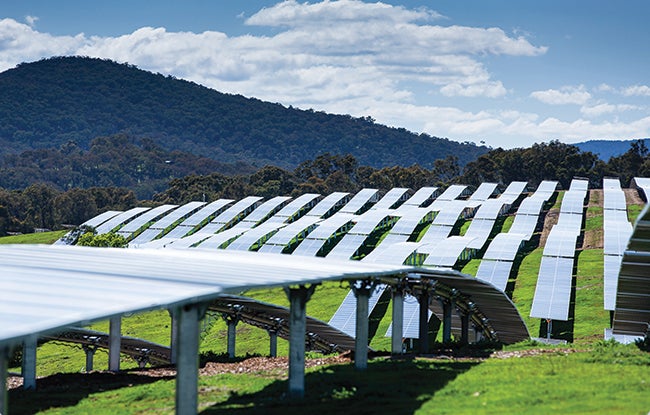
2. Terrain-following solar tracker systems, such as those from Nextpower, enable deployment on uneven and complex sites, expanding usable land while reducing grading and construction risk. Courtesy: Nextpower |
Nextpower, known for its innovative solar power equipment and project designs (Figure 2), also recently expanded its steel component manufacturing capacity in Memphis, Tennessee, one of more than 25 U.S. factories Nextpower has opened or expanded since 2021.
“Improving module durability and strengthening domestic supply chains are closely linked priorities and areas where Jinko Solar has long been a leader,” said Nigel Cockroft, general manager at Jinko Solar (U.S.) Industries. “From our fourth-generation extreme weather module platform to our Jacksonville facility, which has operated since 2018, we have consistently invested ahead of the market. Partnering with Nextpower to integrate domestically produced steel frames into our U.S. modules is a natural extension of that leadership, aligning with U.S. manufacturing priorities, while delivering greater durability at scale for customers and the broader solar industry.”
Said Eastwood, “The regionalization of solar supply chains is well underway. Nextpower began its U.S. manufacturing buildout in 2021, prior to the Inflation Reduction Act. Today, we work with more than 25 manufacturing partners in the U.S. and over 100 globally across 45-plus countries.
“For us, localization is now a core requirement, not just to meet regional requirements, but for execution,” said Eastwood. “Regional supply chains reduce logistics risk, shorten delivery timelines, and support local economic and community objectives—all key benefits and direct value to our developer owner customers. Tariffs and policy changes can create near-term pricing variability, but the broader trend is toward more resilient, regionally aligned supply chains.”
 |
|
3. US Modules is among the companies expanding their manufacturing of solar power equipment in the U.S. More groups are moving production to U.S. facilities to mitigate supply chain disruptions. Courtesy: US Modules |
US Modules, a Texas-based solar panel manufacturer, in late March opened a new manufacturing facility in College Station, Texas (Figure 3). The company said it has commissioned Production Line 1 at the site, focused on producing solar modules for large solar farm projects.
Production Line 1 is designed for about 400 MW of annual production capacity, with the site built to scale to roughly 1.4 GW of annual production as additional lines come online. The 150,000-square-foot facility includes two solar module production lines along with warehouse and loading infrastructure to support utility-scale deployment.
“US Modules is focused on building durable scalability—disciplined operations, consistent output, and a team that takes pride in how the work is done, while responsibly stewarding the environment and supporting the infrastructure this country depends on,” said Charles D. Carey, the company’s founder.
Diversifying Production
Joseph Johnson, a market analyst with Intertek CEA, noted a number of projects that are designed to lessen dependence on Chinese manufacturing. “Several efforts are underway to diversify Chinese polysilicon production. The most notable is the new United Solar Polysilicon plant in Oman, which started production this year,” said Johnson. “In addition, Corning announced the reactivation of U.S.-based polysilicon capacity. There are also a few projects ongoing in India, albeit many appear to be delayed, as Chinese polysilicon prices remain low and the slow rollout of Indian policy requirements for upstream materials has shifted Indian supplier focus to the more immediate need to ramp cell and wafer factories.”
Johnson added, “Elsewhere in the Middle East, ongoing studies are underway on regional polysilicon development to complement new investment studies in regional module, cell, and ingot/wafer capacity. Finally, markets like Australia are looking to support domestic production and stand up a complete solar value chain, although timelines and commitment decisions remain uncertain.”
Carter Atlamazoglou, a managing director in FTI Consulting’s Power, Renewables, and Energy Transition practice, said, “In the near to medium term, a full decoupling from Chinese technology is impractical given China’s entrenched leadership across wafers, cells, modules, and critical manufacturing equipment, though partial diversification is already underway. Policy measures such as tariffs and local content requirements in the U.S. and Europe are catalyzing domestic manufacturing while simultaneously increasing near term project costs and adding complexity to procurement. The most likely outcome is a China-reduced, rather than China-free, supply chain in which developers integrate domestic and partner-country production with residual Chinese inputs.”
Also of note: California-headquartered Swift Solar in March announced it had acquired manufacturing assets and intellectual property from European solar equipment manufacturer Meyer Burger to accelerate the production of perovskite-silicon tandem solar technology in the U.S. Joel Jean, CEO and co-founder of Swift Solar, said the deal means Swift Solar is “bringing in GW-scale silicon heterojunction [HJT] manufacturing equipment, a deep global IP [intellectual property] portfolio, and a world-class team of manufacturing veterans, equipment engineers, and silicon experts, led by Gunter Erfurt [former Meyer Burger CEO] and Marcel Koenig [former global head of research and development]. This acquisition puts Swift Solar on track to speed-run gigawatt-scale solar manufacturing in the United States. Everything is pointing in the same direction—tax credits, tariffs, supply chain reshoring, AI. The U.S. needs more solar, and we need it built here.”
The Data Center Impact
Though much of the discussion about powering data centers has focused on thermal options, those who spoke with POWER noted that solar can and should be part of the equation.
“We frequently hear interest from the data center community around multi-source microgrids for powering data centers,” said Camelot Energy’s Shaw. “These microgrids often mix solar, energy storage, and natural gas combined cycle turbines to create an optimized system that uses low marginal cost solar first, flexible energy storage resources next, and then gas-generated electricity to fill the gaps and keep batteries charged during low-sun periods. This is very similar to the many energy resilience projects our team has worked on over the years but instead of powering community centers we are now taking the same concepts to power data centers with electrical loads the size of cities.”
Nextpower’s Eastwood told POWER: “Data center demand requires gigawatts of new capacity to be deployed quickly and reliably. In that context, solar is essential because it can be built at scale and brought online faster than most other power sources. We are seeing a small number of microgrid systems being developed to feed data centers that are not grid-tied. These projects often have solar, BESS [battery energy storage systems], and in some cases gas, for an all-of-the-above solution.”
Shaw added, “We have moved from a ‘solar-plus-storage’ world to one in which we need to think about ‘storage plus solar.’ Energy storage is the future of reliable baseload power and offers tremendous savings to grid operators. Instead of having to overbuild grid infrastructure for 2–3x average load, simply to accommodate short-term load spikes, energy storage can manage those spikes and keep costs low while improving reliability. Solar power, with its low costs, incredible reliability—over 98% availability on average—and high predictability is increasingly the best way to charge those batteries to provide clean baseload power.”
Fengrong Li, a senior managing director in FTI Consulting’s Power, Renewables, and Energy Transition practice, told POWER: “AI‑driven data centers are reshaping the solar market. Since 2023, hyperscalers and major tech firms have signed more than 30 GW of solar PPAs [power purchase agreements], making them one of the most powerful demand drivers for new solar development. And they are not slowing down. 24/7 carbon-free targets are pushing them to lock in even more clean power deals.”
Li added, “What we’re seeing now is that AI isn’t just raising demand, it’s restacking the power delivery paradigm. With interconnection queues clogging up and transmission lines maxed out, the industry is moving toward integrated, behind-the-meter, multi‑technology systems that can be built quickly and placed right next to the load. And in some locations, these solutions include on‑site solar paired with battery storage.”
Atlamazoglou said solar may experience temporary slowdowns for a variety of reasons, but is likely to remain at or near the top of global power generation capacity additions. “Global solar deployment appears to be transitioning from a phase of rapid expansion to one of more mature, measured growth. In that context, a modest year-over-year decline in 2026 would represent a normalization rather than a structural peak,” he said. “Policy recalibrations in key markets, particularly around interconnection, incentive design, and grid integration, may temper additions in the near term, but they do not undermine the fundamental economics underpinning solar adoption. Even with a potential short-term dip, annual capacity additions are likely to remain elevated by historical standards, with solar continuing to command a major share of new power investment globally.”
—Darrell Proctor is a senior editor for POWER.
Search
RECENT PRESS RELEASES
Related Post