Central Asia Ramps Up Renewables as Global Capacity Reaches Record High in 2025
May 17, 2026
ALMATY – Central Asian countries recorded a notable growth in renewable energy capacity in 2025, as global installations surged by a record 692 gigawatts (GW), according to a new report by the International Renewable Energy Agency.
Photo credit: Open source
The report, titled Renewable Capacity Statistics 2026, shows that global renewable capacity reached 5,149 GW, marking a 15.5% annual increase, with renewables accounting for 85.6% of all new power additions.
Central Asia sees steady growth
Central Asian countries also reported varying dynamics in renewable energy development, reflecting different stages of the energy transition across the region.
In Kazakhstan, expansion remained steady but moderate, with total renewable capacity increasing from 5,561 megawatts (MW) in 2024 to 6,084 MW in 2025. Growth was driven primarily by wind energy, which rose from 1,520 MW to 1,909 MW, while solar capacity increased more gradually from 1,229 MW to 1,325 MW. Despite these gains, the overall share of renewables in electricity capacity that could be generated at maximum output edged up only slightly, from 22.4% to 22.8%.
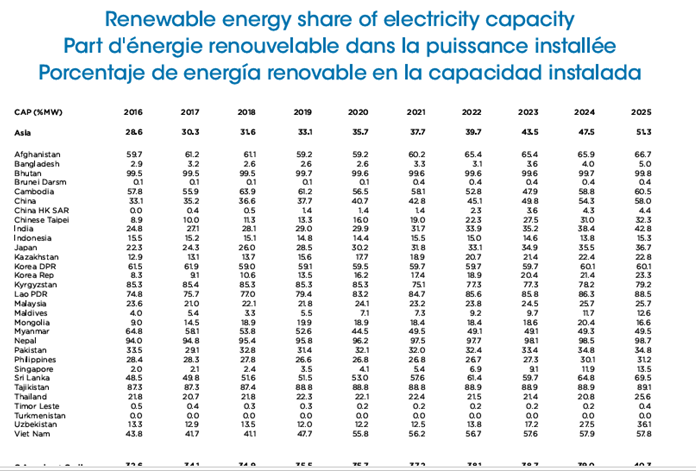
The Kyrgyz Republic, by contrast, continues to rely heavily on renewable sources, with capacity rising from 3,314 MW to 3,527 MW. Renewables already account for more than 79% of its electricity mix, underscoring a structurally different model, though with comparatively limited additions of new capacity.
In Uzbekistan, renewable energy expansion accelerated sharply, with total capacity jumping from 6,079 MW to 10,027 MW in 2025, a 65% increase in a single year. Wind capacity more than tripled, growing from 501 MW to 1,652 MW, while solar power nearly doubled, rising from 3,188 MW to 5,934 MW. As a result, the share of renewables in electricity capacity increased from 27.5% to 36.1%, highlighting the rapid scaling up of clean energy deployment.
Renewables gain momentum amid global uncertainty
The rapid expansion comes as geopolitical tensions, particularly in the Middle East, raise concerns over energy security and fuel price volatility.
Against this backdrop, renewable energy is increasingly seen as a reliable alternative, enabling countries to reduce dependence on imported fuels and build more resilient energy systems.
“In the midst of uncertain times, renewable energy remains consistent and steadfast in its expansion. This not only indicates market preference but also makes a strong case for renewable energy resilience with brutal clarity. Countries that invested in the energy transition are weathering this crisis with less economic damage, as they boost energy security, resilience and competitiveness.” said IRENA Director-General Francesco La Camera.
Solar and wind drive record growth
Solar power led global expansion, accounting for 511 GW, or nearly 75% of total renewable additions. Wind energy followed with 159 GW.
Together, solar and wind made up 96.8% of all new renewable capacity, reflecting significant cost reductions and strong market demand.
Other technologies saw more modest growth. Hydropower, excluding pumped storage, expanded by 18.4 GW, with 96% of the increase coming from China, alongside contributions from Ethiopia, India, and Vietnam. Bioenergy capacity rose by 3.4 GW, led by Japan, China, and Brazil, while geothermal energy saw a modest 0.3 GW increase, with additions primarily in the Philippines and Indonesia.
Regional disparities persist
Asia remained the dominant driver of renewable growth, contributing 74.2% of global additions, or 513.3 GW, with a growth rate of 21.6%.
Africa recorded its highest-ever increase, adding 11.3 GW, while the Middle East posted the fastest growth rate at 28.9%, led by Saudi Arabia.
In contrast, Central America and the Caribbean remained the least-developed region in terms of renewable capacity, with just 21 GW, underscoring global imbalances in progress on the energy transition.
According to the report, the record growth in 2025 marks the fastest expansion of renewable energy capacity in history, both in absolute and percentage terms.
However, the report highlights that, despite this progress, regional disparities remain a key challenge, underscoring the need for broader investment and policy support to ensure a more balanced global energy transition.
Get The Astana Times stories sent directly to you! Sign up via the website or subscribe to our X, Facebook, Instagram, Telegram, YouTube and Tiktok!
Search
RECENT PRESS RELEASES
Related Post