Amazon turns to Jeff Bezos’ other company to do some heavy lifting
May 28, 2026
Amazon is turning a corner with its launch providers, but ULA’s Vulcan remains grounded.
Credit:
Blue Origin
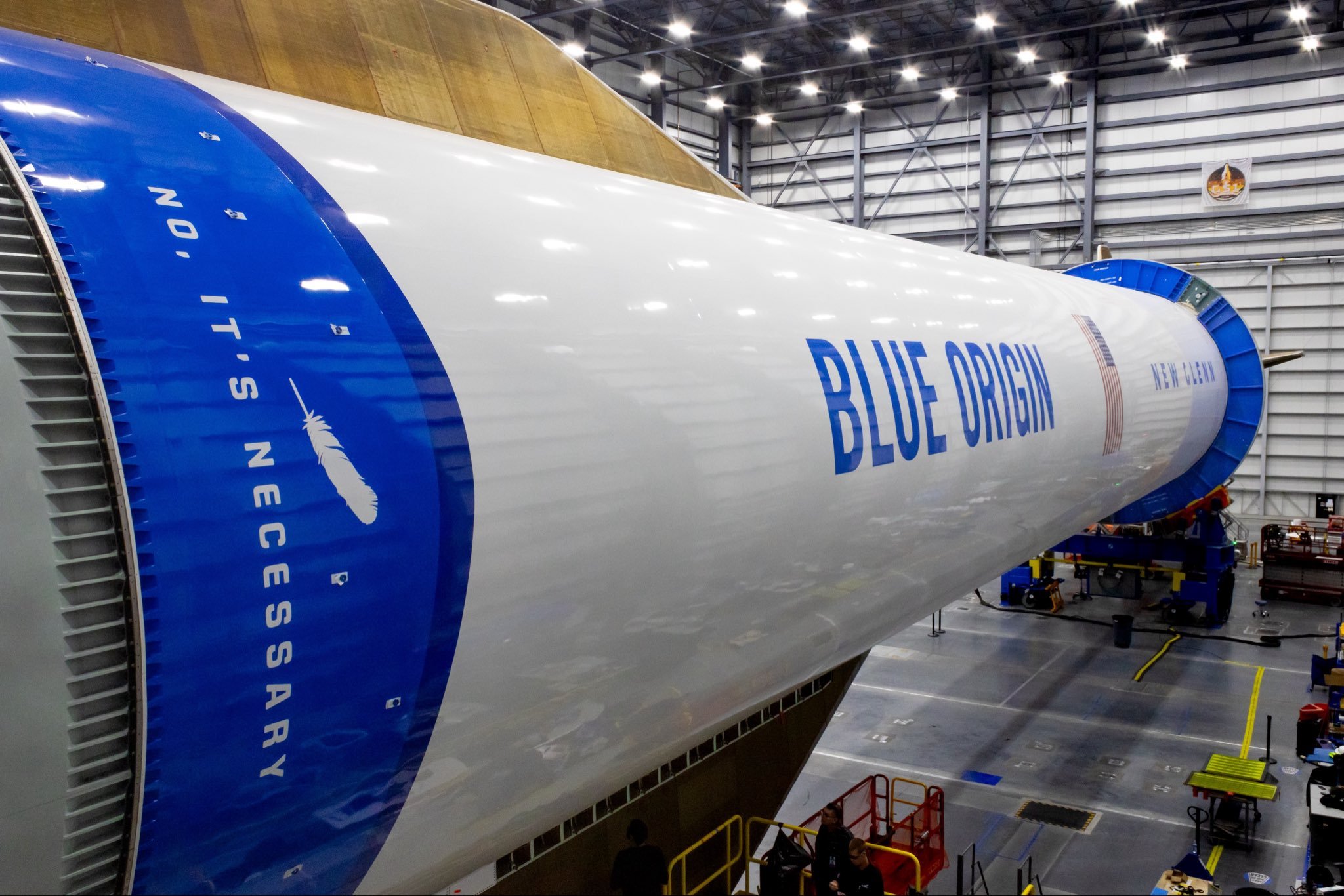
It was less than two months ago that the third flight of Blue Origin’s heavy-lift New Glenn rocket left a customer’s payload in an unusable orbit. Investigators have now identified the cause of the failure, and Blue Origin is preparing to launch the next New Glenn mission as soon as next week.
The Federal Aviation Administration and Blue Origin announced the closure of the failure investigation May 22. Yesterday, officials confirmed Blue Origin’s next launch will loft a payload of 48 commercial satellites for Amazon’s broadband network in low-Earth orbit. This will be the most satellites Amazon has launched on a single rocket, surpassing previous flights on United Launch Alliance’s Atlas V, SpaceX’s Falcon 9, and Europe’s Ariane 6.
Blue Origin and Amazon, each founded by Jeff Bezos, have not officially revealed a target launch date, but public notices of airspace and maritime closures suggest the mission is set to lift off from Cape Canaveral Space Force Station, Florida, as soon as next Thursday, June 4. Blue Origin is expected to roll the New Glenn rocket to its launch pad in the coming days for a test-firing of its seven main engines, fueled by liquified natural gas and liquid oxygen.
When it does fly, the New Glenn rocket will aim to release the 48 Amazon Leo satellites into an orbit a few hundred miles above Earth. A turnaround of less than two months, especially after a launch failure, would be a good sign that Blue Origin is ramping up the launch cadence for New Glenn.
More rockets, please
It would be timely. Another heavy orbital-class rocket developed at the same time as New Glenn, ULA’s Vulcan, has struggled to sustain even a meager launch cadence since debuting in 2024. Two of the four Vulcan launches to date have suffered anomalies with solid rocket boosters, and although the missions succeeded in placing their payloads into orbit, the launcher is grounded as ULA and its subcontractors probe the recurring problem.
Amazon has tapped ULA’s Vulcan as the primary launch vehicle for the Amazon Leo constellation, the first generation of which will number more than 3,200 satellites. The first of 38 Vulcan launches for Amazon Leo could fly later this year, but a firm schedule remains elusive as the solid rocket booster problem remains under investigation. Each Vulcan launch for Amazon Leo will use six of the strap-on rocket motors.
Of course, the New Glenn rocket must work as intended before Blue Origin can claim it is on a path to a higher launch rate. The last New Glenn flight carried a large satellite for AST SpaceMobile’s direct-to-cell broadband network. The rocket’s upper stage was supposed to fire its engines two times to inject AST’s satellite into the proper orbit, but the stage misfired on the second burn, stranding the payload in a lower-than-planned orbit. The satellite was unable to recover from the rocket’s shortfall, and it burned up upon reentry into the atmosphere.
In a statement last week, Blue Origin said engineers completed their investigation into the upper stage failure and implemented corrective measures ahead of the next New Glenn launch. “Prior to our second GS2 burn, we experienced an off-nominal thermal condition, and, as a result, one of the BE-3U engines didn’t achieve full thrust to reach our target orbit,” Blue Origin posted on X.
The Federal Aviation Administration accepted the findings of the investigation and added a few details on the cause of the failure. The FAA said a cryogenic leak froze a hydraulic line and led to a thrust anomaly during the second burn of the upper stage. Blue Origin identified nine correction actions, according to the FAA.
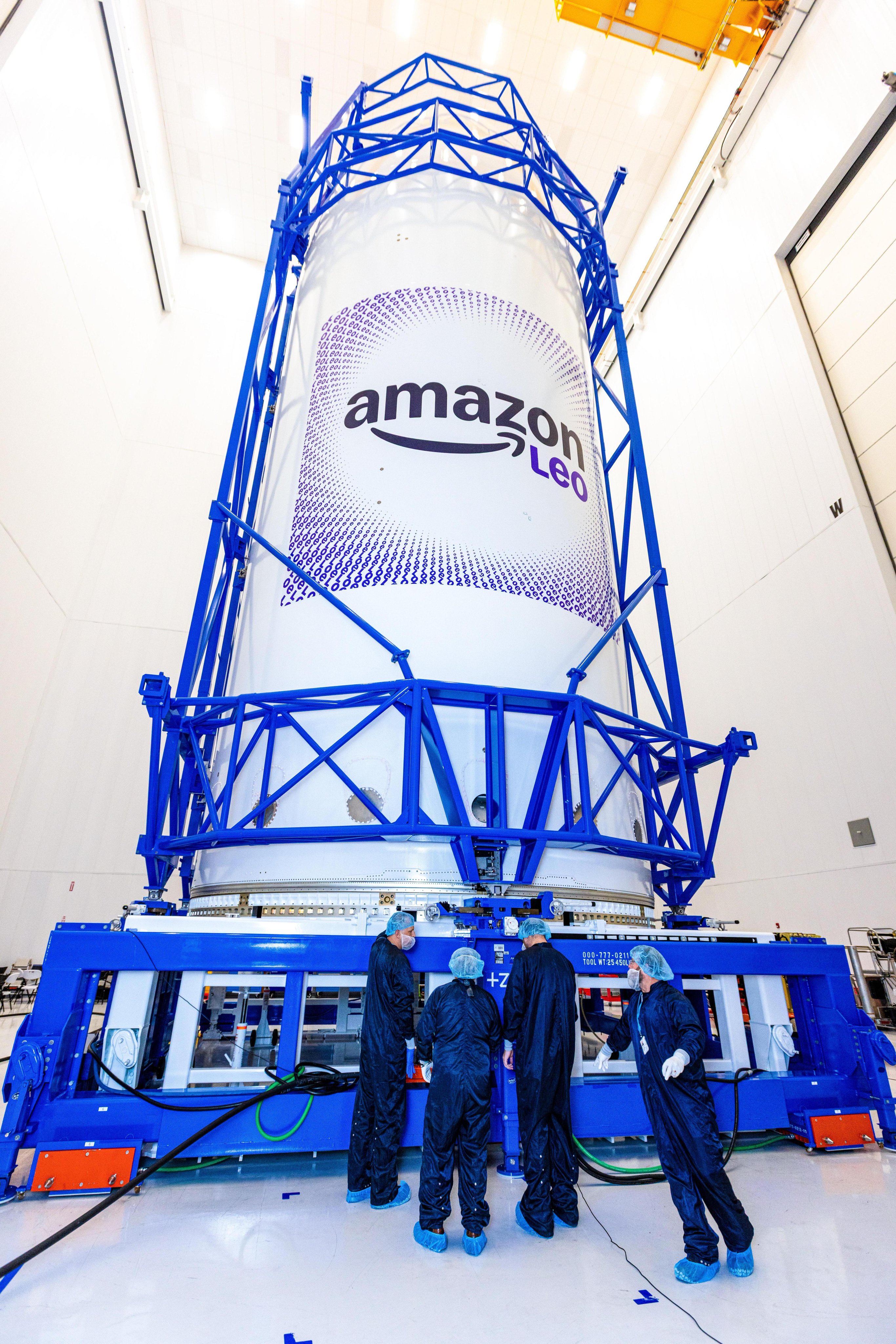
The 7-meter-diameter payload fairing offers twice the payload volume of the smaller 5-meter fairings used on Falcon 9, Vulcan, and Ariane 6.
Credit:
Blue Origin
Getting New Glenn into service for Amazon should help accelerate deployment of the Amazon Leo satellite constellation, a would-be competitor with SpaceX’s Starlink network. ULA boasts a large backlog for the Vulcan rocket, which can loft 45 Amazon Leo satellites in one go. But the US Space Force has reserved numerous Vulcan missions of its own. ULA says it is equipped to support two Vulcan launches per month once the rocket is flying routinely.
Blue Origin has the advantage of reusability. The New Glenn rocket’s first-stage booster is reusable, a capability first demonstrated on the company’s last flight April 19, despite the upper-stage failure that occurred later in the mission.
The bulk of Amazon’s satellites have so far been launched on ULA’s Atlas V rocket, a reliable workhorse that is nearing retirement. Amazon has just two more launches on the Atlas V, each carrying 29 satellites. The next one is scheduled to launch from Cape Canaveral on Friday evening. Amazon currently has 302 satellites in orbit, and Friday’s launch should push the network past the 10 percent mark for the total number of 3,232 spacecraft.
That is far below the requirement from the Federal Communications Commission for Amazon to deploy half of the constellation by the end of July, a deadline in place since the FCC’s approval of the Amazon Leo network in 2020. In January, Amazon requested an extension to the deadline. At the same time, the company announced it purchased 12 additional flights on New Glenn, bringing the total number of Amazon launches with Blue Origin to 24. Amazon also added 10 more launches on SpaceX’s Falcon 9 rocket on top of three Falcon 9 launches for Amazon Leo last year.
Meanwhile, in French Guiana, Europe’s Ariane 6 rocket has launched two dedicated missions for Amazon Leo, each with 32 satellites. Amazon has shipped the next batch of satellites to French Guiana for the next Ariane 6 launch, which will debut an upgrade for higher payload capacity.
Amazon originally bought launches on every available large Western rocket except SpaceX’s Falcon 9. The only rocket in Amazon’s stable of launchers with any flight history was ULA’s Atlas V, with a finite number of remaining launches due to its impending retirement. Delays with Vulcan, Ariane 6, and New Glenn were initially of little concern to Amazon, which was contending with its own issues scaling production of satellites in a factory in Kirkland, Washington. The situation changed last year, when Amazon’s satellite production outpaced the availability of rockets to put them into space.
Amazon retreated from the “everyone but SpaceX” strategy in 2023 after a shareholder lawsuit accused founder Jeff Bezos and the board of directors of breaching their “fiduciary duty” by not considering SpaceX as an option for launching Amazon Leo satellites. The plaintiffs in the lawsuit alleged Amazon didn’t consider the Falcon 9 due to an intense and personal rivalry between Bezos and SpaceX founder Elon Musk.
Amazon bowed to the allegations and announced a contract with SpaceX for three Falcon 9 launches, all of which flew last year. Amazon has scooped up 10 more Falcon 9 flights since then, but none have flown yet.
With Blue Origin’s New Glenn soon to fly its first mission for Amazon, Arianespace’s Ariane 6 on stable footing, and the prospect of more Falcon 9 launches on the horizon, Amazon may have turned a corner in solving its rocket conundrum.
If it has, a well-funded competitor to SpaceX’s Starlink service, long dominant in the satellite broadband market, may finally be at hand. Still, Starlink has the advantage of launching satellites cheaply and reliably on Falcon 9. SpaceX’s internal costs for a Falcon 9 launch are thought to be close to $15 million, one-fifth of the $74 million SpaceX charges external customers like Amazon for a dedicated flight.
Search
RECENT PRESS RELEASES
Related Post