Despite Record Renewable Growth, China Is Still Betting on Coal
June 12, 2026
China’s coal power output rose in early 2026, fueling concerns that last year’s drop in power-sector emissions may be temporary despite record growth in renewable energy.
Data from China’s National Energy Administration suggests that 2025 marked a turning point in China’s shift away from fossil fuels and toward renewable energy. Installed renewable energy capacity, including wind, solar, biomass and hydro, reached 2,340 gigawatts, accounting for nearly 60 percent of China’s total generating capacity. Combined wind and solar capacity surpassed thermal power capacity for the first time.
The rapid expansion of renewables helped drive the first annual decline in carbon emissions from China’s power sector in more than a decade, according to the Centre for Research on Energy and Clean Air (CREA). The trend appeared to reinforce expectations that China could meet its goal of peaking its carbon emissions before 2030 and achieving carbon neutrality by 2060.
Get Inside Clean Energy
Today’s Climate
Tuesdays
A once-a-week digest of the most pressing climate-related news, written by Kiley Price and released every Tuesday.
Get Today’s Climate
Breaking News
Don’t miss a beat. Get a daily email of our original, groundbreaking stories written by our national network of award-winning reporters.
Get Breaking News
ICN Sunday Morning
Go behind the scenes with executive editor Vernon Loeb and ICN reporters as they discuss one of the week’s top stories.
Get ICN Sunday Morning
Justice & Health
A digest of stories on the inequalities that worsen the impacts of climate change on vulnerable communities.
Get Justice & Health
Coal-fired generation, however, rose again during the first four months of this year, pushing power-sector emissions higher, though they remain below 2024 levels. Analysts say the rebound raises questions about whether last year’s decline represents a lasting structural shift.
The resurgence also comes as China continues to rapidly approve and construct new coal-fired power plants.
“The situation is alarming,” Qi Qin, an analyst at CREA, told Inside Climate News, “China has installed enormous amounts of solar and wind capacity, but the question is whether that capacity is being fully utilized.”
For decades, Chinese policymakers have viewed coal as a cornerstone of national energy security. Unlike oil and natural gas, which are more exposed to geopolitical risks and disruptions in global trade, coal is widely regarded by policymakers as a reliable source of electricity that can help stabilize the power system during periods of uncertainty.
Official data show that China produces more than 90 percent of the coal it consumes domestically, while imports account for roughly three-quarters of its oil supply and about 40 percent of its natural gas consumption.
Those concerns have been reinforced by recent disruptions in global energy markets linked to tensions over the Strait of Hormuz. China’s crude oil imports fell about 20 percent year-over-year in April, while natural gas imports declined 12.5 percent, official customs data shows.
Some researchers, however, argue that the energy-security rationale is becoming less convincing as renewable energy expands.
“The arguments to say we need this because of what’s happening with the U.S. attacking Iran, those arguments are just old,“ said Daniel M. Kammen, a professor of energy and climate justice at Johns Hopkins University, “But they keep using them because many political leaders don’t think that renewables are cheaper than fossil energy. “
Research shows that assumption is no longer correct.
A BloombergNEF analysis published last year found that electricity generated by new wind and solar projects is already cheaper than power from newly built coal- and gas-fired plants in almost every market worldwide. The cost advantage is particularly pronounced in China, where the country’s dominance in solar-panel and wind-turbine manufacturing has driven renewable-energy costs sharply down.
Both Kammen and Qin argue that coal’s persistence is driven not only by energy-security concerns but also by political and economic interests.
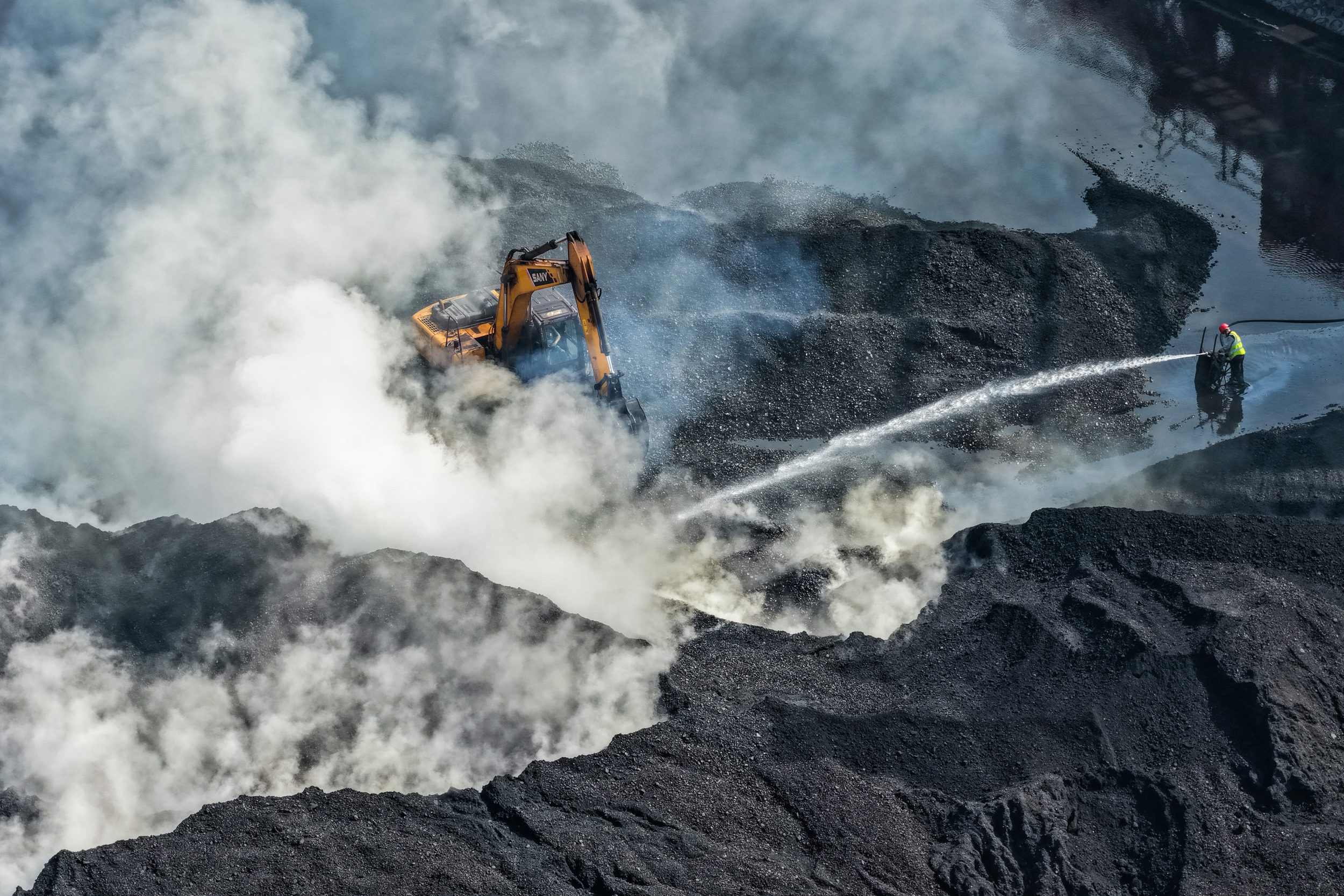
Coal-producing provinces depend heavily on mining for jobs and tax revenue, giving local governments strong incentives to support the industry. Meanwhile, wealthier coastal provinces often prefer to maintain local generation capacity rather than rely on electricity imported through long-distance transmission networks from western and northern China.
China began construction on 94.5 gigawatts of new coal-fired power capacity in 2024, the highest level since 2015. The construction boom extended into 2025, when roughly 78 gigawatts of new coal-fired capacity were commissioned, also marking largest annual increase in a decade.
The trend continues this year, as the country added another 24 gigawatts of coal power in the first quarter.
Qin said the increase in coal-fired generation is likely driven less by conflict around the Strait of Hormuz than by the rapid addition of new coal plants to the grid.
“It is more likely that China has commissioned too many new coal-fired power plants since 2024,” she said.
Analysts say the surge in coal construction could have long-term implications for China’s energy transition. Many newly built coal plants operate under medium- and long-term power contracts that guarantee a specific level of utilization, creating competition with renewable energy for a limited pool of electricity demand.
“Some say these new coal plants are being built as backup for renewable energy,” Qin said.
“But China only has so much room for new electricity demand. How will coal power and renewable energy compete with each other? In our view, it is a competition, and coal plants have an institutional advantage.”
Some supporters of coal expansion argue that new plants are replacing older, less efficient facilities. Qin disputes that claim. CREA researchers found that China retired only about 3 gigawatts of coal-fired power capacity last year.
The tension is noticeable in western China, where renewable-energy resources are abundant but electricity demand is relatively low.
This story is funded by readers like you.
Our nonprofit newsroom provides award-winning climate coverage free of charge and advertising. We rely on donations from readers like you to keep going. Please donate now to support our work.
Qinghai province, for example, covers roughly 280,000 square miles, about the size of Texas, but has a population of just 5.9 million people. The province has become one of China’s leading renewable-energy hubs. Chinese state media reported that Qinghai had installed 73 gigawatts of clean-energy capacity by October 2025, including solar, wind and hydropower, accounting for about 93 percent of its total generating capacity.
Much of that electricity is destined for population centers in eastern China through long-distance transmission lines, a strategy long promoted by Beijing.
But Qin said many eastern provinces remain reluctant to depend heavily on imported electricity.
“For high-demand provinces in eastern China, they prefer to maintain control over power generation themselves,” she said. “So they continue building coal plants. That allows them to keep the investment, tax revenue and employment locally.”
The result, Qin said, is a growing conflict between China’s national climate goals and the incentives facing local governments.
“This is a huge problem in terms of the flexibility of China’s energy strategy,” she said.
The economic and political stakes are significant. About 2.7 million people still work in China’s coal-mining industry. Although employment has roughly halved from its peak in 2013, coal remains a major source of jobs and government revenue in many inland provinces.
The debate comes as China continues to grapple with the human costs of coal production. A gas explosion at a coal mine in Shanxi province in May killed 82 people, injured 124 and left two missing, making it the country’s deadliest mining disaster in more than 17 years.
The toll from coal extends beyond high-profile accidents. For decades, coal miners across China have suffered from pneumoconiosis, commonly known as black lung disease, caused by prolonged exposure to coal dust. The disease remains one of the country’s most serious occupational health challenges.
Beyond the mines, coal combustion generates air pollution and carbon emissions. Although China has made significant progress in improving air quality through stricter emissions standards and cleaner technologies, coal remains a major source of fine particulate pollution and the country’s largest source of greenhouse gas emissions.
Kammen said the accident brought renewed attention to the hazards of coal mining. However, many provinces remain reluctant to reduce coal production because of concerns about job losses.
While most of the coal mines are in the inland provinces, the manufacturing hubs for renewable energy, such as solar panels and wind turbines, are in the east.
“It is unlikely that a coal miner who loses his job in Shanxi province is going to move to a clean-tech job in Shanghai,” Kammen said. “The challenge is really, how does China keep pushing on renewables, but without angering the coal-producing parts of the country?”
In a written statement, China’s National Energy Administration described coal-fired power as the “backbone” and “stabilizing force” of the country’s electricity system, saying it plays a “critical role” in ensuring a secure and reliable power supply.
Kammen argues that this should not be used to justify building more coal-fired power plants.
“China is already the biggest producer not only of solar panels and wind turbines, “but also batteries,” he said. “And China could certainly convert some of its hydro capacity to act like a battery if they want. So the old argument that you need coal for security is definitely incorrect.”
For Kammen, who frequently travels to China and has long worked with Chinese researchers and policymakers on clean-energy development, the shift has made his efforts to accelerate the world’s largest carbon emitter’s transition to net-zero emissions even more challenging.
“This has made everybody’s job more difficult,” he said. “China’s path is too slow. The U.S. path was good under President Biden. But now, of course, we’ve gone in totally the wrong direction.”
Clean-energy and transportation investment in the United States declined 11 percent from a year earlier in the fourth quarter last year, the first year-over-year quarterly decline since 2019. Investment then fell another 3 percent in the first quarter this year, the Clean Investment Monitor found.
Solar and wind power continue to expand rapidly in China. Nearly 59 gigawatts of new renewable-energy capacity were installed in the first quarter of this year, accounting for about 70 percent of all newly added power-generation capacity.
Yet the central question remains unresolved. As more coal-fired power plants are commissioned, the challenge is no longer how quickly China can build renewable energy, but “how fast and to what extent renewables will be allowed to displace coal,” Qin said. The answer may become clearer this year: Whether China’s power-sector emissions can decline for a second consecutive year will be an early test of the country’s energy transition.
About This Story
Perhaps you noticed: This story, like all the news we publish, is free to read. That’s because Inside Climate News is a 501c3 nonprofit organization. We do not charge a subscription fee, lock our news behind a paywall, or clutter our website with ads. We make our news on climate and the environment freely available to you and anyone who wants it.
That’s not all. We also share our news for free with scores of other media organizations around the country. Many of them can’t afford to do environmental journalism of their own. We’ve built bureaus from coast to coast to report local stories, collaborate with local newsrooms and co-publish articles so that this vital work is shared as widely as possible.
Two of us launched ICN in 2007. Six years later we earned a Pulitzer Prize for National Reporting, and now we run the oldest and largest dedicated climate newsroom in the nation. We tell the story in all its complexity. We hold polluters accountable. We expose environmental injustice. We debunk misinformation. We scrutinize solutions and inspire action.
Donations from readers like you fund every aspect of what we do. If you don’t already, will you support our ongoing work, our reporting on the biggest crisis facing our planet, and help us reach even more readers in more places?
Please take a moment to make a tax-deductible donation. Every one of them makes a difference.
Thank you,

Andrew Liu
Fellow
Andrew Liu is an Outrider fellow at Inside Climate News and a journalist covering climate, business and technology. Born and raised in China, he spent more than 20 years living and working in Singapore before moving to the United States. He holds degrees from Columbia Journalism School and Singapore Management University. Before focusing on climate and business reporting, Liu spent more than a decade as a sports reporter for Singapore’s Lianhe Zaobao, a leading Chinese-language daily newspaper. His reporting took him across Southeast Asia, China and Brazil.
Search
RECENT PRESS RELEASES
Related Post