Transmission Fluids Market Poised for Steady Growth as Global Vehicle Ownership Continues
June 15, 2026
The automotive industry has undergone remarkable transformations over the past decade. Electric vehicles are gaining popularity, vehicle technologies are becoming increasingly sophisticated, and consumers are demanding better performance, fuel efficiency, and reliability from their automobiles.
Amid all these changes, one component often remains overlooked despite playing a critical role in vehicle operation: transmission fluid.
While consumers may focus on engines, batteries, and advanced driver-assistance systems, transmission fluid quietly performs some of the most important functions within a vehicle. It lubricates moving parts, reduces friction, dissipates heat, protects against wear, and enables smooth gear shifting. Without it, modern vehicles would struggle to deliver the performance and efficiency drivers expect.
As global vehicle ownership continues to rise and automotive technologies become more advanced, the transmission fluids industry is experiencing steady expansion. According to Renub Research, the global Transmission Fluids Market is projected to grow from US$8.63 billion in 2025 to approximately US$12.4 billion by 2034, registering a compound annual growth rate (CAGR) of 4.11% between 2026 and 2034.
The market’s growth reflects the ongoing importance of vehicle maintenance, advancements in transmission technology, and increasing awareness among consumers regarding long-term automotive care.
Transmission fluid is far more than a simple lubricant.
In modern vehicles, transmission systems contain numerous moving parts that operate under intense pressure and temperature conditions. Transmission fluid ensures these components function efficiently by reducing friction and preventing excessive wear.
The fluid also acts as a coolant, helping regulate operating temperatures within the transmission system. Excessive heat is one of the leading causes of transmission failure, making thermal management a critical responsibility of transmission fluids.
Additionally, transmission fluids support hydraulic functions within automatic transmission systems, allowing gears to shift smoothly and efficiently.
These functions contribute directly to vehicle performance, fuel efficiency, driving comfort, and component longevity.
Whether a vehicle uses a manual transmission, automatic transmission, continuously variable transmission (CVT), or dual-clutch transmission (DCT), specialized fluids play an essential role in maintaining reliable operation.
One of the strongest drivers behind transmission fluid demand is the continued expansion of the global vehicle population.
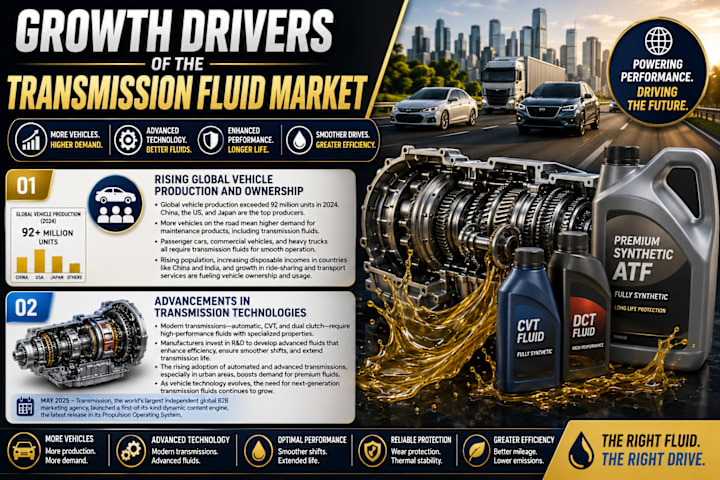
Worldwide vehicle production exceeded 92 million units in 2024, with countries such as China, the United States, and Japan leading global manufacturing activity. As vehicle production grows, the need for maintenance products naturally increases.
Every passenger car, commercial vehicle, delivery van, truck, and off-road vehicle requires transmission system maintenance throughout its operational life.
Growing urbanization and rising disposable incomes in emerging economies are further accelerating vehicle ownership. Millions of consumers in developing countries are purchasing automobiles for personal transportation, business activities, and commercial operations.
Ride-sharing services, logistics companies, transportation networks, and delivery fleets are also expanding rapidly. These vehicles accumulate high mileage and require regular maintenance to maintain operational efficiency.
As more vehicles enter roads worldwide, transmission fluid demand is expected to remain strong for years to come.
The transmission systems used in modern vehicles have become significantly more sophisticated than those found in earlier generations of automobiles.
Automakers are increasingly adopting advanced transmission technologies designed to improve fuel economy, driving comfort, and overall vehicle performance.
Automatic transmissions have become increasingly common in both developed and emerging markets. Dual-clutch transmissions provide faster gear changes and improved efficiency. Continuously variable transmissions offer smoother acceleration and enhanced fuel economy.
These advanced systems require highly specialized transmission fluids engineered to meet specific performance requirements.
Modern transmission fluids must withstand higher operating temperatures, increased mechanical stress, and tighter performance tolerances than traditional lubricants.
As a result, lubricant manufacturers are investing heavily in research and development to create next-generation products capable of supporting increasingly complex transmission systems.
The evolution of automotive technology is not reducing demand for transmission fluids—it is increasing demand for higher-quality and more specialized solutions.
Consumer attitudes toward vehicle maintenance have changed significantly in recent years.
Many vehicle owners now recognize that preventive maintenance is often more cost-effective than major repairs. This shift in mindset has benefited the transmission fluids market.
Replacing transmission fluid at recommended service intervals helps reduce wear, improve fuel efficiency, and extend transmission lifespan. Neglecting maintenance can result in expensive repairs or complete transmission failure.
Automotive service centers, dealerships, and repair shops continue educating consumers about the importance of regular maintenance schedules.
Fleet operators are particularly attentive to transmission maintenance because vehicle downtime directly affects profitability and operational efficiency.
As awareness of preventive maintenance continues to grow, demand for transmission fluid replacement services is expected to remain stable across both consumer and commercial markets.
Among all transmission fluid categories, automatic transmission fluid (ATF) represents one of the most important market segments.
Automatic vehicles continue gaining popularity worldwide because they provide greater driving convenience, especially in urban environments characterized by traffic congestion and frequent stop-and-go conditions.
Unlike manual transmissions, automatic systems rely heavily on transmission fluid to perform multiple functions simultaneously. The fluid lubricates internal components, cools the system, transmits hydraulic pressure, and facilitates smooth gear shifts.
As automatic vehicle adoption expands globally, demand for high-performance automatic transmission fluids continues to increase.
Developed markets such as North America already exhibit high penetration rates for automatic transmissions. Meanwhile, emerging economies are gradually embracing automatic vehicles as consumers prioritize convenience and comfort.
This trend positions automatic transmission fluids as a key growth segment within the broader market.
Dual-clutch transmission technology has gained considerable attention among automakers seeking to combine performance and efficiency.
DCT systems blend characteristics of manual and automatic transmissions, delivering rapid gear changes while improving fuel economy.
However, these sophisticated systems operate under demanding conditions that require specially formulated transmission fluids.
Dual-clutch transmission fluids must provide exceptional lubrication, thermal stability, friction control, and wear protection.
Automakers increasingly incorporate DCT technology into performance vehicles, premium passenger cars, and fuel-efficient models.
As adoption expands, demand for specialized DCT fluids is expected to grow alongside broader transmission technology advancements.
Manual Transmission Fluids Still Hold Importance
Despite the growing popularity of automatic vehicles, manual transmissions remain widely used in many regions.
Developing countries continue to maintain substantial populations of manual-transmission vehicles due to lower purchase costs, fuel efficiency advantages, and mechanical simplicity.
Commercial vehicles, agricultural equipment, and certain industrial applications also continue relying on manual transmission systems.
Consequently, manual transmission fluid remains an important segment of the market.
Although growth rates may be slower compared to automatic transmission fluids, the large installed base of manual vehicles ensures ongoing demand for maintenance and replacement products.
For many consumers, manual transmissions still provide greater control over vehicle performance, helping preserve their relevance in specific markets.
One of the most significant trends shaping the industry is the increasing adoption of synthetic transmission fluids.
Unlike conventional petroleum-based products, synthetic fluids are engineered using advanced chemical formulations designed to deliver superior performance.
Synthetic transmission fluids offer several advantages, including:
- Enhanced thermal stability
- Improved oxidation resistance
- Better protection against wear
- Longer service intervals
- Improved fuel efficiency
- Superior cold-weather performance
Modern vehicles often operate under more demanding conditions than earlier models, making these benefits increasingly valuable.
Many automakers now recommend synthetic fluids because they support advanced transmission technologies and contribute to overall vehicle efficiency.
As consumers become more aware of long-term maintenance benefits, synthetic products are expected to capture a growing share of the global market.
The global automotive aftermarket continues to play a critical role in supporting transmission fluid demand.
Vehicles require regular maintenance throughout their lifespan, creating recurring opportunities for service providers, dealerships, repair shops, and lubricant manufacturers.
As vehicle ownership expands globally, aftermarket activity is increasing correspondingly.
Consumers today have greater access to service centers, maintenance information, and replacement products than ever before. This accessibility supports more consistent maintenance practices.
Fleet operators also represent a major source of aftermarket demand. Delivery services, logistics companies, public transportation providers, and commercial vehicle operators maintain strict maintenance schedules to maximize vehicle uptime.
These trends create a stable foundation for long-term transmission fluid consumption.
Despite positive market fundamentals, the transmission fluids industry faces an important challenge: the rapid growth of electric vehicles.
Unlike traditional internal combustion vehicles, many electric vehicles utilize single-speed transmission systems that require significantly less transmission fluid.
Some EVs eliminate the need for conventional transmission fluids altogether.
Governments worldwide continue promoting electric vehicle adoption through incentives, emissions regulations, and sustainability initiatives. Consumer interest in EVs is also rising as charging infrastructure improves and battery costs decline.
As EV penetration increases, demand for traditional transmission fluids may face long-term pressure.
However, this transition is expected to occur gradually.
Internal combustion vehicles and hybrid vehicles will continue representing substantial portions of the global vehicle fleet for many years, providing ongoing demand for transmission maintenance products.
Additionally, lubricant manufacturers are already developing specialized fluids designed specifically for electric drivetrains and emerging mobility technologies.
Environmental sustainability is becoming increasingly important within the transmission fluid industry.
Traditional transmission fluids are petroleum-based products that require careful handling, disposal, and recycling to minimize environmental impact.
Governments and regulatory bodies are implementing stricter environmental standards regarding lubricant production, usage, and disposal.
In response, manufacturers are investing in environmentally responsible product development.
Biodegradable formulations, improved recycling initiatives, and lower-emission production processes are becoming more common throughout the industry.
While regulatory compliance may increase production costs, it also creates opportunities for innovation and differentiation.
Companies that successfully balance performance with environmental responsibility are likely to gain competitive advantages in future markets.
The United States remains one of the world’s largest transmission fluid markets due to high vehicle ownership rates, extensive transportation networks, and widespread use of automatic transmissions.
The United Kingdom continues benefiting from strong maintenance awareness and a well-developed automotive service sector. Consumers increasingly seek premium synthetic fluids that improve performance and fuel efficiency.
India represents one of the most promising growth opportunities. Rising urbanization, increasing vehicle ownership, and growing awareness of vehicle maintenance are driving demand across both passenger and commercial vehicle segments.
Saudi Arabia also remains an important market due to extensive vehicle usage, long transportation routes, and environmental conditions that place additional demands on vehicle lubrication systems.
These regional developments demonstrate the broad and diverse nature of transmission fluid demand worldwide.
The transmission fluids market may not generate the same headlines as electric vehicles or autonomous driving technologies, but its importance within the automotive ecosystem cannot be overstated.
Transmission fluids remain essential to vehicle performance, reliability, fuel efficiency, and longevity. As global vehicle ownership expands and transmission technologies become increasingly advanced, demand for high-performance lubrication solutions will continue to evolve.
Although challenges such as electric vehicle adoption and environmental regulations are reshaping the industry, they are also creating opportunities for innovation and product development.
With the market projected to grow from US$8.63 billion in 2025 to US$12.4 billion by 2034, transmission fluids are expected to remain a vital component of the global automotive maintenance landscape.
In an industry built on movement, performance, and reliability, transmission fluids will continue doing what they have always done—keeping vehicles running smoothly behind the scenes.
Search
RECENT PRESS RELEASES
Related Post