What caused Meta to destroy its iconic engineering culture?
June 17, 2026
The management team at Meta, the company that operates social media platforms like Facebook and Instagram, is relentlessly pushing forward with ‘AI-driven reforms’ within its engineering organization. Gergely Oross explains the reality of these reforms taking place within Meta.
Why is Meta destroying its engineering organization?
https://newsletter.pragmaticengineer.com/p/why-is-meta-destroying-its-engineering 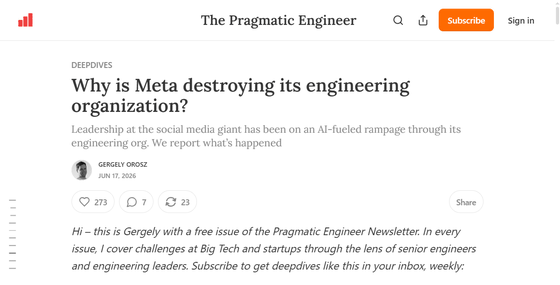
For 20 years, Meta has had an unparalleled engineering organization. At its core is a company culture that has been in place since the company’s founding: ‘Act quickly and don’t be afraid to fail when necessary.’ This culture then evolved around the beginning of 2020 to ‘Act quickly and maintain a stable infrastructure.’
Then, Oros pointed out, the situation changed dramatically with the introduction of AI around April 2026. ‘It’s as if Meta’s management is following a blueprint to destroy a proven and successful engineering culture in the most ruthless and efficient way possible,’ he said.
Meta’s engineering culture before the introduction of AI can be divided into two periods: the era after its founding, characterized by ‘acting quickly and not being afraid of failure,’ and the era since early 2020, characterized by ‘acting quickly and maintaining a stable infrastructure.’
◆An era of swift action and a willingness to sometimes fail.
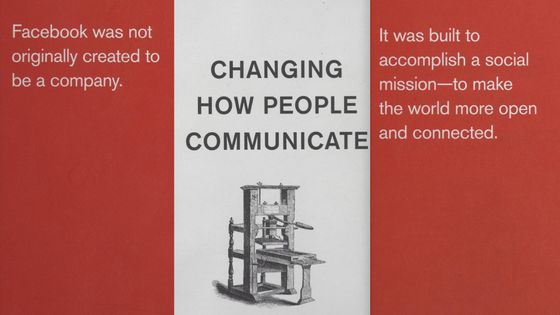
Back in the 2010s, when Meta was still Facebook, Facebook’s unconventional engineering culture defied conventional best practices, achieving great success and becoming a legend in the technology industry. When Facebook’s user base surpassed one billion in 2012, the company reportedly created a small booklet introducing its culture and distributed it to employees. This booklet resembled the ‘Little Red Book,’ a compilation of Chairman Mao Zedong’s thoughts published in 1964, and became affectionately known as the ‘Little Red Book’ within the company.
The Little Red Book was a booklet of about 70 pages that systematized Facebook’s engineering culture at the time, emphasizing speed, fearlessness, responsibility, and unconventional thinking. Some of the representative slogans found in the Little Red Book include:
Act quickly and break the mold.
It’s better to complete the task than to aim for perfection.
Let’s fail more
If you didn’t have fear, what would you do?
Every day feels like a week
The Wright brothers did not have pilot licenses.
– Stupid waiting time
Luck favors the brave.
Little Red Book is available online in a free downloadable format.
◆An era of swift action and maintaining stable infrastructure
Subsequently, from early 2020, Facebook’s engineering culture shifted to an era of ‘acting quickly and maintaining a stable infrastructure.’ In this era, the recklessness of the past largely disappeared, replaced by the principle of rapid development and the construction of a stable infrastructure.
Facebook is a very engineering-centric company compared to other major technology companies, and this was thought to be due to the fact that its founder and CEO, Mark Zuckerberg, is an engineer himself, and that many of Facebook’s early innovations were created by engineers.
Furthermore, Facebook at the time lacked the rigorous processes and standardization of major technology companies, and its emphasis on testing, documentation, and code comments was surprisingly low. It was nowhere near Amazon’s engineering culture, and even compared to companies like Google, Microsoft, and Uber, Facebook’s processes were far more relaxed. Oros points out that this is because Facebook is an engineer-centric company, and engineers don’t like processes.
At the time, engineers working at Facebook were highly skilled, motivated, and product-oriented, and their work was highly valued. Furthermore, engineers felt a strong sense of contributing to the company’s profit-generating operations.
However, Facebook has transformed into Meta and is accelerating its investment in AI . Meta is the only company that does not own a hardware platform or operating system, unlike major technology companies such as Apple, Microsoft, Amazon, and Google. Apple owns hardware such as iPhones and Macs and operating systems such as iOS and macOS, Google owns hardware such as the Pixel series and operating systems such as Android and ChromeOS, Microsoft owns Windows, and Amazon owns Kindle.
Having failed to develop its own hardware and OS in the 2010s, Meta has continued to invest in establishing new platforms. For example, investments in virtual reality (VR) based on Oculus and augmented reality (AR) including Ray-Ban Meta. Meta continues to invest hundreds of billions of yen in these areas in order to become a market leader, but Oros points out that ‘VR ultimately did not become mainstream.’
In fact, Meta has incurred significant losses due to its investments in the VR sector, resulting in layoffs and the closure of its VR studios.

When it became clear in 2022 that AI would become a major trend, Meta’s CEO, Mark Zuckerberg, didn’t miss the opportunity. Meta formed an in-house foundational AI research team and a generative AI product organization, and announced ‘Llama’ as an openweight AI model. Llama was announced in February 2023, three months before ChatGPT was released.
Furthermore, in July 2023, they unveiled the ‘Llama 2,’ the successor to the Llama.

In April 2024, they released ‘Llama 3.’ Oros described Llama 3 as ‘the most competitive of Meta’s Large-Scale Language Models (LLMs), and its adoption has accelerated across the industry.’
On the other hand, he described ‘Llama 4,’ which was released in April 2025, as ‘extremely disappointing.’
Furthermore, in June 2025, Meta acquired a 49% stake in Scale AI to accelerate its AI business and established Meta Superintelligence Labs, an AI research institute headed by Scale AI CEO Alexander Wang.
Meta has reportedly created ‘The List,’ a compilation of top talent in the AI industry, and is attempting to poach them.
Meta was also in the process of acquiring Manus AI , another AI startup from China, but that deal is on the verge of being called off due to intervention by the Chinese government .

Scale AI and Mr. Wang play a major role in Meta’s AI development. Scale AI brings Meta ‘training data and labeling’ and ‘ RLHF and fine tuning ,’ and Mr. Wang has been given very broad authority in these areas.
Wang used this authority to begin collecting data on employees’ mouse movements and keystrokes to use as AI training data. Oros pointed out that this is ‘obviously a privacy violation and raises concerns.’
Meta begins collecting employee mouse movements and keystrokes as AI training data – GIGAZINE

Furthermore, Oros pointed out that discontent is growing within the company because 30-50% of Meta’s core team engineers have been forcibly reassigned to data labeling and RLHF. From its founding in 2004 until 2025, Meta’s engineers had the autonomy to freely choose their work location and responsibilities. This was a core element of Meta’s operational structure.
However, 30-50% of Meta’s core team engineers will be forced to reassign to data labeling and RLHF. Oros points out that this work involves simply repeating human feedback on AI-generated GitHub repositories, which is vastly different from their previous work ‘developing products used by hundreds of millions of users.’ The infrastructure and security teams were the ones most affected by this.
One of the affected engineers described the situation as ‘just like ‘ The Hunger Games ‘.’ The Hunger Games is a film in which 24 randomly selected men and women are forced to participate in a deadly survival game.
Then, in April 2026, Meta announced it would lay off 8,000 employees, or 10% of its total workforce.
Meta to cut approximately 8,000 jobs, or 10% of its workforce – GIGAZINE

Meta employs a Performance Summary Cycle (PSC) to evaluate employee performance. This PSC is extremely rigorous, even compared to companies like Google and Apple. Meta’s HR managers try to lower the evaluations of engineers in other teams to raise the evaluations of their own team’s engineers in exchange for their subordinates’ salaries. The PSC reportedly uses metrics such as business impact, number of code reviews, and number of lines of code written. Furthermore, Meta has also started measuring AI token usage as part of its PSC.
Oros points out that as a result, Meta’s engineers lost interest in their original work and became solely focused on performance-oriented tasks.
The engineering culture that Meta had built up over the years crumbled with the introduction of AI, resulting in Meta experiencing ‘the most embarrassing system failure in Meta’s history’ at the end of May 2026. This involved ‘hackers deceiving Meta AI’s support chatbot to steal the Instagram accounts of celebrities.’ Meta representatives explained that a combination of AI-generated and reviewed code and downsizing of the security team led to this embarrassing incident.
Hackers deceive Meta AI’s support chatbot to steal celebrity Instagram accounts – GIGAZINE

Although this system failure was resolved on June 1, 2026, it led to the resignation of Meta’s Chief Security Officer, Guy Rosen, on June 2.
Within Meta, CEO Mark Zuckerberg and Alexander Wang have been cited as the cause of the collapse of the company’s engineering culture. This is not surprising, considering that Zuckerberg has complete control over the business and has made decisions such as redeploying engineers to large-scale data labeling, tracking employees’ keyboard and mouse movements, and laying off 10% of the workforce.
However, Oros pointed out that, apart from the layoffs, it was clear that most of the measures taken by Meta that drew resentment from employees were the work of Wang of Scale AI.
Search
RECENT PRESS RELEASES
Related Post