A 2,000-HP Car You Have Never Heard Of Claims 0.9-Second 0-60 Thanks To Solid-Fuel Rockets
May 5, 2026
This week, a Chinese home-appliance brand unveiled a concept hypercar that claims to hit 60 mph in 0.9 seconds — a figure that doesn’t just beat every production car on the planet, it destroys them. The Dreame Nebula Next 01 Jet Edition, pairs 1,876 horsepower with two solid-fuel rocket boosters strapped to the rear. On paper, it is the most audacious launch-performance claim ever attached to a road-going vehicle.
For context: the Bugatti Bolide, a 1,825-hp track weapon that costs millions of dollars, runs 0-60 in around 2.17 seconds. The Rimac Nevera — widely regarded as the quickest production EV ever built — clocks 1.85 seconds. The Lotus Evija, another all-electric hypercar with serious engineering behind it, needs roughly 3.0 seconds. Dreame’s concept, if the claim holds, would be nearly twice as fast as the Rimac off the line.
What The Rocket Boosters Actually Do
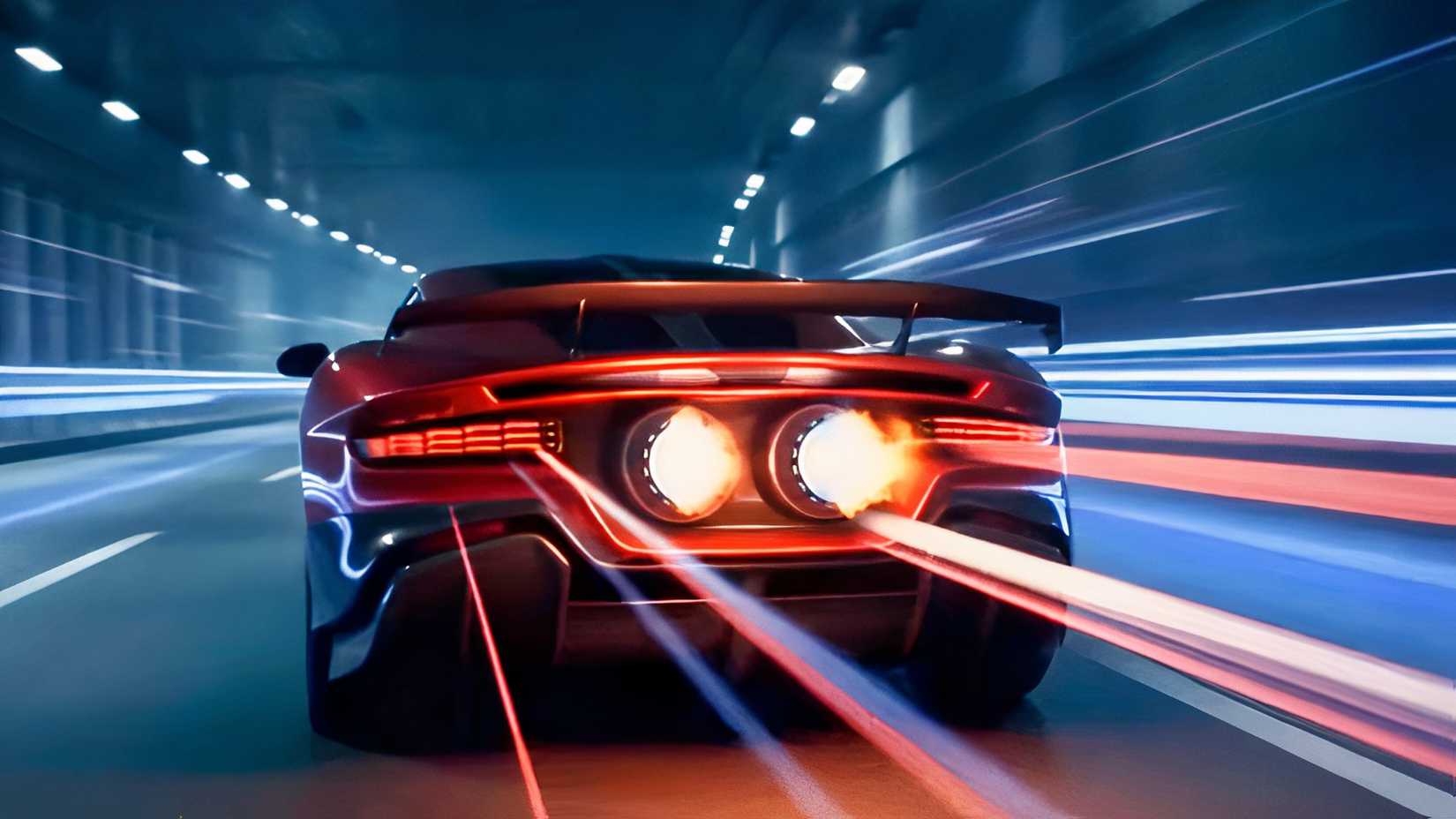
The Nebula Next 01 Jet Edition’s party trick is a pair of solid-fuel rocket boosters mounted at the rear of the car. Solid-fuel rockets — the same basic propulsion principle used in military ejection seats and space shuttle strap-ons — ignite a pre-packed propellant that burns rapidly and produces a short, violent thrust spike. They are not a sustained power source. The boosters are designed to assist launch acceleration only, delivering a concentrated burst of force during the critical first fraction of a second when traction and inertia are the limiting factors. Once the fuel is spent, the 1,876-hp electric drivetrain takes over.
It is a fundamentally different approach from anything Ferrari, Porsche, or Koenigsegg has attempted in a road car. Those manufacturers chase 0-60 times through torque vectoring, all-wheel-drive launch control, and increasingly sophisticated traction management. Dreame’s answer is: what if we just added rockets? The engineering logic is not entirely absurd — rocket-assisted takeoff has been used in aviation and military vehicles for decades. Applying it to a hypercar is the stunt part. Whether it actually works as claimed is another question entirely.
A Vacuum Brand in Hypercar Territory — And Why That’s the Story
Dreame Technology was founded in 2017 and built its reputation on cordless vacuums and robotic floor cleaners — products that compete with Dyson and Roborock in the increasingly crowded smart-home appliance space. The brand is well-funded, backed by Xiaomi’s ecosystem, and has been expanding aggressively. But nothing in that trajectory predicted a 1,876-hp EV concept with rocket boosters.
The culture-clash element is impossible to ignore. Established hypercar makers spend decades building credibility — racing heritage, engineering pedigree, decades of road-car development. Dreame is skipping that queue entirely and going straight to the most extreme spec claim in the segment’s history. Whether that reads as bold or brazen probably depends on how the car performs if it ever reaches a test track. As Car and Driver noted at the time of the reveal, the Nebula Next 01 Jet Edition is a concept, and the 0.9-second figure is an unverified manufacturer claim. No independent instrumented test has confirmed it.
Treating the 0.9-second figure as a verified benchmark would be a mistake. Concept cars routinely carry performance numbers that never survive contact with a dynamometer or a timing strip. The rocket-booster mechanism adds another layer of complexity — solid-fuel rockets are single-use, require reloading between runs, and introduce safety and regulatory questions that no road-car manufacturer has had to answer before. It is genuinely unclear how any licensing authority would classify a street vehicle with pyrotechnic propulsion.
Search
RECENT PRESS RELEASES
Related Post