A decade in the making, clean energy power line for Mass. to begin flowing this week
January 16, 2026
Support WBUR

After years of controversy and delay, a major new power line delivering climate-friendly electricity to Massachusetts is expected to get up and running Friday.
The long-awaited New England Clean Energy Connect is a 145 mile high-voltage transmission line that carries power generated by hydroelectric facilities in Quebec to the commonwealth. With a capacity of 1,200 megawatts, the line can transmit enough power to satisfy about 20% of Massachusetts’ total electricity needs. And thanks to a 20-year fixed price contract with the state’s electric utilities, it’s projected to save ratepayers $50 million a year.
“This is a dramatic change in the way that we’re going to be receiving our electricity — and it’s a good change because it’s lower cost and cleaner,” said Massachusetts Energy and Environmental Affairs Secretary Rebecca Tepper.
Putting this transmission line into service marks an important environmental milestone for the state, which is required by law to zero-out carbon emissions by mid-century. It also comes at a critical time for the region’s energy grid: For the first time in decades, electricity demand is expected to start rising this year. And offshore wind, the other large source of renewable power New England was relying on, faces an uncertain future under the Trump administration.
“ We need more energy on the grid, and it’s great that that energy can be clean energy,” said Amy Boyd Rabin, vice president of policy at the Environmental League of Massachusetts. “ It’s been over a decade in the making, so it’s really exciting to see those little clean electrons come do their thing.”
But getting to this point was far from inevitable. While many large infrastructure projects encounter setbacks and challenges, the New England Clean Energy Connect faced a particularly tumultuous path.
It began in 2016, when then-Gov. Charlie Baker signed a law authorizing Massachusetts to solicit bids for a clean energy transmission line to Quebec. The state originally chose a project that went through New Hampshire, but that effort fell apart in 2018 because of permitting delays and public outcry over the environmental impact of building a power line through undeveloped forest.
The Baker administration then shifted its sights to the New England Clean Energy Connect, directing electric utilities in the state to sign a 20-year contract with the project’s developers, Central Maine Power — a subsidiary of the energy company Avangrid— and Hydro-Québec, the main power generator and utility in Québec.
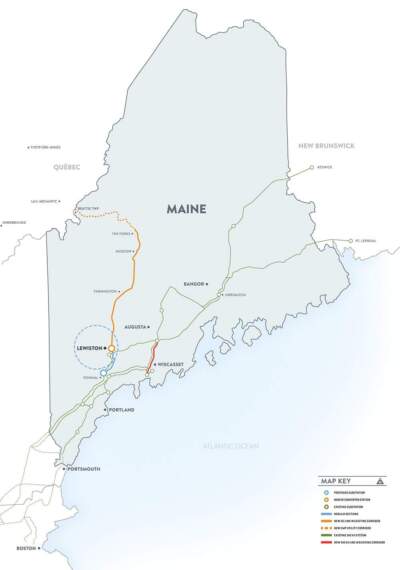
Though the project would mostly be built in existing transmission right of ways, it did require clearing a 150-foot wide corridor through 54 miles of forest in western Maine. Almost immediately, the plan encountered much of the same pushback as the New Hampshire proposal. There were lawsuits and regulatory delays, and many Maine residents questioned why their state should sacrifice pristine forest for the benefit of Massachusetts customers.
Despite promises from Avangrid that the ecological impacts of the project would be minimal, a powerful alliance of local environmentalists and fossil fuel companies — some of which stood to lose money if the power line was built — took root. This effort culminated in a 2021 ballot referendum in Maine to revoke a key permit for the project, which had already begun construction.
Advocates and opponents of the transmission line poured more than $90 million into the campaign, and in the end, nearly 60% of Maine voters rejected the project. Construction was halted, the developers sued. In April 2023, a Maine jury verdict paved the way for construction to resume.
The year-and-a-half delay caused the project’s price tag to balloon by more than $500 million dollars — an increase that Massachusetts ratepayers are on the hook to pick up. Even so, electric customers in the state are expected to come out ahead.
The projected annual savings are small — around $18-$20 per household, according to the governor’s office. But with power demand rising, the actual savings could grow over time, said Boyd Rabin of the Environmental League of Massachusetts.
Residents of Maine will also benefit from the transmission line. As part of the contract negotiations, Gov. Janet Mills arranged for Hydro-Québec to sell some discounted electricity to the state through the new transmission line. The deal is expected to save ratepayers at least at least $14 million annually. The project developers have also agreed to invest millions in residentialenergy efficiency programs, job creation, broadband internet access and conservation efforts in the state. And they’ve promised to help defray the cost of heat pumps for low-income residents, and make investments in Maine’s electrical infrastructure.
Outside of Massachusetts and Maine, electric ratepayers in other New England states should see some savings as well, said Phelps Turner, director of the Conservation Law Foundation’s Clean Grid program. That’s because bringing in relatively cheap hydroelectric power from Canada can displace the need for more expensive fossil fuel energy and help suppress the wholesale cost of electricity for everyone in the region.
The process of getting this transmission line permitted and built may have been a rollercoaster, Turner added, but putting it into service “is a significant moment for clean energy in New England. It will provide a significant amount of electricity for the region that is low cost and clean.”
Looking to the future, between the expected rise in power demand and the growth in renewable energy, like wind and solar, New England will need to build many more miles of high-voltage transmission lines. With that in mind, Boyd Rabin said there are lessons to be learned from the New England Clean Energy Connect process.
“We cannot do this as a state-by-state matter and pit states against each other,” she said. “We really need to have a regional discussion and get everybody on board from the beginning.”
Search
RECENT PRESS RELEASES
Related Post