A look at Alumni Ventures
April 24, 2026
Venture capital has long been one of the most compelling alternative asset classes.
The returns speak for themselves. Early investors in companies like Uber, Airbnb, and SpaceX earned generational wealth. Top-quartile VC funds have consistently outperformed public markets.
In recent years, individual investors have gotten significantly more access to venture.
But moreaccess doesn’t necessarily mean better access.

Today, we’re looking at a firm that’s spent the last decade developing an entirely different approach to this asset class: Alumni Ventures.
AV offers investors access to venture in a curated way. They have a team of full-time pros vetting deals and co-investing alongside brand-name VCs (including the big ones: a16z and Sequoia).
They’ve grown from a single alumni-only fund to a community of 25,000+ investors and Syndicate members – building a flywheel that leads to better deals and outcomes.
Alumni is a similar company to Alts in many ways: Strong community, a big focus on due diligence, and they enable co-investing.
But they operate solely in a space we don’t: High-growth, venture-backed startups.
In this issue, we’ll take a close look at how AV works and why their model stands out:
-
How AV’s alumni network origins gave the firm a wedge into Silicon Valley’s most competitive deals
-
How they let investors co-invest alongside leading VCs, in a fundamentally different entry point to venture,
-
How AV’s syndicate model lets investors pick individual deals with no management fees,
-
And why three major sectors – AI, defense, and global VC – make right now a particularly compelling time to consider AV.
Let’s go 👇
What is Alumni Ventures?
Before we get into the mechanics of how Alumni Ventures operates, let’s talk about the name.

When you hear “Alumni Ventures,” you might assume it’s a closed-door club for Ivy League grads.
And yes, to be fair, that’s exactly how they got started.
Breaking into competitive Silicon Valley deals isn’t easy. AV earned a seat at the table through a clever concept: tapping into deep-rooted college loyalty to access competitive venture rounds.
In AV’s early years, the company deployed this strategy through alumni-only venture funds, starting with the Dartmouth Green D fund in 2014.

Through these alumni funds, AV learned the venture space, invested alongside established players, and figured out what works and what doesn’t.
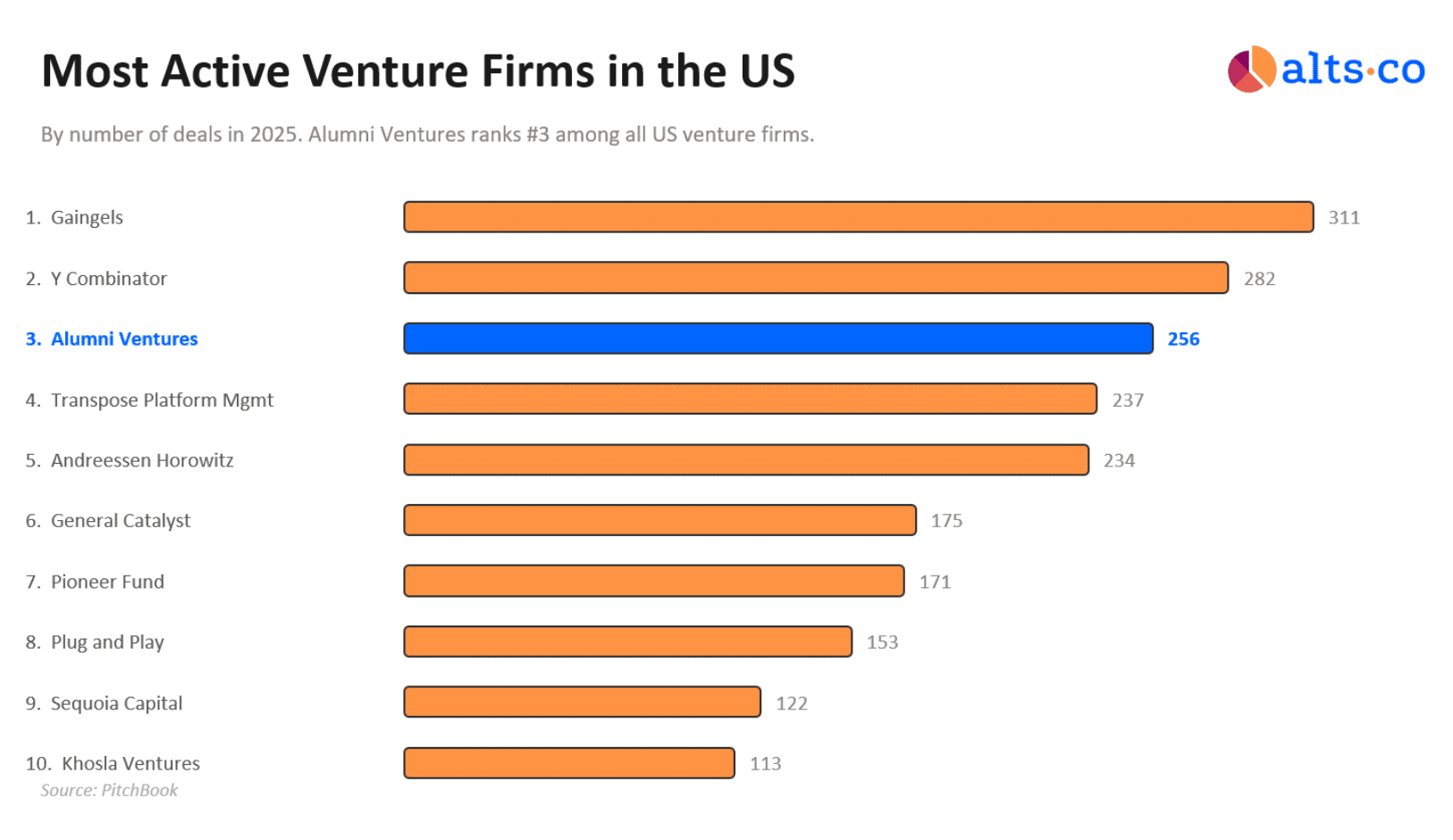
The end result: AV became a leading Silicon Valley investor in its own right. Today, they are one of the most active venture investors in the US:
-
AV has committed over $1.4 billion in capital across thousands of startup investments.
-
Their team of roughly 120 full-time employees includes about 40 dedicated venture investing professionals, each with deep expertise in specific sectors.
-
Both TIME Magazine and CB Insights recently named AV to their lists of America’s Top 20 Venture Firms. That’s big. It’s a distinction shared with names like Sequoia, Andreessen Horowitz, and Accel.
What started as a small affinity group became a massive venture network.
Today, any accredited investor can access AV’s high-quality deal flow – whether you’re a university alum or not.
What sets AV apart (three key things)
It’s no secret that venture capital has become more accessible. But most of this ‘access’ is still tied to crowdfunding platforms or open marketplaces, where deals aren’t thoroughly vetted.
That approach isn’t fundamentally wrong. These platforms have done real work to unlock capital, and that level of independence is exactly what some investors are looking for.
But AV operates a different model, one where deals are sourced and vetted by experts before ever reaching investors.
There are three key elements that set AV apart from both traditional venture firms and self-directed platforms.
1) Co-investing alongside leading VCs
AV’s investment approach centers on a unique type of investment model: co-investments.
You may be familiar with co-investments through our film financing portal.
In a venture co-investment structure, a lead sponsor (typically a major VC firm):
-
Sets the valuation
-
Negotiates the term
-
Takes a board seat, and
-
Writes the largest check.
Then, co-investors tag along to fill out the rest of the allocation.
Why does this matter? Because in venture, who else is in the deal is one of the strongest signals you can get!
When a brand-name VC leads a round, they’ve already committed their own capital and conducted extensive diligence. The partners who closed the deal also put their reputation on the line.
AV’s investors get to follow that signal; participating in the same round, at the same terms.
That’s a far cry from browsing an open marketplace and hoping you’ve found a winner. Co-investing provides institutional credibility for the deal upfront.
2) Community as a flywheel
In the firm’s early days, AV’s alumni-based model was important for getting access to venture deals.
But it also provided something arguably more valuable: the initial seed for a massive, self-reinforcing community.
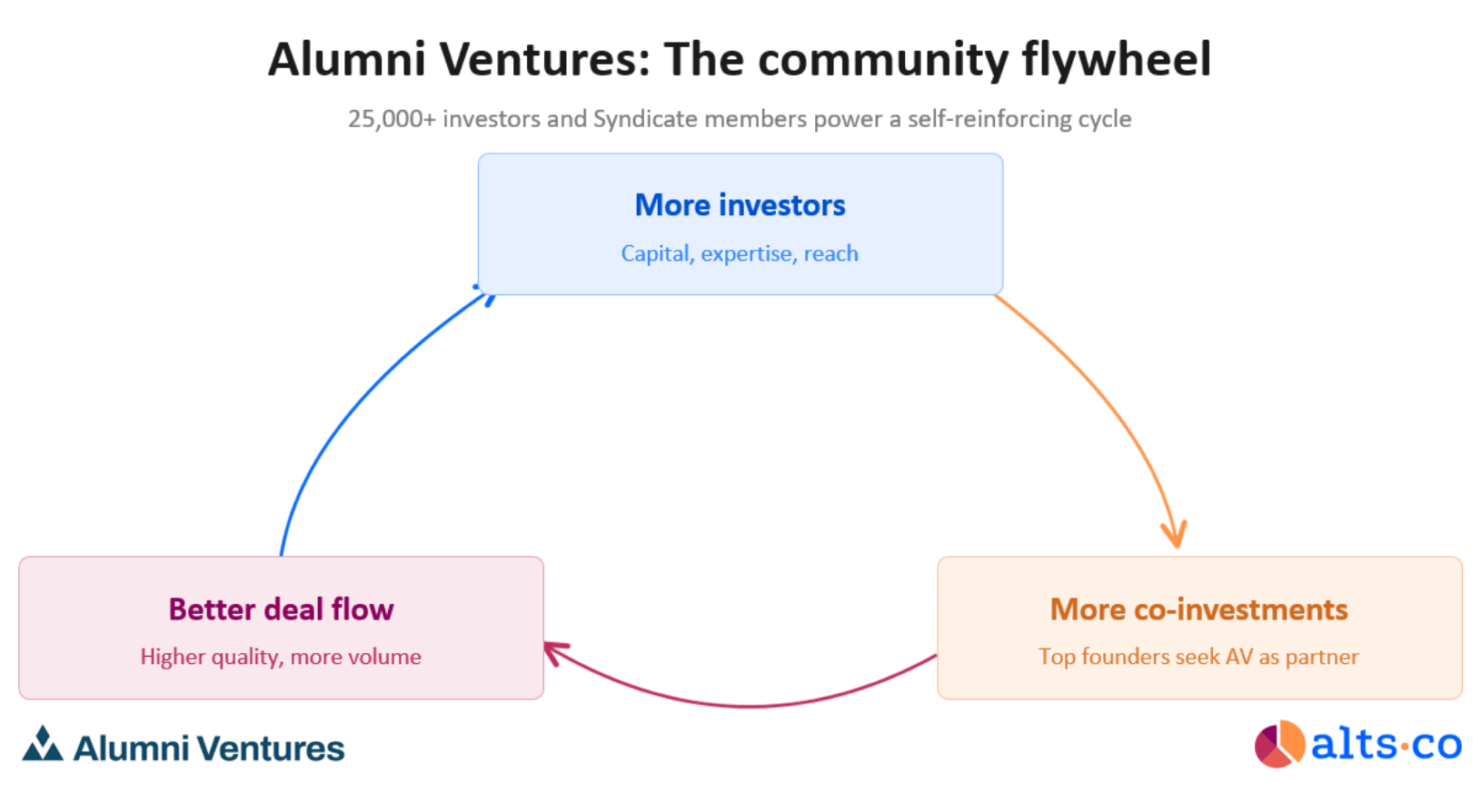
With over 25,000 individual investors and Syndicate members, AV’s network is a flywheel that’s hard to replicate.
At Alts, we can speak to the power of community firsthand.
Our Altea Community is one of the most valuable assets we’ve built. A deeply engaged group of investors creates value that goes beyond any single deal.
AV has taken that same principle and built it into the core of an industry-leading venture firm.
3) Expertise through volume
AV is one of the most active venture investors in the country.
Every year since 2018, the firm has ranked among PitchBook’s top 3 most active US VCs in terms of deal volume.
This activity isn’t just about bragging rights. AV’s volume creates expertise through pattern recognition.
When your team evaluates thousands of deals per year across AI, defense, healthtech, and space, you develop an instinct for what works.
For AV, consistently being one of the most active venture investors in the country fosters ‘learning by doing’ that compounds with every deal.
How AV syndicates work
Alumni Ventures offers investors a few different ways to participate in venture capital.
The most straightforward is through the firm’s venture funds – diversified portfolios of 20-30 startups selected by AV’s investment team.
These offer a hands-off approach to venture capital. The firm deploys it on your behalf. That can be valuable for investors who’d rather “set it and forget it.”
But AV also offers a second investment path for investors who want their own seat at the table: syndicates.
Why syndicates?
Syndicates flip the fund model on its head.
Instead of handing over your capital and trusting someone else to allocate it, you decide on each deal for yourself.
Yes, syndicates offer less upfront diversification than funds. But there are a few reasons that investors might prefer a deal-by-deal approach:
-
Portfolio strategy. Syndicate deal flow allows you to take a ‘barbell approach’ to venture: investing in both large, diversified funds as well as high-conviction investments in individual companies.
-
Control and conviction. Syndicates let you invest in the areas you know best, rather than delegating those decisions entirely. (Have you done your own research on defense tech and want to focus on drone startups? Syndicates give you that control.)
-
Education. Every syndicate deal comes with full diligence materials, investment committee call recordings, and live discussions with AV’s investment team. For investors looking to sharpen their own insights, that venture education is valuable in itself.
How AV’s syndicates work
Getting started with AV’s syndicate deals is a straightforward, four-step process:
-
Set preferences. Create a profile, verify your accredited investor status, and choose the sectors and deal stages you’re most interested in seeing.
-
Get 1-2 curated deals per month. Each comes with full diligence materials – including financials, investment committee call recordings, and AV’s proprietary research.
-
Review and decide. Evaluate each opportunity on your own terms. AV’s investment team hosts live deal discussions so you can ask questions directly. If a deal isn’t for you, pass. No obligation to invest.
-
Invest ($10k minimum). When you find a deal you like, invest.
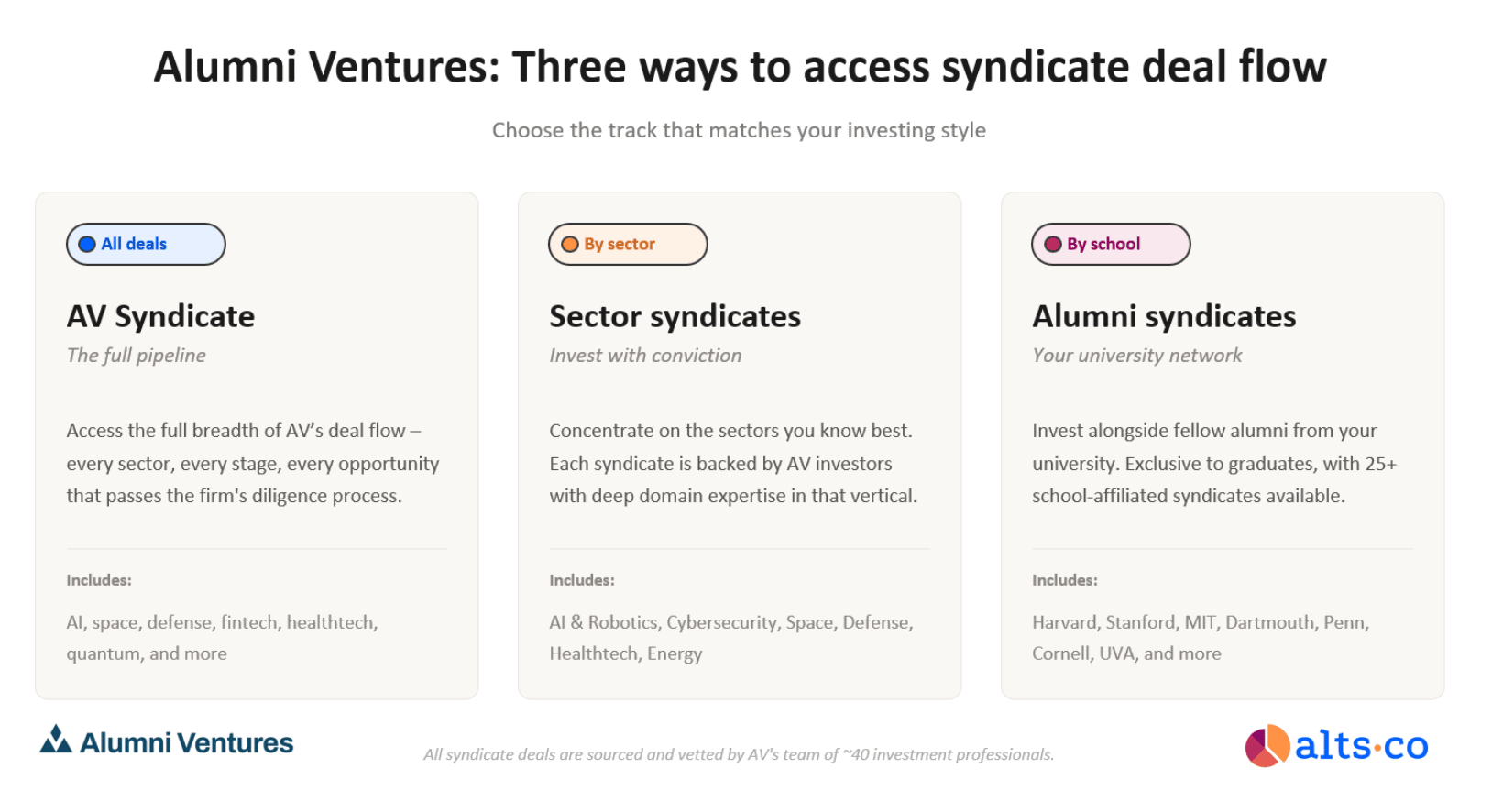
Depending on your investing style, there are a few different ways to access syndicate deal flow:
-
The AV Syndicate gives you access to the full breadth of opportunities that pass the firm’s diligence process and are added to AV’s syndicate deal flow. That means you’ll see deals across every sector and every stage.
-
Sector syndicates let you concentrate on a specific area. Options include AI & Robotics, Cybersecurity, Space, Defense, Healthtech, Energy, and more.
-
Alumni syndicates offer the chance to invest in deals alongside your university network (shout out to UVA’s Emmet Street syndicate!). In the spirit of AV’s founding model, the company has over 25 dedicated alumni syndicates.
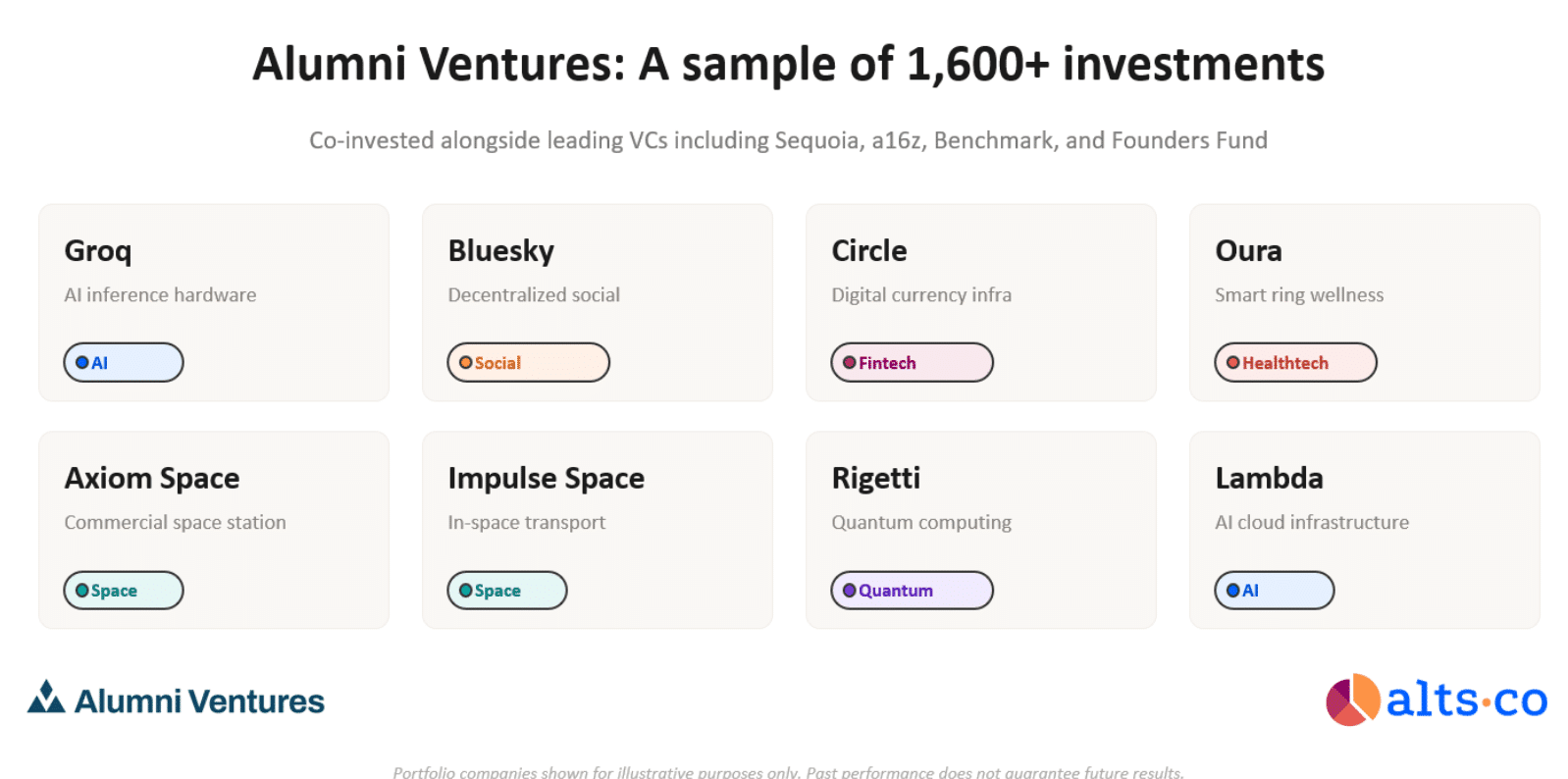
To make this more concrete, here’s a small sample of recent deals AV has offered syndicate members:
-
Axiom Space (Space) – building the world’s first commercial space station, co-invested alongside C5 Capital.
-
Lambda (AI) – GPU cloud infrastructure purpose-built for AI training, co-invested alongside Gradient Ventures.
-
Impulse Space (Space) – in-space transport with SpaceX and NASA contracts, co-invested alongside Founders Fund.
-
Rigetti (Quantum) – superconducting quantum computing circuits, co-invested alongside Andreessen Horowitz.
Each of these went through AV’s full diligence process before being presented to investors. And each was led by a brand-name institutional VC.
With AV, you’re choosing between deals already screened for quality, not trying to find a diamond in the rough.
Access AV’s syndicate deal flow →
Is now a good time to invest?
AV’s model – curated co-investments, deep sector expertise, and a community flywheel – has been in place for years.
But there’s a reason to pay especially close attention to the firm’s model right now. Three of the most capital-intensive sectors in venture are seeing a surge of opportunities – and AV is deeply active in all of them.
Artificial intelligence
AI is the most exciting area of venture right now. Last year, over half of all global venture funding went to AI firms, reaching a total of $211 billion.
But exciting doesn’t mean easy. The challenge for investors isn’t finding AI deals in general, but finding AI deals that are actually worth backing.
This sector is flooded with hype, and separating genuine plays from vaporware requires real expertise.

AV’s approach to this sector is worth noting. While the firm will invest across the AI landscape, AV tends to focus on infrastructure and tooling – the picks-and-shovels layer that powers everything else.
Portfolio companies like Groq (inference hardware) and Lambda (GPU cloud) are good examples of this thesis in action.
Defense & strategic tech
Government spending on defense technology has accelerated dramatically.
In 2024, global military expenditure saw its sharpest increase since the Cold War, followed by an additional jump in 2025. In the US, geopolitical tensions and supply chain concerns have created a wave of demand for next-gen defense startups.
AV has been one of the most active investors in this space, with a dedicated Strategic Tech Fund and syndicate. The firm was also recognized as a top national security VC on Silicon Valley Defense Group’s NATSEC100 list (alongside firms like IQT).
This is a sector where curated access matters more than usual.
Defense deals often move quickly, involve sensitive technology, and require domain knowledge to evaluate. That’s why it’s important to work with a team that already has relationships with the right founders and lead VCs.
Non-US ventures
Finally, there’s a growing recognition that the best venture deals aren’t always in Silicon Valley anymore.
Twenty years ago, nearly 80% of all VC dollars were invested in US-based companies. Today, that figure is closer to 57% – and falling.
AV has positioned itself to capture this trend with a dedicated Non-US Ventures syndicate. The company also has an international presence that includes offices in London and Tokyo.
For US-based investors, getting access to quality international deals can be even harder than accessing domestic ones. The information asymmetry is greater, the networks are less familiar, and the diligence requirements are different.
Working with a firm like AV – with boots on the ground and an international deal pipeline – solves a genuine access problem.
Closing thoughts: Tilting the odds
Throughout this piece, we’ve looked at why Alumni Ventures’ curated approach stands out.
Still, this curation doesn’t eliminate the fundamental risks of the asset class.
Venture investing is governed by the power law: most startups fail, returns are concentrated in a small number of winners, and capital can be locked up for years.
Ultimately, no amount of due diligence can guarantee a winner. But curation fundamentally changes the portfolio math.
If 90% of startups fail, you should expect to find a single winner every 10 investments. Reduce that to 80% through better vetting, and the number drops to 5 investments – doubling your odds with the same capital.
Having a team of investment professionals vetting deals, co-investing alongside the world’s top VCs, and providing full transparency into every opportunity doesn’t ‘solve’ venture investing – but it does offer a meaningfully different entry point to the asset class.
Accredited investors are eligible to invest
That’s it for today.
As always you can find me in the Community.
Until next time Brian

Disclosures
-
This issue was written by Brian Flaherty, and edited by Stefan von Imhof
-
The AV team was able to review an early draft of this article. Brian and Stefan made final editorial decisions.
-
Alt Assets, Inc has no holdings in Alumni Ventures or any companies mentioned in this issue
Disclaimer from Alumni Ventures
This communication is not an offer to sell, or a solicitation of an offer to purchase, any security. Such offers are made only pursuant to formal offering documents, which describe the risks (which are significant), terms, and other important information that must be considered before an investment is made. Venture capital investing involves substantial risk, including risk of loss of loss of all capital invested. Example investments and co-investors are provided for illustrative purposes only, are not necessarily indicative of all AV investments or co-investors, and do not guarantee future investments or co-investors will be comparable to the examples provided. Alumni Ventures paid cash compensation for the placement of this article.
Disclaimer from Alts
This issue is a sponsored deep dive, meaning Alts has been paid to write an independent analysis of AV. AV has agreed to offer a deep look at its business, offerings, and operations. AV is also a sponsor of Alts, but our research is neutral and unbiased. This should not be considered financial, legal, tax, or investment advice, but rather an independent analysis to help readers make their own investment decisions. All opinions expressed here are ours, and ours alone. We hope you find it informative and fair.
Search
RECENT PRESS RELEASES
Related Post