Acadia Center responds to severe clean energy rollbacks in Governor McKee’s proposed FY202
February 4, 2026
“The Governor’s budget proposal locks Rhode Island into an outdated energy system and strips us of our most potent tools to address skyrocketing energy costs,” said the Acadia Center’s Emily Koo.
From an Acadia Center press release:
On January 15, 2026, the Administration of Rhode Island Governor Daniel McKee released its proposed Fiscal Year 2027 budget for the State of Rhode Island, including sweeping rollbacks of foundational clean energy and climate policies that have made Rhode Island a leader. states historically. Now, Rhode Island is at risk of moving from leader to laggard by succumbing to the faulty, short-sighted logic of energy austerity – cutting critical programs and policies in the name of energy affordability, when in fact those very programs represent some of the most potent tools for the state to take control of its energy future and keep near- and long-term system costs manageable.
“To tackle energy costs, Rhode Island must do everything within its power to bring more local clean energy online and build a stable energy future,” said Emily Koo, Rhode Island Program Director at Acadia Center. “The Governor’s budget proposal locks Rhode Island into an outdated energy system and strips us of our most potent tools to address skyrocketing energy costs.”
At a moment when federal clean energy support is eroding, Rhode Island should be doubling down on the tools still firmly within the state’s control. Instead, Governor McKee’s FY 2027 budget sadly mirrors the short-sighted policies of the Trump Administration, cutting renewables and energy efficiency and delivering what would be a major blow to Rhode Island’s clean energy economy. The Governor’s budget proposal disregards a primary reason for the clean energy transition: to shield residents from volatile gas prices and keep at least $2.7 billion per year in fossil fuel spending in the local economy rather than sending it out of state.1
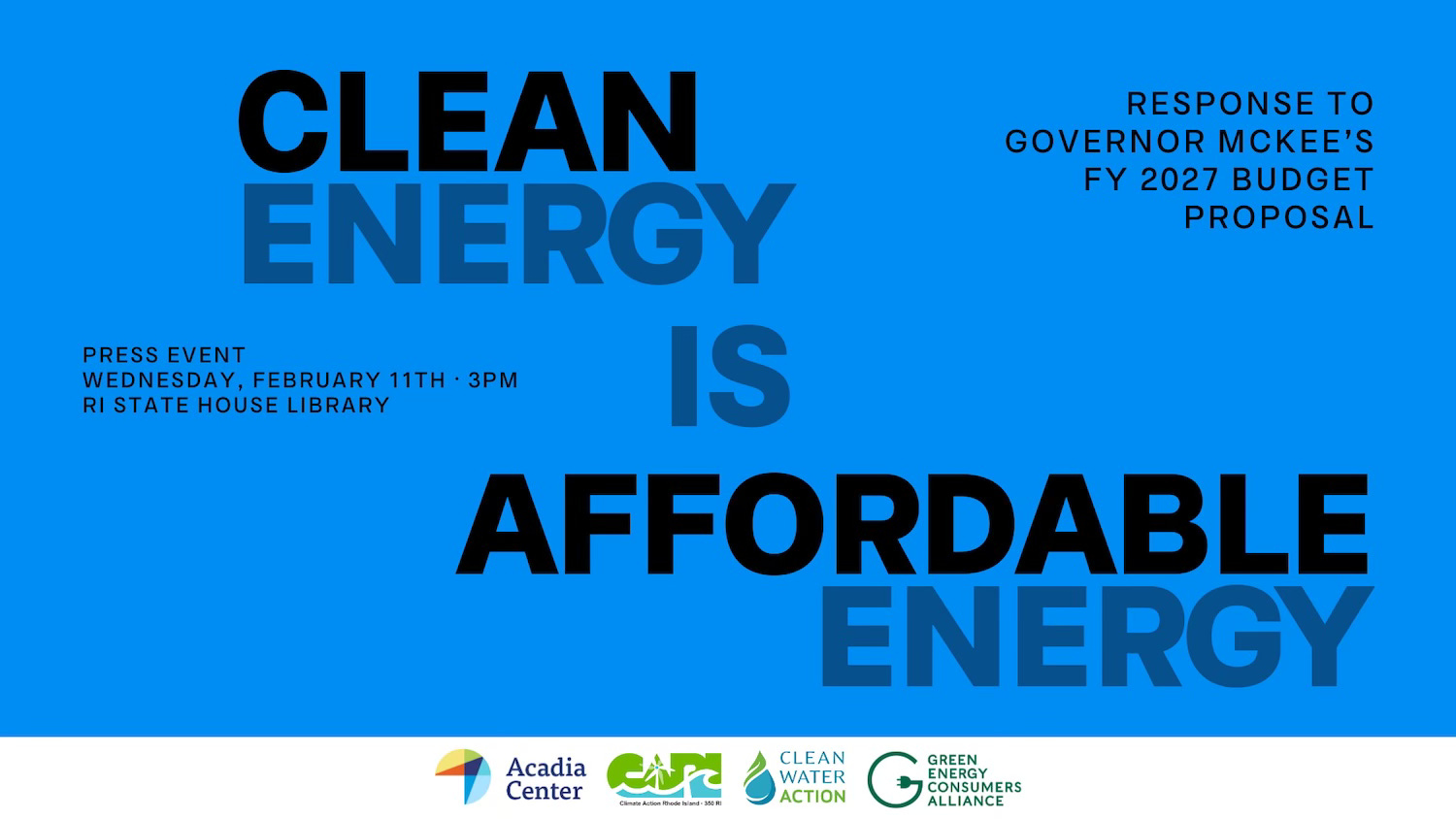
Acadia Center will be joining clean energy advocates for a press event in response to Governor McKee’s FY 2027 budget proposal on Wednesday, February 11, at 3 pm in the Rhode Island State House Library. Members of the media, legislature, and broader public are invited to attend. More information about the event, “Clean Energy is Affordable Energy”, is located here.
The FY 2027 McKee budget includes the following misguided provisions, which should be opposed and modified by legislators and stakeholders:
-
Levies a substantial and punitive “grid access fee” (monthly, in perpetuity) and lowers compensation rates for large renewable energy projects (1 MW or greater), signaling that Rhode Island is closed for clean energy business. The retroactive nature of the changes (on both existing and new net metering systems) would have a severe chilling effect on the industry at large, implying that Rhode Island’s public policies are not predictable or reliable enough to earn investor confidence.
-
Solar developers are required to pay for infrastructure upgrades and to finance them under the laws in effect at the time of interconnection. Solar industry leaders are concerned this provision will drive Rhode Island’s solar industry out of the state.
-
A range of virtual net metering customers, including municipalities, housing authorities, colleges and universities, and hospitals, would lose substantial value in pre-negotiated discounted electricity.
-
There are sound, data-driven ways to reform incentive and compensation structures over time, but this proposal takes a cudgel to foundational programs. Instead, a thorough, methodical, and stakeholder-informed process before the Public Utilities Commission (PUC) should determine how Rhode Island’s renewable policies can and should evolve to serve ratepayer interests best and preserve a stable project investment environment to attract new clean power to the state.
-
-
Delays and weakens Rhode Island’s nation-leading Renewable Energy Standard (RES), prolonging our dependence on dirty, expensive fossil fuels.
-
The rapidly transitioning electricity sector has been a linchpin to achieving the state’s emission reduction mandates. Unlike the transportation and heating sectors, the electricity sector – driven by RES and accompanying procurement efforts – has largely remained on track.
-
Delaying the 100% RES from 2033 to 2050 will prolong the state’s exposure to costly, volatile natural gas, defer and divert major job creation opportunities, and jeopardize Rhode Island’s ability to meet its economy-wide emission reduction targets.
-
Rhode Island can meet the existing RES target, including through joint procurement of affordable clean energy. Rhode Island was notably absent from a recent multi-state procurement of 173 MW of new solar generation (CT, ME, MA, VT).2
-
-
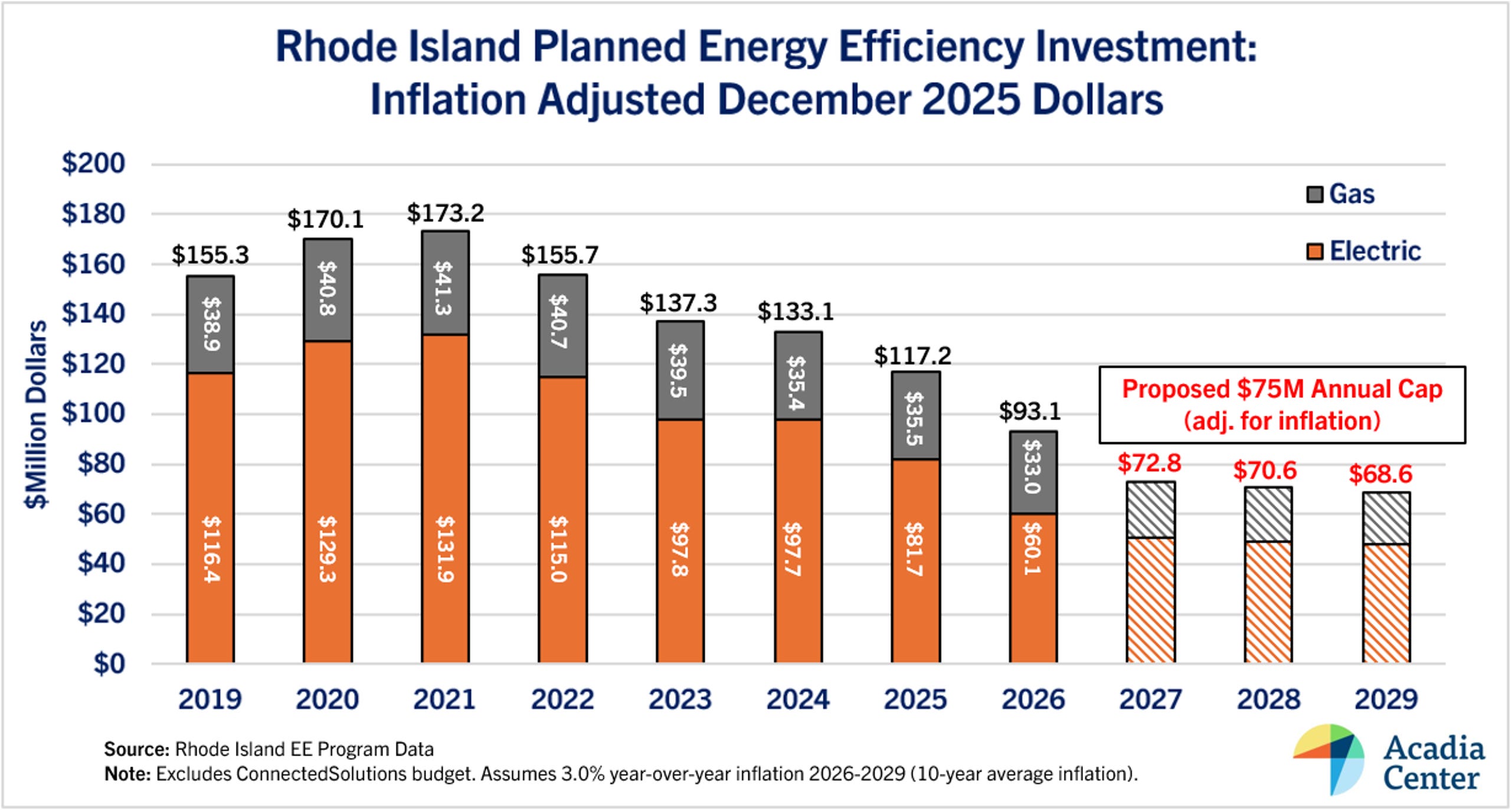
Caps Rhode Island’s cost-effective energy efficiency programs at $75 million per year – a stunning 24% below planned 2026 investment levels and 48% below the average of the past five years (both adjusted for inflation).
-
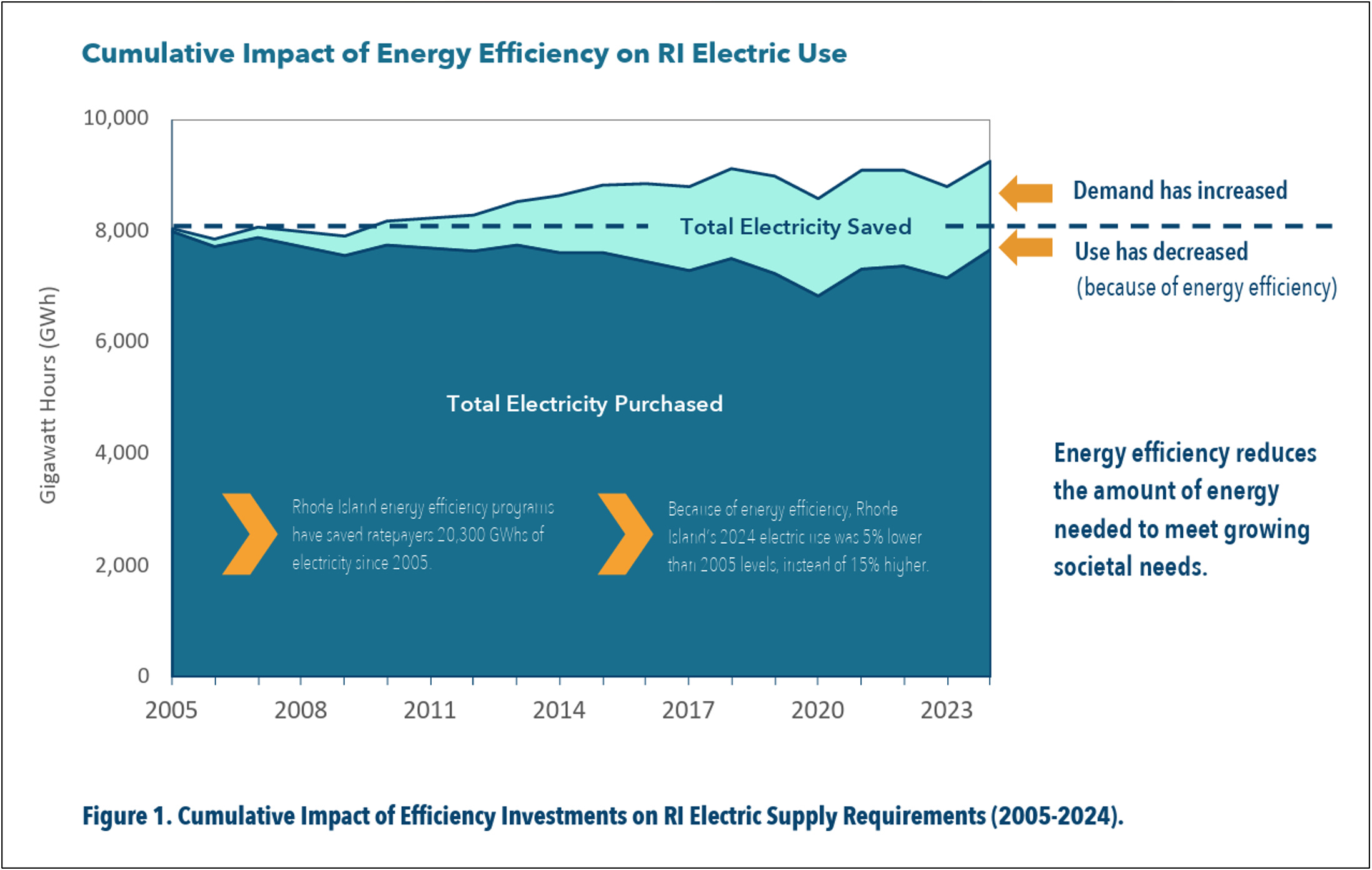
Because of ratepayer-funded energy efficiency, Rhode Island’s electric load is 5% lower than it was in 2005, rather than 15% higher.3
-
In addition to directly lowering energy bills, energy efficiency is one of the most cost-effective ways to reduce energy costs for all consumers, support the local economy, and combat climate change.4
-
In the 2026 program cycle, Acadia Center highlighted the compounding costs of reduced investments in energy efficiency, which will lead to significant reductions in a wide range of benefits, energy savings, and jobs.5 Indeed, the significant drop-off in annual efficiency investments (shown below) during a period of high inflation suggests that budget cuts to date have contributed to rising energy bills for ratepayers.
-
The budget’s proposed bond for energy efficiency is neither a reliable nor consistent source of funding, nor is it close to the amount needed to restore funding levels.
-
In addition, the Governor’s budget proposal:
-
Slashes support for municipalities, businesses, and residents to access financial and technical assistance for clean energy projects, including energy efficiency, solar, and electric vehicles.
Cutting clean energy doesn’t protect ratepayers; it protects an outdated energy system and keeps us dependent on dirty, expensive fossil fuels.
Undoing the baseline of the 2025 Climate Strategy before it begins:
The Executive Climate Change Coordinating Council (EC4)’s 2025 Climate Action Strategy is built on a clear baseline of existing policies, including the 100% Renewable Energy Standard (RES) by 2033 and state energy-efficiency and renewable-energy programs. Yet the Governor’s proposed budget would dismantle these policies, undermining the foundation of the state’s recently released climate strategy before it can be implemented.
Eliminating these core electric-sector strategies would force Rhode Island to rely more heavily on transportation and building emissions reductions – sectors already facing significant uncertainty. Scaling those strategies fast enough to meet the 2030 climate targets in just four years would be extraordinarily difficult, if not impossible. Rather than advancing solutions, the Governor’s budget proposal rolls back the baseline assumptions on which the climate strategy depends.
Clean energy is stable, affordable energy:
In simplest terms, some components of the energy transition will cost money (e.g., electric generation buildout) and some will save money and increase in-region economic activity (e.g., reduced reliance on fossil fuel imports for heating and transportation). It is a glaring omission to report clean energy costs while ignoring the cost savings, one of the primary reasons for undertaking the energy transition in the first place. Cutting clean energy is not fiscal prudence – it is a costly step backward.
-
Renewables in our regional grid – such as offshore wind, large-scale solar, and batteries – lower wholesale electricity prices for everyone.6,7
-
Energy efficiency, behind-the-meter solar, and storage reduce how much power we need during expensive peak hours. Lower overall and peak demand means less exposure to volatile gas prices, less strain on the grid, and fewer costly infrastructure upgrades. This helps reduce the largest (and growing) components of energy bills: supply costs and delivery costs.8,9
-
Delaying Rhode Island’s nation-leading Renewable Energy Standard (RES) will prolong and worsen the state’s exposure to and overreliance on natural gas, sending Rhode Islanders’ hard-earned dollars out of the state and regional economy.
-
States with higher renewable energy penetration have experienced smaller electricity price increases. States that invested early and heavily in wind, solar, and storage have had slower electricity price growth over the past 20 years. States that rely heavily on natural gas for power generation, particularly in the Northeast, have higher electricity prices.10
-
Renewable energy costs have fallen dramatically – and gas costs are going up.11
-
Solar and storage are among the fastest and most cost-effective ways to add new power.12 As electricity demand rises from electrification and AI-driven growth, Rhode Island cannot afford to sideline the very resources that can be built quickly and locally and will deliver inexpensive energy.
Renewables and efficiency reduce supply and delivery costs, helping hedge against volatile gas price spikes and rein in transmission and distribution costs.
Solutions to tackle energy costs
Cutting renewables and energy efficiency is not the answer to Rhode Island’s rising energy costs. Governor McKee and the General Assembly have a unique opportunity to meet the moment and stand up to Trump by asserting Rhode Island’s commitment to clean energy. There is much within Rhode Island’s state powers, short of slashing the state’s renewable energy targets and rolling back renewable and energy efficiency programs.
Reduce dependence on volatile gas supply to help stabilize energy bills
-
In addition to fighting the Trump administration’s obstruction of offshore wind, Rhode Island has significant control and should do everything within its power to bring more local clean energy online. A more balanced generation mix will reduce exposure to fuel price volatility and spread risk across more hours, decreasing prices.13,14
-
Move away from gas supply expansion as a cost-control strategy. Gas supply has increased in the region, but prices remain high and are expected to continue increasing due to global LNG markets.15
-
The U.S. Energy Information Administration (EIA) expects gas prices to increase 33% or more in 2026.
-
Leverage municipal aggregation to secure more stable and transparent energy pricing than third-party suppliers.
-
Invest in statewide virtual power plants to unlock additional demand response that can be called upon to reduce load during grid stress, lowering prices for everyone.
-
Coordinate with neighboring states to unlock the most affordable clean energy resources through, for example, joint supply procurements.
-
Increase regional and inter-regional transmission capacity so power can move more easily from where it’s generated to where it’s needed – lowering supply costs and improving reliability.
Rein in rising transmission and distribution costs
-
Enable state siting boards to add scrutiny and suggest cost-saving measures of transmission upgrades and construction.
-
Expand stakeholder participation in regulatory proceedings.
-
Provide intervenor compensation to enable organizations or affected individuals to hire experts and challenge Rhode Island Energy’s assumptions.
-
-
Limit categories of spending a large investor-owned utility may recover from ratepayers, such as lobbying or charitable spending; cap the allowable increase in annual spending on Infrastructure, Safety, and Reliability proceedings.
For more information on energy cost drivers in the Northeast, visit Acadia Center’s website here.
About Acadia Center
Acadia Center is a nonprofit organization with over 25 years of experience, dedicated to advancing transformative clean energy solutions that promote a livable climate and a more equitable economy at the state, regional, and community levels, primarily in the Northeast U.S. and eastern Canada. Through rigorous data analysis and strategic partnerships, Acadia Center advocates for policies that significantly reduce carbon emissions and address systemic energy challenges. By collaborating with stakeholders across government, business, and communities, Acadia Center pursues ambitious yet pragmatic strategies to help ensure an inclusive and sustainable energy future for all.
Search
RECENT PRESS RELEASES
Related Post