Amazon Is Using AI to Disempower Workers. The US Labor Movement Must Fight Back.
June 6, 2026
Beginning June 7, the AFL-CIO quadrennial convention gathers in Minneapolis with the stated aim of organizing “in unity and clarity of purpose to empower working people.”
That clarity of purpose ought to include a real commitment to take on the biggest and most important organizing challenge that unions face in this era — Amazon.
Thus far, notwithstanding some inspiring individual sites of struggle, the U.S. labor movement has failed to get Amazon to the bargaining table.
Nationally, union density last year was a measly 10 percent, continuing a historic decline, and that’s not even counting the members lost when Trump ripped up union contracts covering nearly a million federal workers.
That leaves tens of millions of workers to organize, but none are more crucial than the 1.5 million workers and contractors at Amazon.
Ninety years ago, General Motors was capitalism’s trailblazer, emulated by other industrialists seeking to hone productive efficiency, worker exploitation, and profit extraction. GM workers organizing under the CIO banner and resourced by unions that stood to gain no new members themselves from the project — like the United Mine Workers — pushed back against that exploitation, struck, and won new standards. They heralded in a period of mass organizing, the modern heyday of labor’s power.
Amazon is today’s General Motors. What happens to Amazon workers — good or bad — will happen to workers everywhere.
Amazon is a test bed for the future of work for all of us. Employers everywhere are seeking to imitate the behemoth’s labor model of exploitation, job instability, and — terrifyingly — the deployment of AI technologies to discipline and disempower workers.
Amazon is perfecting contracting out, just-in-time labor, and speedups. Its 250,000-plus U.S. drivers are all contracted out, either to a host of small businesses called delivery service partners (DSPs), or hired as independent contractors. That way Amazon can deny responsibility when drivers get injured, ask for more money, or try to unionize. Warehouses operate on a lean-labor model. Normal full-time warehouse schedules are four consecutive 10-hour shifts, but Amazon often cuts workers’ hours any time production slows, even in the middle of a shift, wreaking havoc on already tight family budgets. Then, between Thanksgiving and Christmas, Amazon imposes mandatory overtime — an extra hour a day, plus an additional required workday every week — bringing the workweek to a brutal 55 hours and disregarding the effects on workers’ personal and family lives.
Amazon is today’s General Motors. What happens to Amazon workers — good or bad — will happen to workers everywhere.
Through its aggressive introduction of robots — now over 1 million — Amazon is replacing workers and forcing those remaining to work faster. It’s no wonder that Amazon workers get hurt on the job so often, and that the company’s serious injury rate is nearly double the rate of its warehouse industry peers.
Then there is AI. I know a bit about this directly, as I’ve worked for the last year and a half as a part-time Amazon delivery driver. The delivery service partner I work for is a fair employer, but it is not the problem; Amazon is, because while drivers technically are not employed by the company, we all are subject to its tracking and oversight.
When I’m in the Amazon truck, every movement I make is tracked with technology and evaluated by AI programs — where I am, which packages I’ve delivered, and whether it’s keeping pace with the algorithm that Amazon has determined I must meet. Readouts at the end of every shift show how each of my deliveries compared to the timing prescribed by Amazon’s algorithmic standard. We are evaluated every week on whether we took accurate photos on delivery, delivered the packages exactly where the customer requested, and got good or bad customer feedback. Through the system, drivers who don’t “make rate” or who don’t meet Amazon’s prescribed standards don’t stay employed.
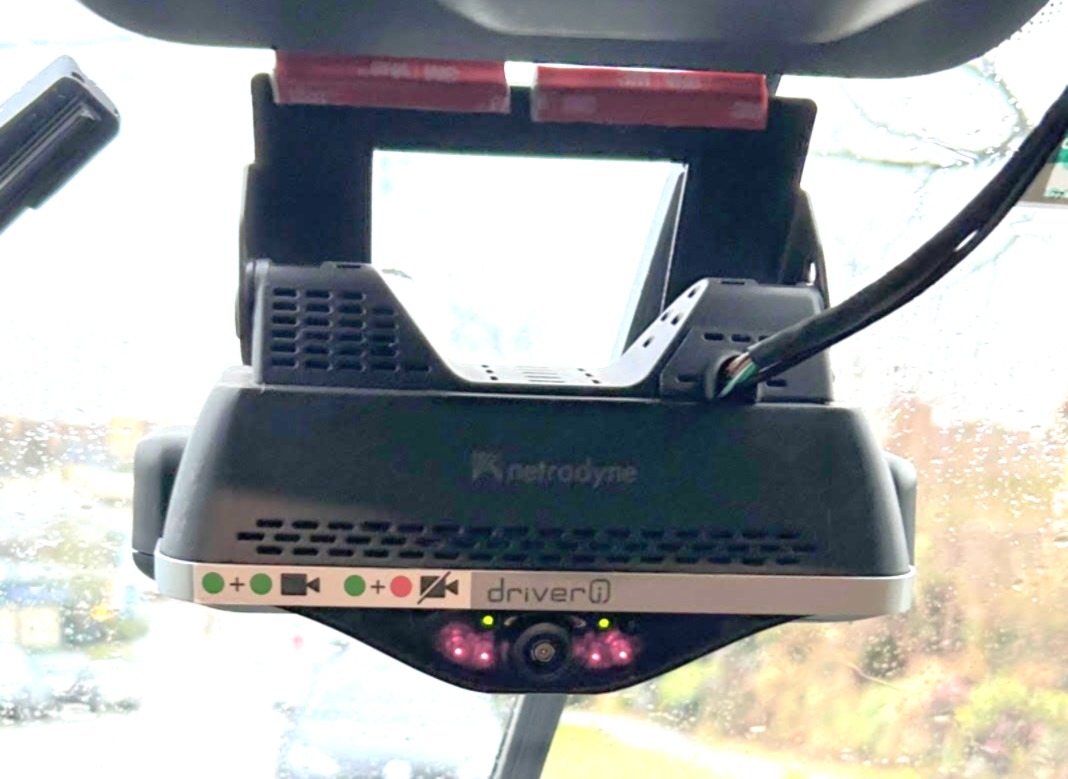
What’s enabling this level of oversight? Big Brother: the “NetradyneDriver•i,” your ride-along buddy in the van. Camera lenses point in all directions, continually measuring your speed and distance. Netradyne also tracks whether or not you are making a complete stop at every stop sign, using your turn signal, avoiding lane drift, braking, accelerating, or cornering too fast. It watches your eye orientation and movement. Whether you yawn. If you look away from the road for too long. All of these data points are ingested into an AI system where technology, not a person, is evaluating your behavior every second. Netradyne boasts about this as “physical AI deployed at scale.”
Employers everywhere are seeking to imitate the behemoth’s labor model of exploitation, job instability, and — terrifyingly — the deployment of AI technologies to discipline and disempower workers.
In Reddit chat groups, Amazon drivers around the country now report being fired not by a human, but by AI.
For warehouse workers, Amazon has harnessed the same surveillance technology to make sure that workers’ pick, pack, and sort rates meet its algorithmically determined standards, that their scans are perfect, and that they’re minimizing “time off task” — like going to the bathroom. Everything is measured and tracked. And if you don’t “make rate,” then first you get counseled, then disciplined, then fired.
In many warehouses, Amazon utilizes security officers and local police to enforce “an organizational culture of near-carceral obedience — what amounts to a ‘militarization’ of human resource functions,” a recent academic report found. “It feels like we’re coming into prison, and they’re trying to make sure we don’t escape,” the report quotes one worker as saying.
This workplace dystopia is being perfected at Amazon, then exported to other employers — in factories, grocery stores, hospitals, restaurants, hotels, construction sites, laboratories, and offices.
This is the bleak future we are handing to our children — unless we organize Amazon at scale and fight back.
Amazon is not just a problem for those of us in the logistics industry. From a humble online book seller, Amazon has transformed in a generation to disrupt other industries. Its avariciousness is only growing. Amazon today operates 532 Whole Foods grocery stores and is rapidly building out its grocery delivery network. This is the next major industry that the company intends to upend.
Through Amazon Web Services, the company is now a dominant global provider of computing power, storage, networking, analytics, and security. Amazon makes its own Trainium AI chips, directly competing with Nvidia. Amazon produces and distributes film and television shows through its Amazon MGM Studios. Amazon founder Jeff Bezos owns the Washington Post. Amazon One Medical is a primary care health service with online and clinic care, and it’s moving aggressively into the prescription drug market with Amazon Pharmacy. Through its Ring subsidiary, Amazon today dominates the home security market, and it provides other leading consumer electronics such as Alexa and Kindle.
Can a company that big and expansive, a behemoth with nearly $3 trillion in market valuation, be beaten?
Yes, it can. But as a report published on June 4 emphasizes, it will take a herculean, all-in effort by the entire U.S. labor movement to beat back Amazon — not just the valiant but fragmented efforts we have seen thus far.
In Reddit chat groups, Amazon drivers around the country now report being fired not by a human, but by AI.
The report, Renewing Labor and Winning at Amazon, which I coauthored along with Michael McQuarrie and Benjamin Y. Fong, and which was published by the Center for Work and Democracy at Arizona State University, documents how in contrast to the 1930s, when CIO organizers were able to throttle production by striking at a few key production sites, the Amazon organizing project must aim wider. With a network of hundreds of warehouses, sort centers, and air cargo facilities, “the company has the agility to redirect package flow to other facilities, keeping the supply chain intact” and render single-site strikes largely irrelevant, the report notes, concluding that “today’s labor strategists need to recognize that in order to be successful, organizing must disrupt Amazon’s supply chain flow.”
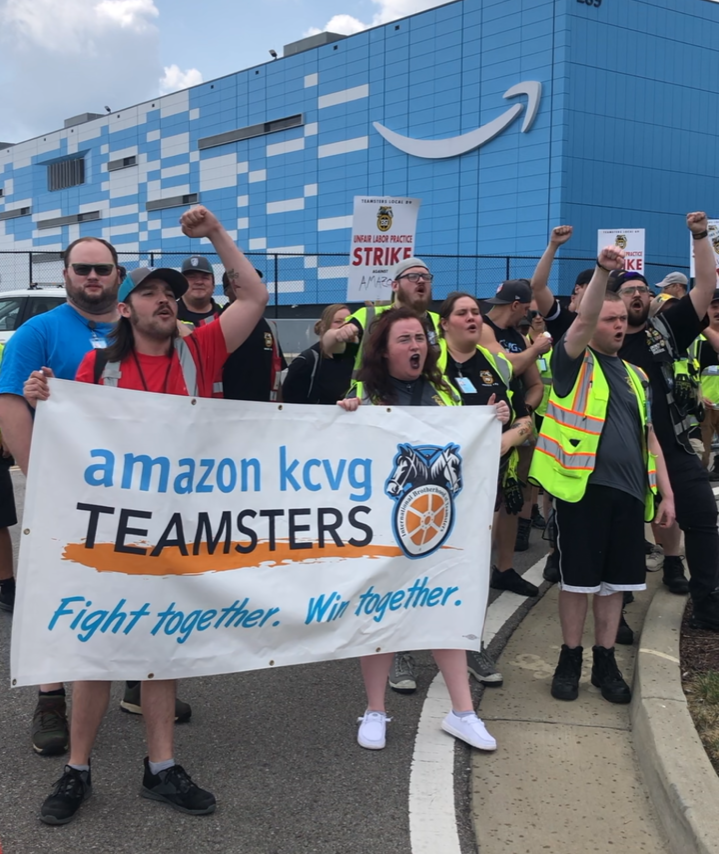
That means organizing throughout entire regions or sections of the company’s supply chain. The report highlights two strategic regions in particular. The first is centered in the Los Angeles area and the Inland Empire just east of the Ports of Los Angeles and Long Beach, where most of Amazon’s imported goods flow before being disbursed to warehouses nationally. The second comprises the Northeast region, which is home to a huge concentration of Amazon customers. The Teamsters union already is organizing in both of those regions, where workers doggedly have been taking on the company. But the scale of organizing to date is not equal to the challenge. In the company’s massive JFK8 warehouse on Staten Island, the Amazon Labor Union, now part of the Teamsters, won a historic union representation vote in 2022. Four years on, notwithstanding persistent worker organizing, Amazon has yet to agree to recognize the union and bargain.
Hundreds of inside organizers — political activists who have taken jobs at Amazon to “salt,” or organize from within — have developed sophistication in organizing at Amazon in recent years, and must play an important role in any national campaign. The same is true for existing logistics, grocery, health care, and other union members. “UPS and DHL Teamster members have been especially effective organizers, sharing with Amazon workers a common language and common concerns about the supply chain work process, speedups, technology, and the problems posed by management,” the Renewing Labor and Winning at Amazon report notes. “They, along with union members in other sectors, can easily point to wins they have achieved through collective bargaining and striking that differentiate their working conditions dramatically from those of the Amazon workers.”
While organizing must be centered in the warehouses and geared toward building mass strike actions, the labor movement must envision — and fund — an all-encompassing campaign that draws in the public, other businesses, governments, and regulators. That’s because Amazon’s impact goes far beyond the workplace, and it will take pressure both inside Amazon’s supply chain and throughout society to force the company to deal with unions.
Tens of thousands of Amazon trucks pollute the air, harm public health, and degrade public roadways, and the tax breaks demanded routinely by Amazon starve local governments of the resources needed to provide public services.
“Communities in warehouse concentration areas, such as California’s Inland Empire, are ripe sites for uniting workers and community members in common campaigns against both exploitation in the warehouse and also against the externalized burdens that Amazon imposes on the community at large,” the report notes.
Amazon utilizes security officers and local police to enforce “an organizational culture of near-carceral obedience — what amounts to a ‘militarization’ of human resource functions.”
Because the National Labor Relations Board is not an effective pathway to force Amazon to bargain, unions must advance state and local ballot initiatives to advance key worker and community demands. This is not a novel concept. Fifteen years ago, the Fight for $15 drew on the power of ballot initiatives to win raises for millions of workers. Some went on to build unions in their workplaces. Today, the call could be “Fight for $30,” a number frequently cited by Amazon workers as the bare minimum they need to survive.
Initiatives also could set safety standards for workers, ban the contracting-out of Amazon delivery drivers, and restrict data center siting.
Another initiative idea involves taxing robots. This would replenish revenue that governments lose when Amazon swaps out humans — who pay payroll taxes and who also contribute to sales tax revenue when they spend money in the community — with robots, who do neither of those things. Initiatives could also require Amazon to pay into a publicly controlled affordable housing fund to offset the destruction of housing that warehouse expansion causes. Or they could require Amazon to pay for health clinics and air cleanup, to compensate for the pollution that is caused by the daily movement of Amazon trucks and train cars.
These and other initiative ideas disrupt Amazon’s business model of exploitation and can be powerful mechanisms for drawing workers and community members together in common cause and in the ultimate demand for union recognition and contracts.
In some cases, ventures that challenge Amazon’s business model can be run as legislative campaigns instead of initiatives. In New York City, a coalition of union members and community activists is pressing City Council to pass the Delivery Protection Act, which would require Amazon to hire drivers directly and improve safety standards. That’s a good start. Now imagine Delivery Protection Act campaigns being waged simultaneously in 20 cities.
Unions also should exploit frustration that third-party vendors and sellers have with Amazon. Individuals and small businesses trying to sell their products on the Amazon platform find their margins squeezed by the behemoth. Some companies have accused Amazon of stealing their ideas and then launching competitor products. Vendors like the DSPs are continually on tenterhooks, their contracts with Amazon subject to cancellation with almost no notice. A creative Amazon campaign can find common cause with these unlikely forces by launching local and state fights to rein in the behemoth’s power against individual sellers and small businesses.
Amazon “has a corporate dynamism and infrastructural flexibility unmatched by any other contemporary company,” the report notes. “But sheer size and wealth does not make it invincible. Indeed, the speed and complexity of Amazon’s supply chain make it a vulnerable organizing target as well as a challenging one. A well-resourced and multi-dimensional campaign can secure union recognition and contracts at Amazon.”
What constitutes a “well-resourced” campaign? Unions currently spend in aggregate about $10 million a year on Amazon organizing, with the lion’s share of that coming from the Teamsters. That is simply not enough to beat a company with 1,500 U.S. worksites and more than $120 billion cash on hand. To organize 80,000 workers in LA, or 100,000 on the east coast, or 50,000 in Florida, or the tens of thousands in other regions, I think we will need at least $100 million annually for at least a decade to fund thousands of organizers, both inside and outside Amazon facilities, along with a robust campaign infrastructure to build a new CIO-style industrial organizing movement.
That may seem like a lot of money, but consider that the U.S. labor movement assets today are around $35 billion, a 225 percent increase in the last 15 years, and that U.S. labor leaders spent more than $400 million on the failed Biden-Harris candidacy.
Collectively within labor, the resources are there to mount a serious Amazon campaign. Whether or not to take on the fight is a political choice.
This can’t be a fight taken on by just a handful of unions. It must be an all-in effort. Some 90 years ago, leaders in the United Mine Workers and other unions made a pact to organize workers in the auto, steel, electrical, and rubber industries, because they knew that without mass organizing, the entire working class was in jeopardy. This weekend, as AFL-CIO leaders meet in Minneapolis, unions stand at the same parlous crossroads. Let’s hope they make the right choice that their predecessors did 90 years ago.
Truthout
Search
RECENT PRESS RELEASES
Related Post