Amrit Baral: Estimates of Cannabis and Classic Psychedelic Use Among Older U.S. Cancer Survivors
April 25, 2026
Amrit Baral, a trained epidemiologist, medical doctor, and Postdoctoral Fellow at Johns Hopkins Bloomberg School of Public Health, presents findings from a new nationally representative study examining cannabis and classic psychedelic use among older U.S. cancer survivors, highlighting how usage patterns vary significantly by cancer type and survivorship context.
“Estimates of Cannabis and Classic Psychedelic Use Among Older U.S. Cancer Survivors (≥50 years) by Cancer Type/Site
A new study in Cancer Causes & Control estimates how older U.S. cancer survivors use cannabis and classic psychedelics—LSD, psilocybin, and peyote/mescaline—compared with adults without a cancer history. Overall differences between the two groups were modest, but lifetime use patterns varied across cancer type/site.
The research, led by Dr. Amrit Baral, a NIDA T32 Postdoctoral Fellow at the Johns Hopkins Bloomberg School of Public Health, pooled National Survey on Drug Use and Health (NSDUH) data: 42,815 respondents from 2015–2019 and 21,144 from 2021–2022.
Key Findings
In 2015–2019, lifetime cannabis use was comparable between cancer survivors (41.6%) and those without cancer (42.6%). Use of LSD (8.9% vs. 10.3%), psilocybin (6.4% vs. 7.7%), any classic psychedelic (11.6% vs. 12.9%), and cannabis–psychedelic co-use (11.2% vs. 12.6%) were each modestly but significantly lower among survivors (p < 0.01). In 2021–2022, group differences were not statistically significant—likely reflecting reduced precision due to a smaller post-pandemic sample and NSDUH methodological changes, rather than a true shift in behavior.
Use varied across cancer type and site. Three survivor groups consistently stood out:
- Head and neck (mouth, tongue, lip, throat, pharynx): highest lifetime cannabis use in 2015–2019 (63.5%), with elevated any-classic-psychedelic use (34.1%) and co-use (30.1%).
- Cervical: highest lifetime classic psychedelic use among gynecologic cancers; co-use reached 34.4% in 2021–2022.
- Hepatobiliary/pancreatic (gall bladder, liver, pancreas): among the highest for co-use in 2021–2022 (23.4%).
Thyroid and bladder survivors (2015–2019) and blood and colorectal survivors (2021–2022) reported the lowest prevalence of any classic psychedelic use and co-use.
Why This Matters for Survivorship Care
Cancer survivors often face chronic pain, anxiety, depression, sleep disturbance, and existential distress long after treatment ends. Cannabis is widely used for symptom management, and psilocybin is under active investigation for cancer-related psychological distress.
“Substance use patterns among cancer survivors are not a monolith,” Dr. Baral said. “Survivors of cancers with high symptom burden or psychosocial impact—head and neck, cervical, and hepatobiliary/pancreatic—appear to turn to cannabis and psychedelics at notably higher rates than other survivor groups. Survivorship care, harm reduction, and clinical trial recruitment cannot take a one-size-fits-all approach.”
Because the study measured lifetime (“ever”) use, findings cannot establish whether substance use preceded or followed diagnosis, or whether it was motivated by symptom management. Several cancer-specific estimates had wide confidence intervals due to small subgroup sizes and should be treated as exploratory.
A Call for Context-Rich Research
Future research—leveraging cancer registries linked to behavioral health surveys, electronic health records, and longitudinal cohorts—is needed to capture what lifetime measures cannot: timing of use relative to diagnosis and treatment, motivations (symptom management versus other), formulations and doses, and long-term clinical outcomes.
“As cannabis legalization expands and psychedelic-assisted therapy moves toward clinical approval, we need evidence grounded in survivors’ real-world experiences across the full spectrum of cancer types,” Dr. Baral said. “This study is a starting point for generating those hypotheses.”
About the Research Team
Lead author:
Amrit Baral, PhD, MBBS, MPH — NIDA T32 Postdoctoral Fellow, Johns Hopkins Bloomberg School of Public Health.
Co-authors:
- Denise C. Vidot, PhD — Associate Professor, School of Nursing and Health Studies and Miller School of Medicine, University of Miami; Director, Global Cannabis and Psychedelics Research Collaboratory; Member, Sylvester Comprehensive Cancer Center.
- Yue Pan, PhD — Research Associate Professor of Biostatistics, Department of Public Health Sciences, University of Miami Miller School of Medicine.
- Paulo S. Pinheiro, PhD — Research Associate Professor of Epidemiology, Department of Public Health Sciences, University of Miami Miller School of Medicine; Member, Sylvester Comprehensive Cancer Center.
- WayWay M. Hlaing, PhD — Professor of Epidemiology, Department of Public Health Sciences, University of Miami Miller School of Medicine.
- Albert Garcia-Romeu, PhD — Associate Professor of Psychiatry and Behavioral Sciences, Johns Hopkins University School of Medicine; Associate Center Director and Susan Hill Ward Professor in Psychedelics and Consciousness, Johns Hopkins Center for Psychedelics and Consciousness Research.
Citation
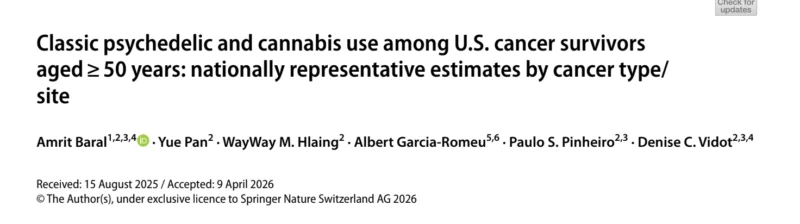
Baral, A., Pan, Y., Hlaing, W.M. et al. Classic psychedelic and cannabis use among U.S. cancer survivors aged ≥50 years: nationally representative estimates by cancer type/site. Cancer Causes Control 37, 85 (2026).
About the Lead Author
Dr. Amrit Baral is a trained epidemiologist and physician-scientist, currently a NIDA T32 Postdoctoral Research Fellow in the Department of Mental Health at the Johns Hopkins Bloomberg School of Public Health. His research focuses on cannabis hyperemesis syndrome (CHS), route-specific patterns of cannabis use and their association with cannabis use disorder (CUD), the cardiometabolic and sleep-related effects of cannabis use in occupational settings, and cannabis and psychedelic use in cancer care and survivorship. Using large national survey data and electronic health records, he examines how patterns and contexts of cannabis use translate into clinical and population-level outcomes. His work takes a comprehensive “cells-to-society” approach to understanding the biological, behavioral, and societal effects of cannabis and psychedelics on human health and disease.
Read the full article.”
Search
RECENT PRESS RELEASES
Related Post