Are Americans interested in EVs and hybrids as their next car in 2026?
April 3, 2026
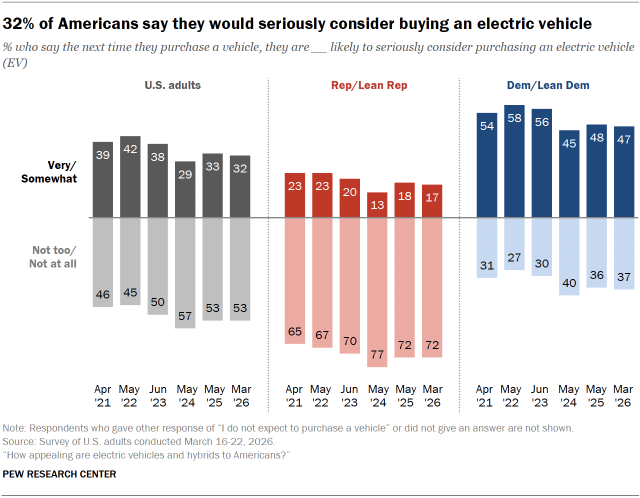
- Americans remain more likely to seriously consider purchasing a hybrid vehicle than an electric vehicle (44% vs. 32%). Interest in EVs is similar to what it was last year, but down from four years ago.
- Democrats, younger Americans and those who live in urban and suburban areas are more likely to seriously consider buying an EV or a hybrid.
About a third of Americans say they would very or somewhat seriously consider purchasing an electric vehicle as their next vehicle. This is a similar share as last year but down from 42% in 2022.
Roughly half (53%) say they are not too or not at all likely to seriously consider purchasing an EV, and 15% say they do not expect to purchase a vehicle.
Americans continue to be more interested in purchasing a hybrid vehicle than an electric vehicle.
(This survey was conducted March 16-22, 2026, a few weeks into the U.S. military conflict with Iran. Gas prices have soared and electric vehicle search interest has gone up in the past few weeks.)
This analysis is part of a broader Pew Research Center study looking at Americans’ shifting views on energy issues. For more, refer to “Americans’ Shifting Views on Energy Issues.”
Democrats and those who lean toward the Democratic Party continue to be more likely than Republicans and GOP leaners to say they would seriously consider purchasing an EV as their next vehicle (47% vs. 17%). But Democrats are 11 percentage points less likely to say they’re interested than in 2022, when 58% said they would seriously consider purchasing an EV.
Younger Americans, including both young Democrats and Republicans, express greater interest than older adults in purchasing an EV. Adults younger than 30 are split on whether they would seriously consider purchasing an EV or not, while greater shares of those 50 and older say they would not seriously consider buying one.
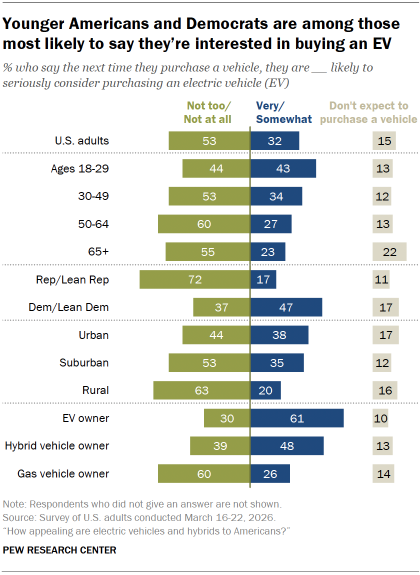
Urban and suburban Americans are also more likely than those who live in rural areas to seriously considering purchasing an EV.
Among current EV owners, a majority would consider an EV for their next car (61%), but three-in-ten would not consider one.
The majority of gas vehicle owners (excluding those who also own an EV or hybrid) also say they would not seriously consider an EV for their next car (60%).
Americans show more interest in purchasing a hybrid vehicle: 44% say they would seriously consider buying one. This is about the same as in 2024.
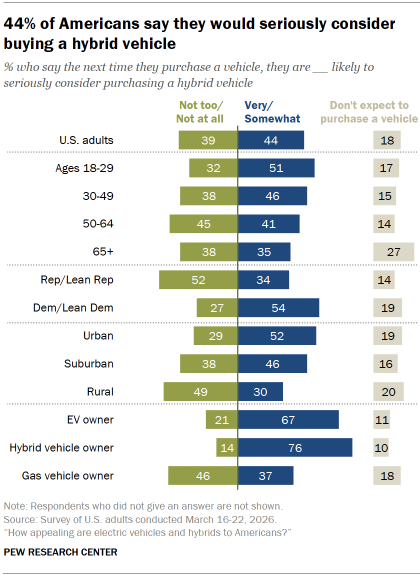
As with electric vehicle interest, Democrats, younger Americans and those who live in urban and suburban areas are all particularly likely to seriously consider buying a hybrid.
Additionally, current hybrid owners largely plan to stick with that type of vehicle for their next purchase: 76% say they would seriously consider it. Gas car owners (who do not own an EV or hybrid) express some interest in hybrid vehicles (37%), but more still do not plan to seriously consider it (46%).
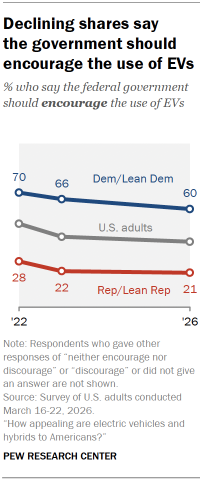
Federal tax credits for buying an electric vehicle expired on Sept. 30, 2025. Four-in-ten Americans now say the federal government should encourage the use of EVs. This share has ticked down since the Biden administration.
A slightly larger share (45%) now say the federal government should neither encourage nor discourage the use of EVs. And 14% say the federal government should discourage their use.
Democrats continue to be much more likely than Republicans to say the government should encourage the use of electric vehicles (60% vs. 21%). However, the shares of both Democrats and Republicans who say the government should encourage the use of electric vehicles have gone down since 2022 (down 10 and 7 percentage points, respectively).
Search
RECENT PRESS RELEASES
Related Post