At 29, she is reshaping Israel’s renewable energy market
January 3, 2026
“The bank clerks looked at me and thought to themselves, ‘Where did she come from?’” Danielle Biton recalls of the first time she tried to raise financing for her company.
She was 23 at the time, a young woman with three academic degrees, seeking funding for EDI Energy, the renewable energy company she founded with her business partner and partner in life, Adi Levy. “I came to the banks after researching and studying the field in depth,” she explains. “I arrived with an organized file containing our business and financial model. Very quickly I moved the conversation from ‘Who is this blonde?’ to practical matters. There is a company here with revenues and permits. It was hard for them to say no.”

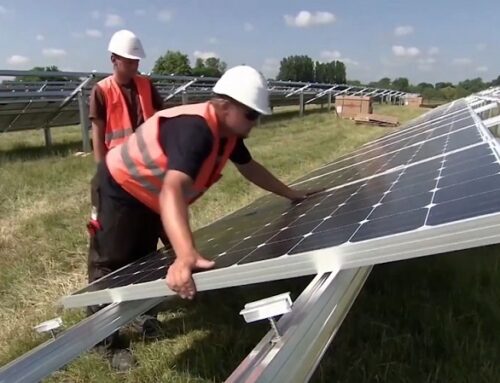
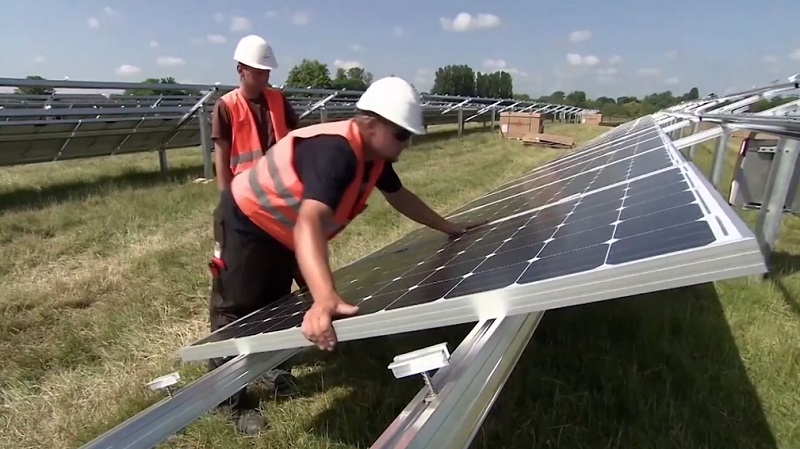
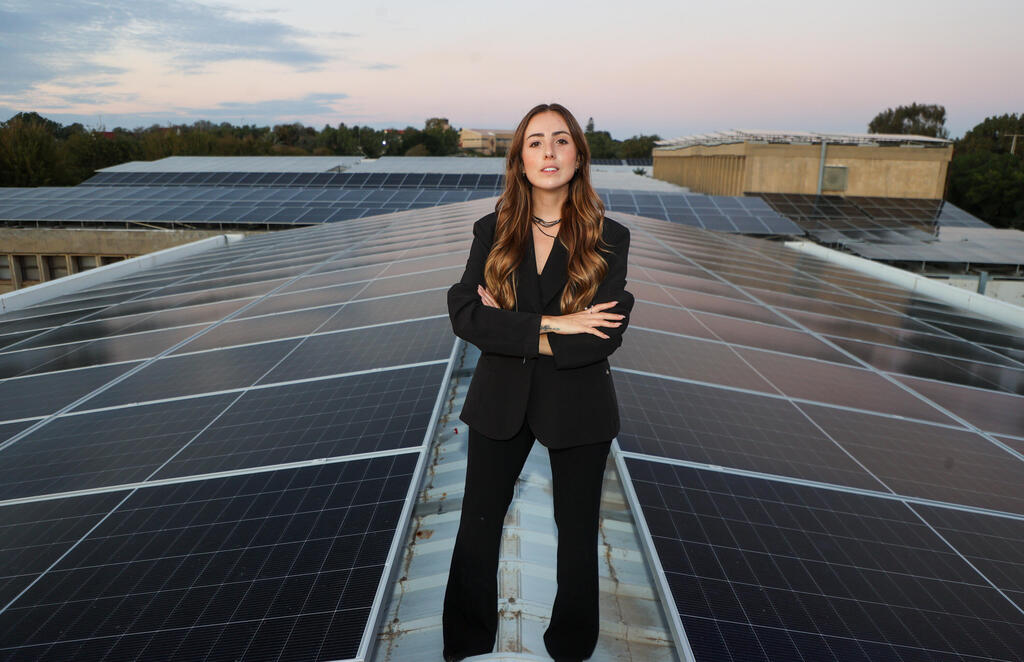
Six years later, Biton is considered one of the most powerful women in Israel’s green energy sector. EDI employs 20 salaried workers and nearly 100 freelancers. The company develops, finances, builds and maintains income-producing solar assets on rooftops, agricultural sites, poultry farms and water reservoirs, generating electricity sold to the Israel Electric Corp. and to major companies.
“The company specializes in dual-use solutions, meaning the use of existing spaces rather than shutting down land,” explains Biton, the company’s co-CEO.
Biton, 29, grew up in the moshav of Be’er Tuvia, the daughter of a contractor and a homemaker. “My parents always told me, ‘We’re behind you. You succeed, you fail, it doesn’t matter, we’re here to support you,’” she says. “They didn’t necessarily mean financially, but spiritually and emotionally. That gave me the courage to do many things at a young age.” She was not an outstanding student. “My parents said, ‘It’s OK, we’re with you. Finish your matriculation exams and everything will work out.’ They didn’t push me toward academia, they encouraged me to be who I am.”
Her turning point came after the army, from which she was discharged after a year due to a medical issue. She enrolled in higher education and earned three degrees: a bachelor’s degree in business administration and computer science, an MBA from the College of Management and a second master’s degree in entrepreneurship from New York University.
Alongside her studies, she worked in high tech, managed projects at Intel and served as a product manager. “But something was missing,” she says. “What I was doing didn’t feel tangible enough. I wanted to do things you can physically touch and see.”
‘My message is to get up and act, to take the first step and understand that even 80% success is OK; in my field, 80% is excellent, and for me it is 100%.”
During her MBA studies, she met Levy. “He was a COO at a renewable energy company, very good at what he does. I recognized his capabilities and we connected.” Levy, an electrical engineer who was then 30, did not initially understand why a young woman from high tech wanted to enter renewable energy. “He didn’t get why I wanted to do this, but I knew we would be a strong team. We complement each other in many ways.”
At first, lacking sufficient knowledge of the field, they thought they would focus solely on building solar facilities. But Biton quickly identified their entrepreneurial potential. “After a month, we began signing projects as developers,” she says.
Their business model was born: The company leases the land, owns the facilities and generates and supplies electricity. Biton took charge of regulation and finance, while Levy handled the technical and economic integration and construction. Ownership is split evenly.

“I raise capital, lead business development, vision and regulation,” she says. Today the company produces 100 million kilowatt-hours per year, enough to supply electricity to between 15,000 and 18,000 homes, depending on consumption and season. It has many projects under construction and development, some in partnership with the energy company Sunflower.
Future revenues from current projects are estimated at 1.1 billion shekels over 25 years. The goal is to double revenues by the end of 2028.
To get there, Biton had to learn the language of the industry. “I knew I could learn,” she says. “I studied everything about renewable energy, read the Electricity Authority’s rulebook, memorized regulatory laws and learned regulator after regulator until I cracked how the system works.”
The real challenge came in 2022. “The Electricity Authority encouraged renewable energy developers to build facilities to meet the target of 30 percent electricity generation,” she explains. “They allocated quotas, but then it became clear the existing grid could not transmit all the electricity.”
EDI deposited 1.5 million shekels as a guarantee. “I went to the Electricity Authority and told them they could not confiscate guarantees for something they were unable to provide,” she says.
The authority referred her to the High Court of Justice. Without the resources or desire for a lengthy legal battle, Biton chose a different route. “I posted videos that went viral,” she says. “I reached the Knesset Economic Affairs Committee and spoke on camera. I didn’t rule out anything.”
‘The age at which we started is also not typical for this field. It’s not like high tech, where young entrepreneurs raising money from venture capital funds is common. We didn’t come with personal guarantees, we came with no money and did everything on our own.’
The strategy worked. “After four months, the Electricity Authority decided to return the guarantees to all developers. Nearly 500 million shekels were returned to the market. From that point on, I became an influential figure in regulation in our field.”
Biton sees this activism as part of a larger mission. “Our fight is not just about advancing the company, but about changing the country’s renewable energy policy,” she says. “I am writing my thesis on regulation of the Israeli electricity market compared with other countries, to see what we can learn and apply.”
Asked how someone so young takes on Israel’s bureaucracy, she replies, “It’s my character. I go all the way with my agenda. I love the moment when a project that was told ‘no’ and ‘impossible’ succeeds, makes money and does good for the country.”
She adds that renewable energy is often perceived as a dull, male-dominated field. “There are almost no women. At our scale, I am the only woman who owns a development company. I noticed the raised eyebrows and didn’t ignore them. At the start of meetings, I addressed it, then moved the conversation to business.”
Biton and Levy live in Kibbutz Karmiya near the Gaza border. On October 7, they were at home, on the edge of the kibbutz between Zikim and Netiv HaAsara. “We heard Iron Dome interceptions and gunfire and knew something unusual was happening,” she says. “When we saw videos of terrorists in Sderot, we got into the car and left. That was a mistake. The terrorists were everywhere. Later we went back to extract my parents.”
After the kibbutz was evacuated, residents were moved to a hotel in Tel Aviv. Company employees were called up for reserve duty. Biton began giving interviews to international media as part of Israel advocacy efforts. After one interview, a Jewish man called her to say that a gathering of young Jews in New York had raised $150,000 for the kibbutz. “The money went toward equipment for the local security squad,” she says.
When it became possible to return home, they did not hesitate. They also rejected an offer to relocate to the United States to expand the business. “We did a few projects there,” she says, “but I love this country and want to stay. It is easy to leave, but this is my place.”
Her determination carried her through difficult moments, including projects that collapsed after significant investment and the struggle to survive when interest rates soared. “The easiest move would have been to sell the projects,” she says. “We could have made a nice exit, but we chose to keep going. I am not afraid of failure. Failure is not one of my fears.”
The company is valued at tens of millions of shekels, and an IPO could be the next step. In the meantime, Biton has been focusing on promoting women’s empowerment through lectures at universities.
“My message is to get up and do it, to take the first step and know that even 80 percent success is fine,” she says. “In my field, 80 percent is excellent. My first step in the company was like a secretary’s. I knew nothing. I took the book and learned.”
She concludes, “Women have enormous power to create change. If you ask me, Israel’s biggest startup is turning women into a leading, driving force.”
Search
RECENT PRESS RELEASES
Related Post