Audi makes a quantum leap in AI quality control with smart factories and robotics
March 26, 2026
Audi is intensifying its focus on
AI tools in production in what it describes as “a quantum leap for efficiency, quality
and adaptability across its plants worldwide”.
The carmaker says it is following
a clear AI and digitalisation roadmap and transforming production by developing
“thinking factories” in which AI supports employees precisely where it creates
the greatest value.

“On our way to intelligent
production, we are creating a symbiosis of Audi’s decades of production
expertise, our own innovative strength and the knowledge of strong partners,”
says Henning Löser, head of the Audi Production Lab, which is focused on
deploying emerging technologies in real production situations.
Advertisement
The Audi Production Lab is
described as a crucial accelerator in the carmaker’s adoption of AI tools for
turning ideas into series production. The lab, located in Gaimersheim
near the Ingolstadt assembly plant, is manned by a team of 25 specialists who
evaluate emerging technologies and prepare them for deployment in real factory
environments. The purpose of the lab is to find and test innovations that
reliably help optimise efficiency, ergonomics, flexibility and quality in Audi
plants.

“We are
currently piloting sequencing with robots in our logistics supermarket testing field,” says Löser. “With
this project, we are taking the next step toward fully automated picking
processes within our supply chain. The pilot will continue through the end of
the year.”
Welding inspection
The roadmap for digitalising
vehicle production has already enabled Audi to identify
more than 100 AI use cases, many of which are already in project or series
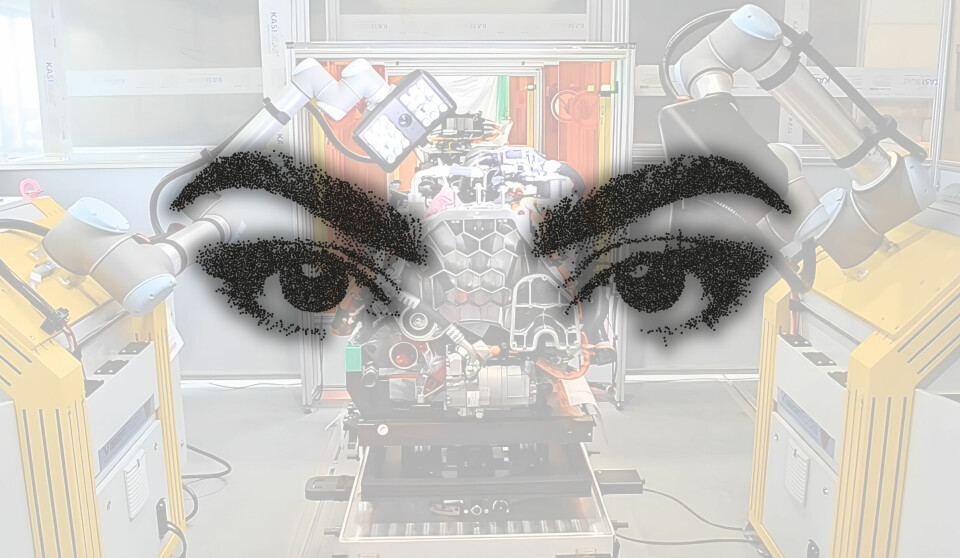
operation. One example is the use of AI robotics in weld spatter detection
(WSD).
At Audi’s Neckarsulm site in
Germany, the WSD system, developed with technology
provider Siemens, uses AI to detect possible weld splatter on vehicle
underbodies. The metal deposited by weld splatter risks such problems as
under-vehicle cable breakage during
production. The AI image processing directs blue lights to mark
any detected weld splatters on the underbody, a job that was
previously carried out by an assembly operative. That automation of laborious
tasks is a key aspect of the AI strategy at Audi (and the wider VW Group).
“AI robotics is not about
replacing people, it is about empowering them – taking over monotonous or
physically demanding tasks so that our teams can focus on work that is more
ergonomic, more creative and more value‑adding,” says Löser.
The AI-supported WSD system will shortly go into
series production at six plants in Ingolstadt, according to Audi.
Advertisement
The WSD system builds on Audi’s
use of AI to analyse 1.5m spot welds on vehicles at its Neckarsulm plant.
Production staff were using ultrasound to manually monitor the quality of
resistance spot welding processes based on random analysis. That system covered
5,000 spot welds per vehicle (across 300 per shift). By applying AI, employees were able to focus
on possible anomalies, and the new approach enabled them to control quality more efficiently and in a more
targeted way. That development has also been rolled out to other plants in the
wider VW Group network.
Monitoring manufacturing
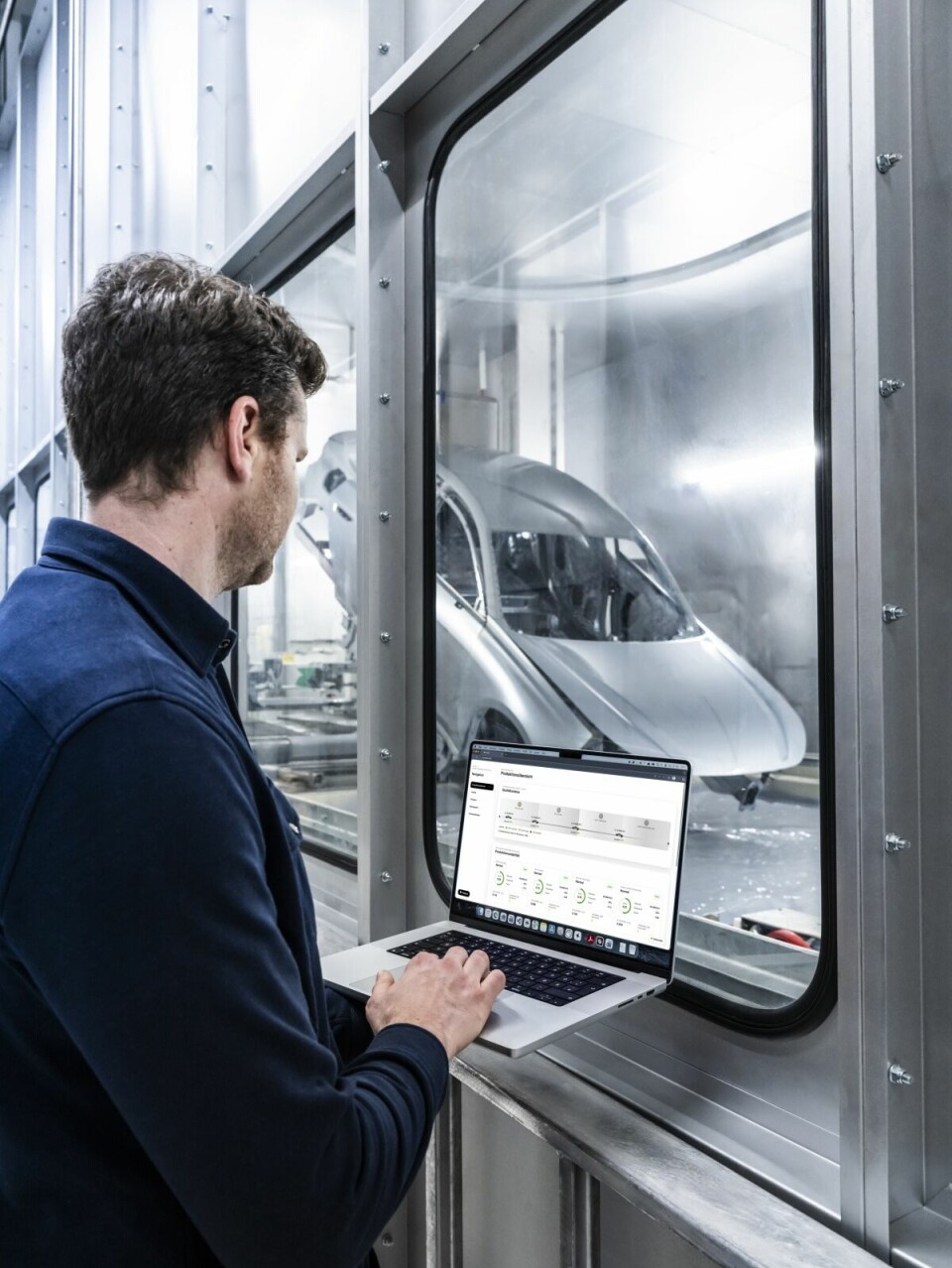
Audi is using AI-supported
real-time process monitoring in several production areas to automatically
detect anomalies in production and predict any costly disruption at an early
stage. That includes in paint shop processes.
ProcessGuardAI is an AI
monitoring tool developed in-house by Audi to drive optimisation into
manufacturing using machine and sensor data. Described
by Audi as a cross‑plant platform P‑Data Engine, itIt unites various system and equipment data
from production at a uniform quality level. This allows Audi data scientists to
develop and scale AI applications quickly and efficiently.
“With
this framework, we create the foundation for consolidating decades of expert
knowledge and system/process data from the entire Audi production network – and
make it available to every employee for higher quality, improved efficiency and
more stable processes,” says Audi.
The carmaker reports that the pilot phase for two use cases is
currently ongoing at the Neckarsulm paint shop. One is for dosage
optimisation in pretreatment and the other in anomaly detection in
cathodic dip coating (CDC). Introduction into series production is planned for
the second quarter of 2026, according to Audi, adding that early fault
detection simplifies manual work steps and reduces follow-up costs.
In the next stages of development
Audi will be using ProcessGuardAI to provide data‑based action recommendations for employees to manage production issues
with an app that is supported by agentic AI. The tool will be central in
predictive maintenance and quality assurance across various VW Group plants where
it will be used to monitor all manufacturing processes, according to Audi.
Saving time with IRIS
Advertisement
Last year Audi also started
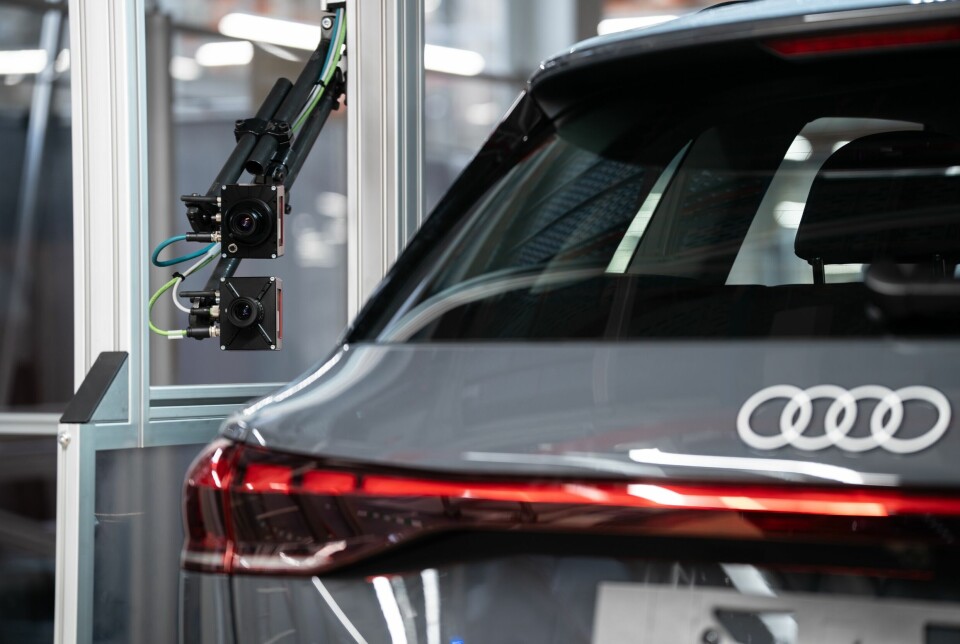
testing a tool called IRIS (Intelligent Recognition and Inspection System), which
uses cameras to check whether labels with technical data are correctly attached
to the vehicle being assembled. The AI system evaluates whether the right label
is correctly attached to the right part, has the right information, that it is in
the right position and in the right language for the vehicle’s destination
country.
Audi says this supports employees
who continue to make spot checks, but the automated IRIS label check saves
roughly one minute of production time per vehicle.
The carmaker says that more than
30 suitable use cases were identified for IRIS, some of which have already been
successfully implemented in several plants.
Audi says that the advantages of
AI-based image processing are visible on a number of levels. As seen in the
time saved, the technology secures processes and
optimises workflows through short control loops. It also
improves quality assurance through objective, traceable and consistent
inspection results, as well as fulfilling regulatory documentation
requirements.
At the same time, it relieves
employees by automating monotonous inspection tasks, while at the same time
eliminating the associated inspection time.
Audi is now moving on to the
implementation of IRIS Next with VW Group partners and reports the technology offering
wider application, which can be implemented more quickly and with less cost in
series production. IRIS Next is based on modern deep learning models that run
in a centrally managed cloud architecture, says Audi. Industrial cameras in
production capture image data, which is encrypted and sent to the cloud, where
AI models analyse it. According to the company IRIS Next is not restricted to
predefined inspections because its AI models enable targeted adaptation to the
specific requirements of each use case. It is currently being applied at
the Ingolstadt and Neckarsulm plants, where several thousand labels are
inspected using AI every day.
“As a platform solution with a
modular architecture, IRIS Next is highly flexible and can be scaled across a
wide range of inspection tasks and production areas,” says the carmaker.
In 2026, IRIS is set to be
deployed at ten VW Group locations, and the system is also being tested in use
cases outside of assembly, such as battery production, logistics and the press
shop. That is helped by the tool having successfully qualified as an inspection
tool in accordance with the requirements laid down by the German Association of
the Automotive Industry (VDA) in its guidance on quality management (VDA QMC 5 part 3 – Capability of optical
sensors and image processing). The AI‑based
image‑processing software can now perform fully automated visual inspection of
product characteristics, which opens up its potential as a quality assurance
tool.
Group-wide
applications
Working with the Volkswagen
brand, Audi has been responsible for the AI robotics strategy across the wider
VW Group since 2024 and, in total, there are currently more than 20 AI-robotics
projects underway across the group worldwide. All VW Group brands are now
working together on AI robotics applications, with a dedicated core team to
develops the strategy, and more than 150 employees exchanging ideas across
brands in an open community.
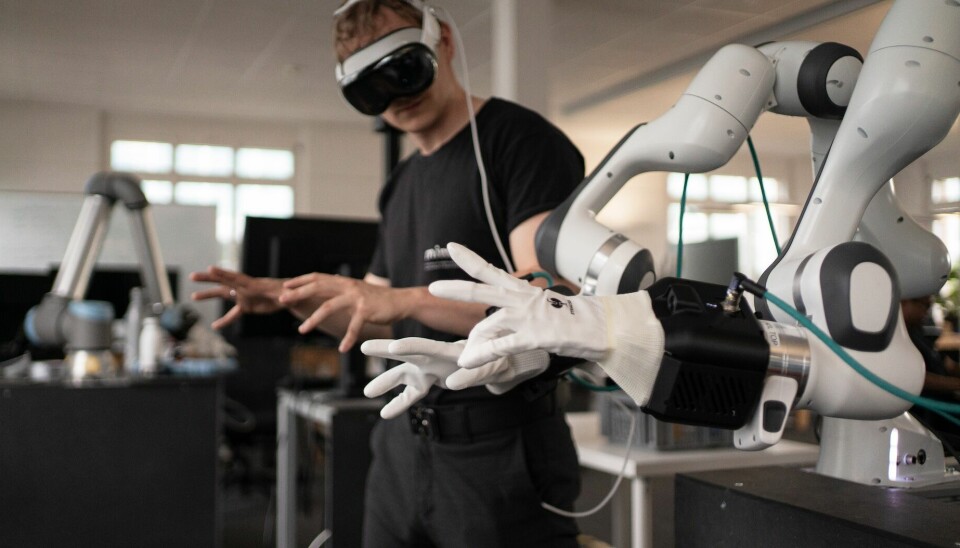
That includes working with Swiss
robotics start-up Mimic to uncover the possibilities of flexible, learning-based
automation enabled by AI, especially in areas where traditional methods fall
short. Recently, the project began testing a system trained to master
intricate, multi-step assembly tasks, including door assembly on the Audi Q6
e-tron.
“Our end-to-end pixel-to-action
model, running on our bi-manual platform, is capable of performing complex,
dexterous and long-horizon insertion tasks,” said Mimic in a posting on
LinkedIn. “We are excited about where this work is leading and the potential it
opens up for deploying flexible, learning-based automation across a broader
range of industrial applications where conventional automation reaches its
limits.”
The group is also looking at the
use of AI to support humanoid robotics. In 2025, Audi and its Chinese partner
FAW carried out a pilot project using humanoid robots with the Beijing
Innovation Center of Humanoid Robotics and UBtech Robotics. Audi reports that
the project provided it with valuable insights into the underlying technology
and this year will launch “several high‑impact pilot projects at [its] German
production sites”.
“With AI robotics, we are
rethinking automation, especially where it was previously considered
impossible,” says Löser. “The goal is to give robots environmental and
contextual ‘awareness’ through AI to overcome today’s limits of automation.”
Search
RECENT PRESS RELEASES
Related Post