Automotive Metaverse In-Car Entertainment Market to Reach USD 12.5 Billion by 2036
March 19, 2026
Rapid Growth at 28.0% CAGR Driven by Shift to Software-Defined Vehicles, Spatial Computing, and Immersive In-Cabin Digital Experiences
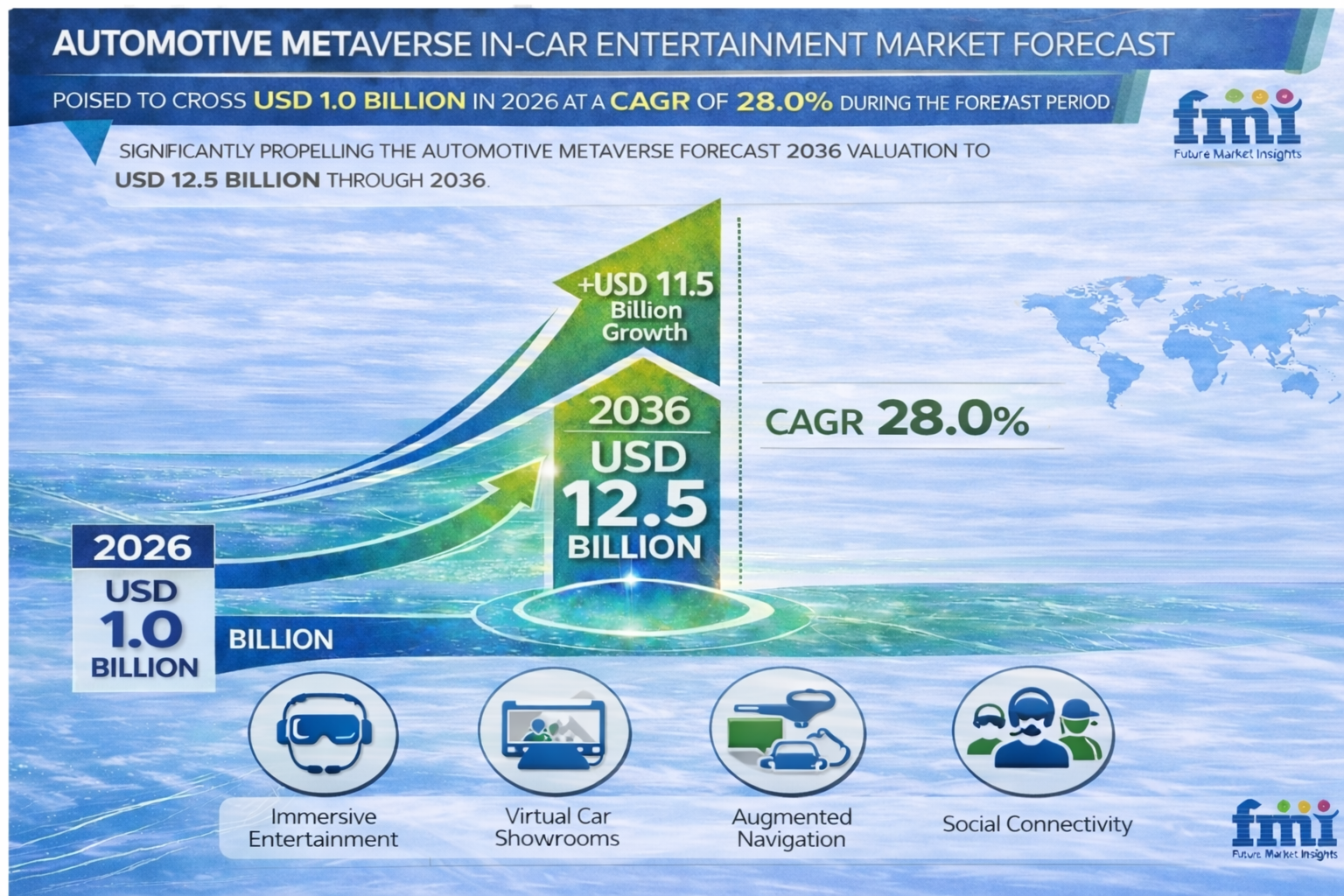
NEWARK, DE / ACCESS Newswire / March 19, 2026 / The global automotive metaverse in-car entertainment market is entering a transformative expansion phase as vehicle cabins evolve from passive transit spaces into persistent, revenue-generating digital environments. Valued at USD 0.8 billion in 2025, the market is projected to reach USD 1.0 billion in 2026 and further accelerate to USD 12.5 billion by 2036, registering a CAGR of 28.0% during the forecast period.
This rapid growth reflects a structural shift in the automotive industry-from hardware-defined infotainment systems to software-defined spatial computing platforms capable of delivering immersive, interactive experiences. As vehicles integrate higher levels of autonomy, the passenger cabin is being reimagined as a connected digital ecosystem where entertainment, productivity, and commerce converge.
Get Access of Report Sample:
https://www.futuremarketinsights.com/reports/sample/rep-gb-32367
Market Value Analysis: Transition Toward Software-Defined Cabin Monetization
Between 2026 and 2030, the automotive metaverse in-car entertainment market is expected to witness accelerated investment as OEMs prioritize digital revenue streams over traditional hardware differentiation.
Automakers are increasingly reallocating capital toward:
-
High-performance in-vehicle compute platforms
-
Real-time rendering engines
-
Edge connectivity infrastructure
-
Spatial user interface development
Legacy infotainment architectures are rapidly becoming obsolete, as they lack the computational capability to support immersive XR (extended reality) environments. OEMs must decide whether to build proprietary ecosystems or rely on third-party platforms-failure to act risks losing long-term digital revenue opportunities.
From 2030 to 2036, market expansion will be driven by large-scale deployment of spatial computing platforms integrated with vehicle telemetry, enabling seamless synchronization between physical motion and virtual environments.
Technology Evolution: Spatial Computing and Telemetry Integration Redefining In-Car Experiences
Automotive metaverse platforms rely on a convergence of advanced technologies to deliver immersive cabin experiences.
Key innovations include:
-
Real-time spatial rendering engines powered by edge computing
-
Vehicle telemetry integration to synchronize motion with virtual environments
-
Extended reality (XR) interfaces including VR and AR
-
AI-driven predictive motion algorithms to prevent motion sickness
-
High-bandwidth 5G connectivity for cloud-based rendering
A critical breakthrough lies in embedding predictive motion algorithms within rendering pipelines. This enables systems to anticipate vehicle dynamics-such as acceleration, braking, and suspension movement-ensuring a seamless and comfortable immersive experience.
An industry analyst notes:
“The defining metric for automotive metaverse success is not display quality-it is motion synchronization. Without aligning virtual environments to real-world vehicle dynamics, even the most advanced hardware fails to deliver usable experiences.”
Precision UX Engineering Becoming Critical to Software-Defined Vehicles
As automotive design shifts toward digital-first architectures, in-car entertainment systems are becoming central to brand differentiation and revenue generation.
Automotive metaverse platforms enable:
-
Fully immersive rear-seat entertainment environments
-
Interactive gaming synchronized with vehicle motion
-
Spatial audio experiences mapped to cabin geometry
-
Augmented navigation and contextual overlays
-
Continuous digital engagement during transit
This transformation shifts value creation from mechanical performance to software-driven user experience, redefining how automakers compete in premium segments.
Segment Spotlight
VR Technology Leads Segment (45.0%)
Virtual reality dominates due to its ability to deliver complete immersion without requiring major structural vehicle redesign.
Passenger Cars Dominate Vehicle Type (75.0%)
Premium passenger vehicles lead adoption due to availability of high-performance compute and power systems.
Gaming & Interactive Entertainment Leads Application (55.0%)
Interactive experiences outperform passive media due to higher engagement and monetization potential.
5G/Edge Connectivity Dominates (65.0%)
High-bandwidth, low-latency connectivity is essential for real-time rendering and seamless user experiences.
Regional Insights: Asia-Pacific Driving Digital Cabin Innovation
Asia-Pacific is expected to dominate the automotive metaverse in-car entertainment market due to strong consumer demand for digital ecosystems and rapid deployment of 5G infrastructure.
Country-wise CAGR (2026-2036)
|
Country |
CAGR (2026-2036) |
Key Growth Drivers |
|---|---|---|
|
China |
35.0% |
Digital-first consumers driving rapid adoption of immersive cabin technologies |
|
India |
32.0% |
Emerging EV ecosystem enabling early deployment of spatial platforms |
|
South Korea |
30.0% |
Advanced 5G infrastructure supporting real-time rendering |
|
United States |
28.0% |
Long-distance travel driving demand for extended engagement |
|
Germany |
25.0% |
Strong engineering validation for high-performance systems |
|
United Kingdom |
24.0% |
Luxury segment driving mixed reality adoption |
|
Japan |
22.0% |
Regulatory constraints shaping cautious deployment |
Opportunities: Spatial Monetization and Open Ecosystems Unlock Growth
Key growth opportunities include:
-
Telemetry-as-a-Service enabling third-party developers to access real-time vehicle data
-
Spatial audio integration for immersive in-cabin experiences
-
Retrofit XR platforms targeting existing vehicle fleets
-
Edge-rendered gaming ecosystems for continuous engagement
-
AI-driven personalization for adaptive user experiences
These innovations are creating new revenue streams through subscriptions, in-app purchases, and content ecosystems.
Competitive Landscape: Tech Giants and Automakers Compete for Cabin Control
The market is defined by a convergence of automotive OEMs, semiconductor companies, and software developers.
Leading players include:
-
NVIDIA Corporation
-
Qualcomm Technologies Inc.
-
Unity Technologies Inc.
-
Holoride GmbH
-
BMW AG
-
Mercedes-Benz AG
-
Tesla Inc.
-
WayRay AG
Competitive differentiation is increasingly driven by:
-
Low-latency rendering capabilities
-
Integration with vehicle operating systems
-
Ability to support scalable developer ecosystems
Future Outlook: Automotive Cabins Evolving into Persistent Digital Platforms
Looking ahead to 2036, automotive metaverse platforms will become foundational to the software-defined vehicle ecosystem.
Key trends include:
-
Standardization of vehicle telemetry APIs
-
Expansion of edge computing infrastructure
-
Growth of subscription-based in-car services
-
Integration with autonomous driving systems
-
Emergence of fully immersive, multi-user cabin environments
As vehicles transition into connected digital platforms, the automotive metaverse in-car entertainment market will redefine mobility-transforming every journey into an interactive, revenue-generating experience.
For an in-depth analysis of evolving formulation trends and to access the complete strategic outlook for the Automotive Metaverse In-Car Entertainment Market through 2036, visit the official report page at: https://www.futuremarketinsights.com/reports/automotive-metaverse-in-car-entertainment-market
Brows More Automotive Industry Reports:
-
Aircraft Gearbox Market – https://www.futuremarketinsights.com/reports/aircraft-gearbox-market
-
Two-Wheeler Aftermarket Components & Consumables Market – https://www.futuremarketinsights.com/reports/two-wheeler-aftermarket-components-market
-
One-Pedal Brake Control Modules Market – https://www.futuremarketinsights.com/reports/one-pedal-brake-control-modules-market
-
Low-Noise Low-Dust EV Brake Components Market – https://www.futuremarketinsights.com/reports/low-noise-low-dust-ev-brake-components-market
-
Regenerative Brake Calibration Services Market – https://www.futuremarketinsights.com/reports/regenerative-brake-calibration-services-market
About Future Market Insights (FMI)
Future Market Insights (FMI) is a leading provider of market intelligence and consulting services, serving clients in over 150 countries. Headquartered in Delaware, USA, with a global delivery center in India and offices in the UK and UAE, FMI delivers actionable insights to businesses across industries including automotive, technology, consumer products, manufacturing, energy, and chemicals.
An ESOMAR-certified research organization, FMI provides custom and syndicated market reports and consulting services, supporting both Fortune 1,000 companies and SMEs. Its team of 300+ experienced analysts ensures credible, data-driven insights to help clients navigate global markets and identify growth opportunities.
For Press & Corporate Inquiries
Rahul Singh
AVP – Marketing and Growth Strategy
Future Market Insights, Inc.
+91 8600020075
For Sales – sales@futuremarketinsights.com
For Media – Rahul.singh@futuremarketinsights.com
For web – https://www.futuremarketinsights.com/
SOURCE: Future Market Insights, Inc.
View the original press release on ACCESS Newswire
Search
RECENT PRESS RELEASES
Related Post