| Automotive World
May 14, 2026
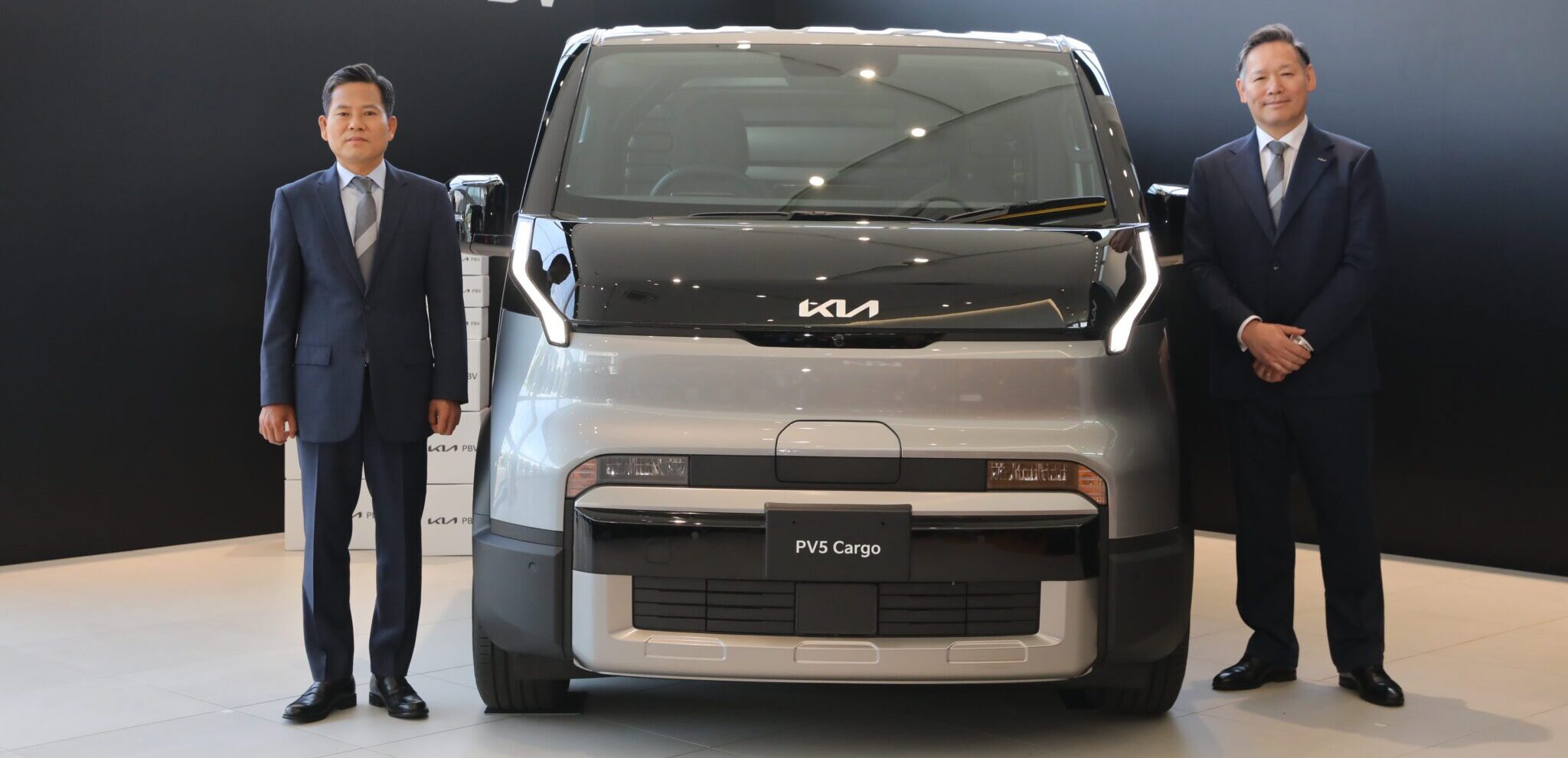
Kia has launched the PV5 electric van in Japan, marking the South Korean automaker’s grand return to one of the automotive industry’s most impenetrable export markets. The launch opened order books on 13 May for the PV5 Passenger and Cargo variants, with Kia PBV Tokyo West—the brand’s first directly-operated dealership in the country—set to open two days later.
The re-entry is structured around Kia’s purpose-built vehicle (PBV) division rather than its passenger car range, a deliberate choice that shapes both the product mix and the partner chosen to distribute it. On this latter point Kia has appointed Sojitz Corporation, a major Japanese general trading company, as local importer and distributor. Sojitz has established Kia PBV Japan as a wholly-owned subsidiary to handle sales and after-sales services.
Sojitz’ network currently spans seven dedicated dealerships and 52 service centres, with Kia targeting 11 directly-operated stores and 100 service centres by the end of the year. For now, its ambitions are relatively modest, with a set target of around 1,000 electric van sales during fiscal 2026.
The PV5 has been calibrated for Japan rather than imported wholesale. At 4,695 mm in length with a 5.5-metre turning radius, the vehicle is suited to the narrow roads that have historically disadvantaged larger foreign models. CHAdeMO, Japan’s native rapid-charging standard, is being included as standard rather than treated as an afterthought. Vehicle-to-home functionality is also being positioned as a primary selling point; given Japan’s history of seismic events, the ability to generate power in an emergency could prove alluring to customers.
Last year, Kia framed the launch as a “full-scale attack” on the Japanese EV market—arguably very pointed, even problematic, language—but the choice of the commercial segment over the passenger car market indicates its strategy is quite pragmatic. It is no secret that domestic automakers like Toyota, Honda and Nissan dominate the Japanese passenger car market with a roughly 95% share; Toyota alone accounted for around 45% in 2025. This fortress-like structure of the market has made it extremely difficult for any global brand to gain meaningful traction, US, Korean or otherwise.
The commercial electric van market, while still in its nascency, is comparatively uncontested. At the time of writing, there are few non-internal combustion engine options available in last-mile logistics. The Japanese government is targeting 30% electric vehicle penetration by 2030, creating a fairly straightforward opportunity for Kia to establish a niche.
The approach shares some common ground with Chinese automotive’s efforts to gain presence in the Japanese electric vehicle market. BYD has directed its Japan strategy into the kei car segment, launching the Racco—its first overseas market-exclusive model—in summer 2026, while building out a physical retail and charging footprint across regional cities.
Meanwhile, Chery is planning a 2027 entry through a joint venture involving auto parts retailer Autobacs Seven, routing its vehicles under a new brand to create distance from its Chinese identity. All three are operating on the same core premise, to some degree or another: market entry is all-but-impossible if Japanese brands already dominate, so localise as thoroughly as possible and claim a niche.
Whether Kia’s approach earns fairer treatment from Japanese regulators than its Chinese counterparts have received is another matter. Japan’s EV subsidy framework operates through a 200-point scoring system weighted toward charging infrastructure density, service network coverage, and disaster-preparedness commitments — criteria domestic manufacturers satisfy with ease. Toyota and Nissan easily attract the full JP¥1.3m (US$8,000) subsidy; Tesla now receives the same figure following US-Japan trade negotiations, while BYD’s allocation has been cut to JP¥150,000.
The opacity of the scoring compounds the difficulty for non-domestic entrants: BYD scored zero points for charging infrastructure despite deploying proprietary fast chargers at dealerships and supplying free units to multiple hotels, and the Japanese government has declined to explain its methodology—a silence that prompted BYD to publicly accuse regulators of anti-Chinese bias.
Kia’s Sojitz partnership would presumably address the service network question directly, and the PV5’s commercial focus may qualify it for logistics-specific subsidy pools subject to different criteria than those governing consumer passenger car grants. Whether that positioning is sufficient to outmanoeuvre a framework that has arguably demonstrated bias is another matter.
Search
RECENT PRESS RELEASES
Related Post