Bitcoin breaks below $70,000 on Middle East tensions…Ethereum ‘holds up’ and XRP ‘treads water’ [Lee Soo-hyun’s Coin Radar]
March 26, 2026
<Lee Su-hyun’s Coin Radar> is a weekly column that tracks trends in the virtual asset (cryptocurrency) market and explains what is driving them. Going beyond a simple list of prices, it offers a multidimensional analysis of global macro issues and investor positioning to provide insights into where the market may be headed.
Major coins
1. Bitcoin (BTC)

Bitcoin traded choppily around the $70,000 level this week amid Middle East-driven geopolitical risks. It held the $71,000 handle relatively well early in the week, but downside pressure built from the 26th and eventually pushed it below $70,000. As of the 27th, Bitcoin is trading around $68,000 on CoinMarketCap.
The biggest driver of this week’s decline was, unsurprisingly, Middle East risk. Expectations had risen for a breakthrough in ceasefire negotiations between the U.S. and Iran, but talks fell back into a stalemate. President Donald Trump pressured Iran on Truth Social, saying it would be “wise to get serious before it’s too late,” and maintained a hardline stance in a cabinet meeting as well, stating, “We will continue to hit them without any interference.”
Iran, meanwhile, said it is reviewing the U.S. proposal but drew a line by signaling it has no intention to engage, effectively dismissing hopes for negotiations. With signals diverging between the possibility of talks and military pressure, uncertainty in markets widened; risk assets broadly wobbled, and Bitcoin was unable to avoid the downside.
Crude prices surged. As of the 26th (local time), Brent futures rose 5% to top $108 a barrel, while West Texas Intermediate (WTI) climbed to $94. Markets are concerned that higher oil prices could rekindle inflation fears and ultimately push back expectations for rate cuts.
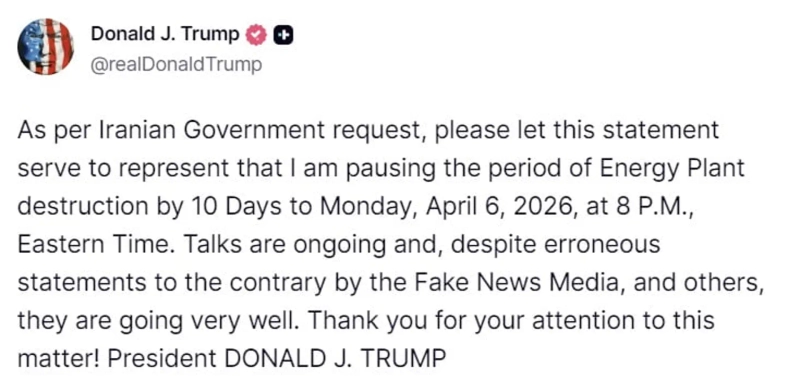
There were also moments when relief was briefly priced in. When Trump extended the pause on attacks on Iranian power plants again until April 6 and said that “talks are going well,” markets reacted to the possibility of a diplomatic solution. Bitcoin also staged a short-term rebound.
But the rebound did not last long. That same day, reports said the U.S. Department of Defense is reviewing the option of deploying additional ground forces of up to 10,000 troops. Adding to that, news emerged that Israel killed the commander of the Islamic Revolutionary Guard Corps (IRGC) Navy—who had been leading efforts to close the Strait of Hormuz—in an airstrike, tilting sentiment back toward a military scenario.
Still, a meaningful medium- to long-term positive catalyst also surfaced. With the door opening for virtual assets to be included in U.S. retirement plans (401(k)s), the likelihood has increased that vast pools of capital could newly flow into the crypto market. Given that the U.S. retirement-plan market totals about KRW 1,800 quadrillion, even a 1% allocation could generate roughly $120 billion in new demand. In particular, pension capital tends to be long-term in nature, raising expectations that it could provide a support base for Bitcoin’s downside at a time when Middle East risks and regulatory uncertainty persist.
In the near term, the low-$70,000 area is the key inflection zone. Ayush Jindal, a researcher at NewsBTC, said “Bitcoin is attempting a rebound as it finds support near $70,200,” adding that “a break above the $71,650 resistance could open room for further gains.” On the other hand, if support fails, he said a pullback toward $70,000 and $69,200 is possible, and if $67,500 breaks, the short-term uptrend could weaken.
Rakesh Upadhyay, a Cointelegraph analyst, said “$74,508 is the key resistance,” adding that “a break and hold above this zone could open the way for a move up to $84,000.” However, he also warned that if prices fall below $67,000, downside pressure could expand toward the $62,500 to $60,000 range.
2. Ethereum (ETH)
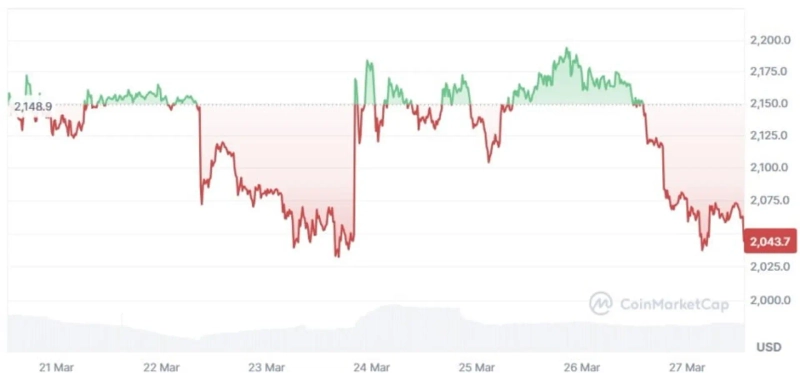
Ethereum, despite a recent pullback, has been holding the $2,000 level relatively firmly. As of today, it is oscillating in the $2,000–$2,100 range on CoinMarketCap.
The market sees Ethereum as a zone of conflicting supply and demand where direction has yet to be firmly determined. On-chain data shows this dynamic clearly.
According to crypto analytics firm Wise Crypto, whale investors moved Ethereum to exchanges over the past week to take profits. This can translate into selling pressure at the top. Meanwhile, steady buying has been coming in on the downside, centered on new wallets.
There was also analysis that the amount of Ethereum withdrawn from exchanges by newly created wallets alone totals about $1.8 billion. In other words, the interpretation is that a classic distribution zone is forming—whales selling into strength while fresh buyers provide support on pullbacks.
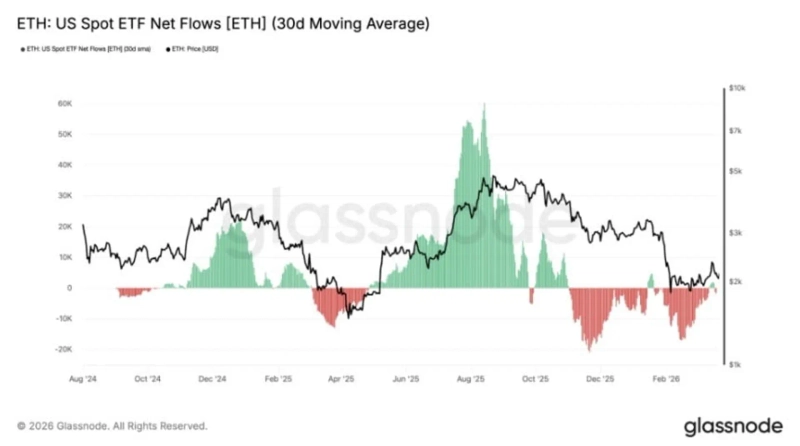
Institutional flows, however, appear to have slowed somewhat. Ethereum spot ETFs have recorded net outflows for six consecutive trading days, and according to Glassnode, the 30-day average flow for U.S. Ethereum spot ETFs has slipped back into negative territory. Outflows have also continued from global Ethereum investment products, suggesting weakening institutional demand.
Some analysts say future price action is likely to be heavily influenced by changes in ETF flows. Crypto outlet Cointelegraph assessed that “if ETF inflows return to a stable uptrend, it could become a key basis for a resumption of the uptrend.”
From a price perspective, the low-$2,000 area is crucial. Wise Crypto cited $2,027 as a key support and $2,148 as near-term resistance. A break above that resistance could revive upside momentum, but if $2,027 gives way, it said the door could open to additional downside toward $1,928.
Crypto analyst Ali Martinez viewed the $1,800–$2,000 range as a strong buying base and pointed to $2,356 as the key resistance. If that level is cleared, he said upside room could open to $2,647 and further to $3,639.
3. XRP (XRP)
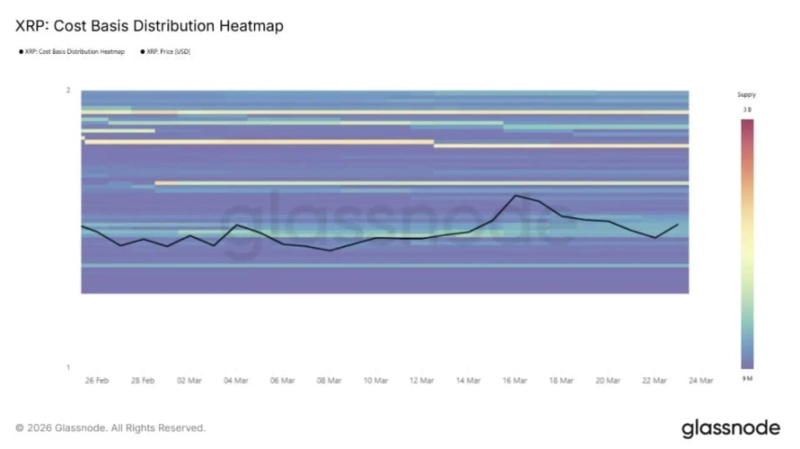
XRP has recently traded in the $1.3–$1.4 range, extending a relatively constrained move. As of the 27th, it is trading at $1.36 on CoinMarketCap.
The key reason behind the limited action is believed to be a thick overhang of supply in the $1.55–$1.59 zone. According to Glassnode, an overhang equivalent to about 1 billion XRP is clustered in that area. Because it is where many past investors’ average entry prices are concentrated, sell orders aimed at getting back to breakeven tend to flood the market whenever price approaches that range. As a result, the upside has remained capped.
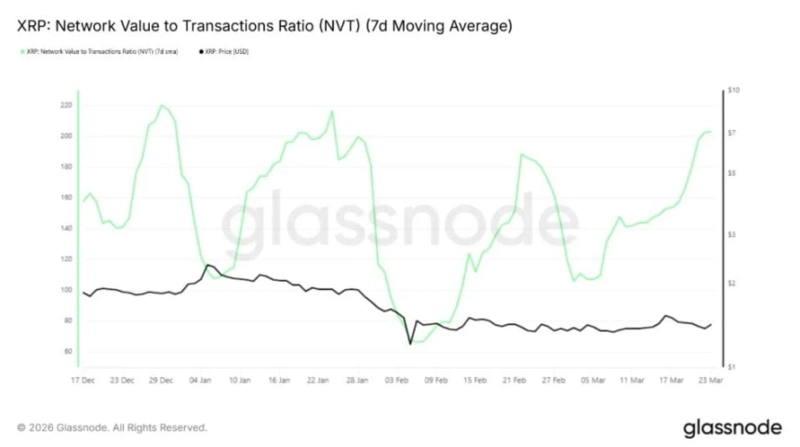
On-chain indicators are not entirely supportive either. XRP’s network value to transactions (NVT) ratio has recently risen to around 200, suggesting price may have moved ahead of network usage.
Historically, such zones have often been followed by pullbacks. On-chain activity has also slowed. According to Santiment, daily on-chain transaction volume, which had increased to about 390 million XRP in mid-March, has recently plunged to about 70 million XRP. Profit-taking continues, but new inflows appear limited.
Whale behavior is also cautious. According to CryptoQuant, Binance’s 30-day cumulative whale outflows fell to about 1.285 billion XRP, the lowest since early February. This is interpreted as a shift toward waiting on the sidelines rather than actively buying or moving assets. CryptoQuant contributor ArabChain analyzed that “whales’ wait-and-see stance has strengthened alongside the possibility of short-term selling.”
However, medium- to long-term variables remain. On the 27th, whether the U.S. Securities and Exchange Commission (SEC) approves a spot XRP ETF and expands institutional access is cited as a key variable that could support prices going forward. In addition, Ripple Prime’s inclusion in the NSCC, growth of the RLUSD stablecoin, and expansion of the payments network are also viewed as positive factors over the medium to long term.
In price terms, $1.50 is the key inflection point. Crypto outlet BeInCrypto forecast that “if the $1.50 zone is convincingly broken to the upside and held, room could open for a rebound toward the $1.65–$1.70 range.”
Investment outlet TradingNews presented a similar view, saying “if $1.44 is decisively broken on a daily close basis, price could rise to $1.60.” However, in a turn lower, $1.33 would act as a key support; if that level breaks, there is also the possibility that downside pressure could expand to $1.16 and further to the $0.80–$1.00 range.
Issue coins
1. Bittensor (TAO)
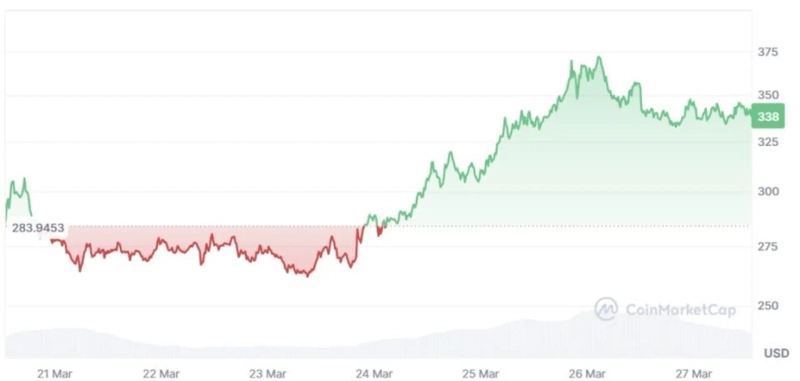
One of the altcoins that posted the most eye-catching move recently is Bittensor (TAO). Bittensor has surged about 140% over the past six weeks to emerge as a central market theme. On CoinMarketCap, it has gained more than 20% over the past week, and as of the 27th it is hovering around $340.
This rise is seen less as a simple technical rebound and more as the result of capital rotating into the decentralized artificial intelligence (AI) theme. The uptrend accelerated further after March 20, as NVIDIA CEO Jensen Huang and investor Chamath Palihapitiya mentioned Bittensor publicly, sharply boosting market attention. As the AI narrative strengthened, Bittensor effectively stood out as one of the representative beneficiaries.
The project’s structure is also a factor drawing attention. Bittensor positions itself as a decentralized machine-learning marketplace, with a setup in which AI models compete to prove performance and are rewarded based on results. It is seen as differentiated from centralized AI in that it assigns economic rewards to performance itself.
A core element is the “subnet.” Various AI networks—such as large language model training, computing, and prediction markets—operate independently while being linked into a single economic system through the TAO token. The fact that it is not driven by a single model but rather an ecosystem where multiple networks compete and grow is highlighted as a point of differentiation.
The outlook is also being framed positively. Crypto analyst AnBessa, citing a two-year price channel, said Bittensor could reach $600. He expressed strong conviction, describing it as “not a question of possibility, but of timing.”
That said, given the already large gains, it is also noted that the near term may be a volatility-expansion phase. Even so, there is also a view that if the AI narrative continues to strengthen, additional upside may remain. Ultimately, Bittensor’s path ahead is seen as depending on whether the AI theme persists and how long market attention can be sustained.
Search
RECENT PRESS RELEASES
Related Post