Bitcoin suffered a flash crash on Christmas Eve, missing out on the ‘Santa Claus rally,’ a
December 25, 2025
The current price of Bitcoin is hovering around $87,000, constrained within the range of $85,000 to $90,000, with a year-to-date decline exceeding 7%. Since retreating from its all-time high in October, Bitcoin has dropped approximately 30%, marking its worst quarterly performance since the second quarter of 2022 when TerraUSD and Three Arrows Capital collapsed.
As traditional financial markets welcomed a year-end rebound, Bitcoin not only missed out on the “Santa Claus rally” but also experienced a rare flash crash on the Binance exchange.
During the U.S. trading session on Wednesday evening, Bitcoin suddenly plummeted from $87,600 to $24,100 on the Binance BTC/USD1 trading pair, with a drop exceeding 70%, before quickly rebounding to around $87,000 within seconds.
 This extreme volatility was confined to USD1, a stablecoin issued by World Liberty Financial, which is supported by the Trump family, and did not occur in other major trading pairs.
The current price of Bitcoin is hovering around $87,000, constrained within the range of $85,000 to $90,000, with a year-to-date decline exceeding 7%. Since retreating from its all-time high in October, Bitcoin has dropped approximately 30%, marking its worst quarterly performance since the second quarter of 2022 when TerraUSD and Three Arrows Capital collapsed.
This asset, known for its high volatility and speculative sentiment, unexpectedly stagnated at the end of the year, in stark contrast to the S&P 500 Index and gold repeatedly hitting new highs.
Insufficient liquidity triggers technical flash crash
Analysts pointed out that this “flash candle” is typically caused by insufficient liquidity or display issues.
Emerging or low-volume stablecoin trading pairs often lack market makers providing dense bid-ask spreads, resulting in shallow order book depth. A large market sell order, forced liquidation, or automated trading can rapidly deplete buy-side orders, causing prices to temporarily deviate from true market levels.
Cryptocurrency analyst and Coin Bureau co-founder Cryptonews stated:
This highlights the risks of executing trades in illiquid trading pairs, especially when liquidity pathways for stablecoin transactions are still in their early stages. Many spot investors found their positions largely unaffected before and after the flash crash.
He believes that, amid uncertain geopolitical conditions and fluctuating market liquidity, this serves as a clear warning against excessive leverage.
Temporary pricing issues caused by widening spreads, malfunctioning market maker quotes, or trading bots reacting to abnormal prices may also trigger such price dislocations. During periods of low trading activity, this effect is amplified due to the reduced number of participants available to absorb order flow and restore price equilibrium.
Missing the ‘Santa Claus Rally’ and divergence from gold
In stark contrast to Bitcoin’s sluggish performance, traditional markets are sending markedly different signals.
The US stock market has experienced a typical ‘Santa Claus Rally,’ with the S&P 500 index closing at a record high of 6921.42 points on December 24. Technology stocks and momentum trading have once again rewarded retail investors who maintained their positions.
Gold has also performed impressively, with spot gold prices reaching a new all-time high of $4,525.18 per ounce on December 24. Despite a subsequent pullback, the annual gain remains over 70%, positioning it for the best yearly performance since 1979 and marking the second-strongest annual rise in over a century.
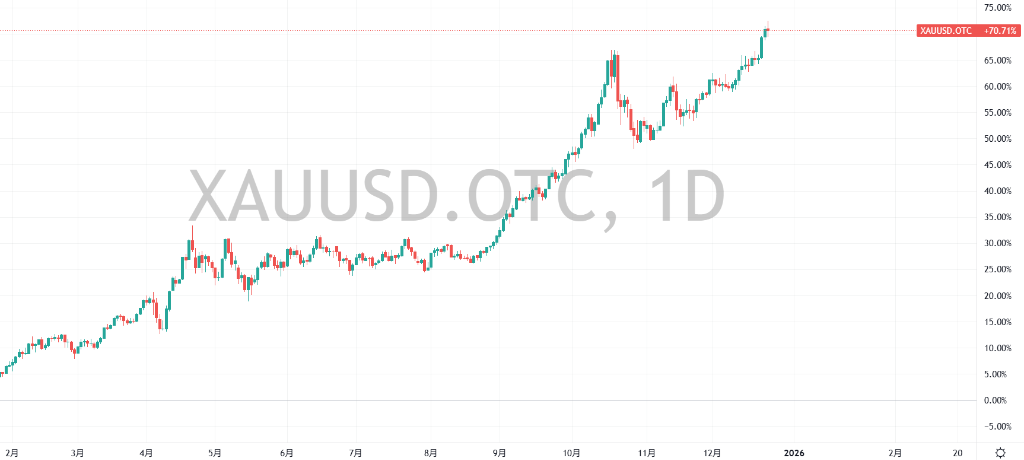 (Spot gold has risen more than 70% year-to-date)
Bitcoin, on the other hand, has missed out on both fronts. For a period in early 2025, Bitcoin’s movements were highly synchronized with risk assets, but it clearly lagged behind in the year-end rally.
Moreover, its long-touted attribute as ‘digital gold’ failed to attract defensive capital inflows that drove gold prices higher. Timothy Misir, head of research at digital asset research firm BRN, stated:
‘Hard assets’ are attracting funds as long-term hedging tools, while crypto assets remain marginalized.
Historical data shows that Bitcoin’s performance during the ‘Santa Claus Rally’ has been inconsistent.
Although gains of 33% and 46% were recorded during the Christmas-to-New Year periods in 2011 and 2016 respectively, declines of 14% and 10% occurred in 2014 and 2021. Since 2011, Bitcoin has averaged a 7.9% increase during the Christmas period.
Deterioration in technical indicators and lack of buying interest
Some market inertia stems from technical factors.
Bitcoin has fallen below the approximately $102,000 365-day moving average, a level that previously acted as key support in this cycle. The inability to reclaim this threshold increases the risk of a deeper correction.
Over $23 billion in options will expire on December 26, freezing directional bets and reinforcing the deadlock. Thin holiday liquidity further dampens market activity. However, these factors merely highlight a deeper issue: the absence of clear buyers willing to enter the market.
Persistent selling by long-term holders constitutes another drag.
Pratik Kala, portfolio manager at hedge fund Apollo Crypto, stated that Bitcoin’s price movement this year has been “noticeably disconnected from the extremely bullish news cycle surrounding the asset.”
He attributed this divergence to ongoing sales by early holders, including the sharp pullback in October, which collectively prevented a rebound from gaining momentum.
Kala noted that much of the selling pressure seems to have subsided for now, leaving Bitcoin in a consolidation range, which he believes may lay the groundwork for stronger performance next year.
Ongoing outflows from ETFs
As traders entered the Christmas holiday, market liquidity declined and risk appetite weakened, leading to renewed outflows from spot Bitcoin and Ethereum ETFs on December 24.
According to SoSoValue data, Bitcoin spot ETFs recorded a net outflow of $175 million on Wednesday, while Ethereum spot ETFs saw an outflow of $57 million.
The largest single-day outflow came from Blackrock’s IBIT, which lost $91.37 million, followed by Grayscale’s GBTC with a net outflow of $24.62 million.
Ethereum spot ETFs recorded a net outflow of $52.7 million on the same day, with Grayscale’s ETHE leading the selling pressure at $33.78 million in outflows, bringing its cumulative historical net outflow to $5.083 billion.
This pattern aligns with typical market behavior during major holidays: trading volumes plummet, market-making desks reduce positions, and holding strategies shift toward defense.
Konstantin Vasilenko, co-founder of the Paybis cryptocurrency exchange, told the media that he does not expect a “Santa Claus rally” in the markets.
Due to tax-related reasons, traders in some regions tend to liquidate cryptocurrencies and exit certain risky positions before the new year, so he anticipates no significant movements before January.
For now, as U.S. equities rise and gold shines, Bitcoin’s stagnation is sending its own signal: an asset built on excitement appears devoid of any excitement at year-end.
Search
RECENT PRESS RELEASES
Related Post