Braun willing to consider pot legalization as report finds Hoosiers spend $2B on cannabis
April 29, 2026
Indiana Gov. Mike Braun on Tuesday signaled a willingness to consider legalizing marijuana and cannabis products, which a new report says Hoosiers spend nearly $2 billion a year to purchase.
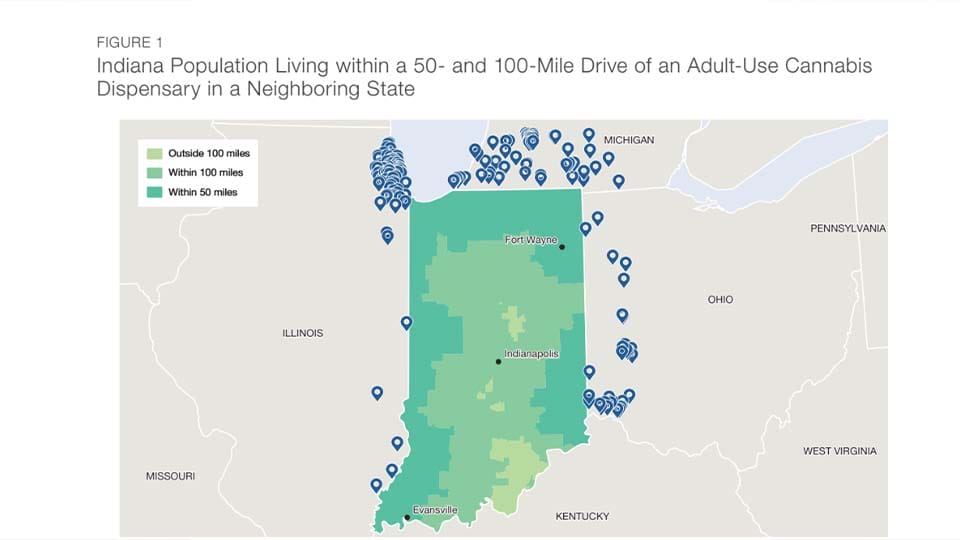
Indiana has some of the strictest marijuana laws in the country, according to one of two reports released Wednesday by the Indianapolis-based Richard M. Fairbanks Foundation. But Indiana’s neighbors have all legalized the use of marijuana to some degree, leading residents to cross the border for purchases. Illinois, Michigan and Ohio allow recreational use, while Kentucky has authorized medicinal uses.
“I’m going to do what makes sense,” Braun told reporters Tuesday. “I’ve said law enforcement will be important. I’ve been talking to them, and now, the amount of traffic that crosses the border, you know, it’s noticeable. So, all of that will be taken into consideration.”
President Donald Trump’s administration last week rescheduled medical marijuana — subject to a state license — to a less restrictive category but kept recreational use in the list of drugs with the highest potential for abuse. But the administration has also kicked off an expedited administrative hearing process to consider reconsider that classification.
“I think the fact that the feds made that move, that makes it more likely,” Braun said about possible state action.
“You’re going to need to ask the legislators and the leaders in [the Indiana House and Senate] to see what they’re thinking, because I’m clear in terms of where I’m at,” he continued. “You’ve got to take what’s evolved over time. [If you] stick your head in the sand, you’re generally going to make the wrong decision.”
As a gubernatorial candidate in 2024, Braun said he was possibly willing to consider allowing medical-use sales, but not recreational, Fox59 reported.
The Fairbanks Foundation’s Cannabis Landscape and Cannabis Policy reports outline detailed data on cannabis use trends, enforcement, public health impacts and potential policy scenarios for Indiana. Conducted by researchers with Los Angeles-based Rand Corp., the findings shows that cannabis use is on the rise, marijuana access is widespread and state legislators face difficult choices about cannabis policy.
Hoosiers have more than doubled their cannabis use over the past decade, researchers said.
In 2011-2012, about 6% of residents age 12 and older reported using cannabis in the past month. By 2023-2024, that number reached 16%.
The increase is driven largely by adults 26 and older, researchers said, while youth use has declined.
Researchers also found, of the 1.3 million Hoosiers who reported using cannabis in the past year, about one-third said they use it daily or near daily.
Most residents can access cannabis easily across state lines, said Emilyn Whitesell, vice president of impact and evaluation at the Fairbanks Foundation.
“Illinois, Michigan, and Ohio are all easily accessible by a drive,” Whitesell said in an interview with Inside INdiana Business.
People can also access cannabis within Indiana, Whitesell said, through illegal markets and widely available hemp products.
Indiana sees about 13,000 cannabis arrests each year and spends between $10 million and $20 million annually enforcing cannabis laws, covering policing, courts, jails and probation.
If the state legalized adult-use cannabis, researchers estimate it could generate about $180 million annually in tax revenue, which Whitesell said is roughly 1% of Indiana’s $18 billion general fund.
But that revenue would not come without new costs.
Researchers found that startup expenses for a regulated cannabis system could range from $10 million to $100 million, with ongoing regulatory costs in the tens of millions of dollars each year to oversee licensing, enforcement and compliance.
Whitesell said those regulatory costs would not replace current enforcement spending one-for-one, because the state would still have some criminal justice expenses even under legalization.
“The new costs for regulating an adult-use market could actually exceed any cost savings that we would gain from reduced criminal justice expenditures,” Whitesell said.
The reports also highlight a sharp rise in cannabis-related poison control calls.
“While people’s self-reported cannabis use in the state has been increasing, there have also been increases in the number of poison calls here in the state, and the share of those that are for young children,” Whitesell said.
A decade ago, children ages 5 and under accounted for about 4% of those calls. Today, they make up nearly 40%.
Several bills, including Senate Bill 286 in the 2026 legislative session, have aimed to address cannabis laws. State Sen. Kyle Walker, R-Lawrence, one of the bill’s authors, said the new report reflects a growing disconnect between law and reality.
“Indiana should take a thoughtful look at cannabis policy, especially as Hoosiers continue spending billions of dollars annually on cannabis products,” Walker said in a statement to Inside INdiana Business. “I have supported and previously authored legalization legislation because I believe it’s time for Indiana to consider a responsible, regulated approach that reflects today’s realities, protects consumers and ensures Indiana, not neighboring states, benefit from tax revenue tied to Hoosier spending.”
The Cannabis Policy report outlines several options for cannabis policy, including maintaining current laws, reducing criminal penalties, legalizing medical cannabis or creating a regulated adult-use market. It also outlines more than a dozen decisions policymakers would need to evaluate when it comes to cannabis.
Whitesell said the decision to legalize cannabis is not a simple one, especially as surrounding states continue to change their laws and federal policy discussions evolve.
“I think oftentimes there’s this idea that it’s all or nothing,” she said. “Like we either have no marijuana that is allowed or anything goes. … There are a lot of different approaches and a lot of different decisions that go into building a policy that can help try to guard against some of those negative outcomes. It just depends on what the priorities are.”
The two reports outline detailed data on cannabis use trends, enforcement, public health impacts and potential policy scenarios for Indiana. Visit the Richard M. Fairbanks Foundation website to access the full reports.
Indiana Capital Chronicle contributed to this report. The Capital Chronicle is part of States Newsroom, a nonprofit news network supported by grants and a coalition of donors as a 501c(3) public charity. Indiana Capital Chronicle maintains editorial independence. Contact Editor Niki Kelly for questions: [email protected].
Please enable JavaScript to view this content.
Search
RECENT PRESS RELEASES
Related Post