Broadcom Joins the $2 Trillion Club, and 4 of the 5 Vanguard ETFs That Just Underwent Stock Splits Hold It. Here’s an Even Better Low-Cost ETF for Long-Term Broadcom Investors.
April 26, 2026
Five low-cost exchange-traded funds (ETFs) operated by investment management firm Vanguard underwent stock splits on April 21. And Broadcom (AVGO +0.62%) is a top 10 holding in four of those five funds.
The next day, on April 22, Broadcom hit an all-time high amid a broader stock market rally and Alphabet-related news.
Broadcom is expanding its partnership with Alphabet’s Google Cloud for network observability enabled by Broadcom’s AppNeta. Google also detailed its new Tensor Processing Unit (TPU) chips — the TPU 8t for artificial intelligence (AI) training and the TPU 8i for AI inference. Google co-designs TPUs with Broadcom.
Broadcom is now one of just seven companies in the world with a market cap of at least $2 trillion — joining Nvidia, Alphabet, Apple, Microsoft, Amazon, and Taiwan Semiconductor Manufacturing.
Broadcom’s custom AI chips and AI networking business is booming, leading to accelerating earnings growth. The company also has an established non-AI semiconductor and software infrastructure business that provides a steady stream of free cash flow — supporting consistent stock buybacks and 15 consecutive years of dividend increases.
There are plenty of reasons to believe Broadcom remains a generational buying opportunity, even at an all-time high. But some investors may prefer to invest in Broadcom through an ETF alongside a basket of other stocks.
Here’s how Broadcom is positioned in the recently split Vanguard ETFs and a dividend-focused ETF that holds a surprising amount of Broadcom.

Image source: Getty Images.
Broadcom plays a key role in these Vanguard ETFs
As a megacap growth stock, Broadcom is excluded from the Vanguard Mid-Cap ETF, which recently underwent a 4-for-1 stock split. But it’s a core holding in these Vanguard funds, which investors can now buy a full share of for less than $100 thanks to the stock split.
|
Fund |
Broadcom Weighting |
Expense Ratio |
|---|---|---|
|
Vanguard S&P 500 Growth ETF (VOOG +1.54%) |
5.1% |
0.07% |
|
Vanguard Growth ETF (VUG +1.48%) |
4.4% |
0.03% |
|
Vanguard Mega Cap Growth ETF (MGK +1.68%) |
4.4% |
0.05% |
|
Vanguard Information Technology ETF (VGT +2.55%) |
4.4% |
0.09% |
Data source: Vanguard.
As you can see in the table, the expense ratios for all four funds are dirt cheap — all under $1 for every $1,000 invested. But there are some key distinctions worth considering.
The Vanguard Tech ETF is the best-performing Vanguard ETF over the last decade. The sector-focused fund invests solely in tech stocks like Nvidia, Apple, Microsoft, Broadcom, and other semiconductor, hardware, and software companies. But it excludes notable megacap names like Alphabet, Amazon, Meta Platforms, Tesla, Eli Lilly, and more.
Those stocks are all top holdings in the Mega Cap Growth ETF, S&P 500 Growth ETF, and Growth ETF. More than two-thirds of the Mega Cap Growth ETF is concentrated in 10 stocks. But that concentration has paid off, as the fund is Vanguard’s second-best performing ETF over the last decade.
The Vanguard S&P 500 Growth ETF and the Vanguard Growth ETF are more diversified, with the key difference that the S&P 500 Growth ETF has far less Apple and way more exposure to financial stocks.
All four ETFs are great buys for growth-focused investors looking for funds that include Broadcom. But the Vanguard High Dividend Yield ETF (VYM 0.56%) could be an even better buy for investors seeking balance.

Broadcom
Today’s Change
(0.62%) $2.59
Current Price
$422.53
Not your typical high-yield ETF
Broadcom is by far the largest holding in the High Dividend Yield ETF — making up 6.3% of the fund. This may seem strange, given the ETF is underweight in technology and overweight in financials, industrials, healthcare, energy, consumer staples, utilities, and materials relative to the S&P 500 (^GSPC +0.80%).
Broadcom doesn’t have a high yield — just 0.6% at the time of this writing. But just a few years ago, Broadcom was viewed more as a stable, moderate growth tech giant with a growing dividend.
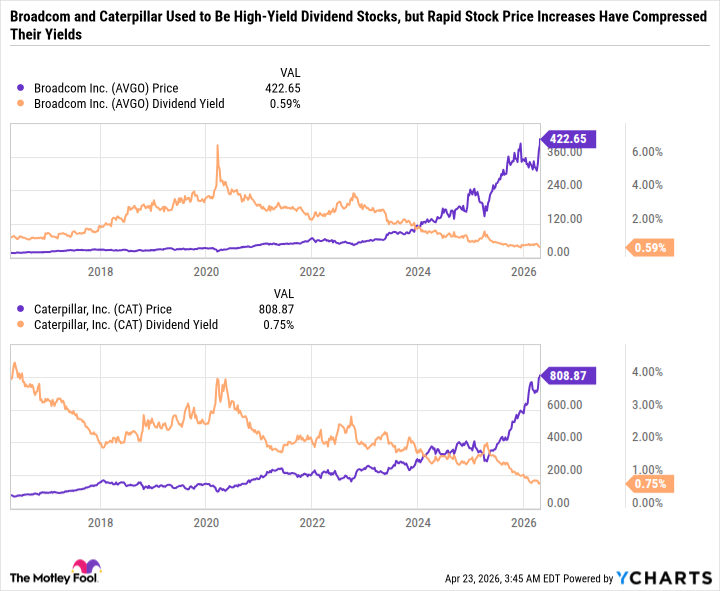
As you can see in the chart, Broadcom spent the better part of the last decade yielding well over 2%. But its soaring stock price has compressed its yield despite consistent dividend raises.
A similar dynamic has played out with Caterpillar, which is also a top 10 holding in the Vanguard High Dividend Yield ETF. But like Broadcom, Caterpillar’s stock price has been outpacing its dividend growth rate, largely due to AI-driven demand for specialized industrial machinery.
The High Dividend Yield ETF won’t punish a stock for doing well. So over time, it has become an excellent balance of growth, income, and value rather than just a passive income play. The ETF sports a 21.5 price-to-earnings (P/E) ratio and a 2.4% dividend yield, compared to a more expensive 28.3 P/E ratio for the Vanguard S&P 500 ETF and a lower 1.2% yield. The High Dividend Yield ETF also has a low expense ratio of just 0.04%.
Investing in ETFs for the right reasons
Stock splits don’t change the value of the underlying security, but they do make it less expensive to buy a full share of a company by increasing the total share count. However, just because a stock or ETF undergoes a split doesn’t automatically make it a compelling buy. And recent research by The Motley Fool shows that stock splits have mixed results.
Investors interested in including Broadcom in a basket of growth stocks may want to take a closer look at one of the four recently split Vanguard ETFs that hold the stock. But investors looking for more passive income at a better value and greater Broadcom exposure may prefer the Vanguard High Dividend Yield ETF.
Search
RECENT PRESS RELEASES
Related Post