Cadets use new technology to monitor the geospace environment • United States Air Force Ac
December 9, 2025
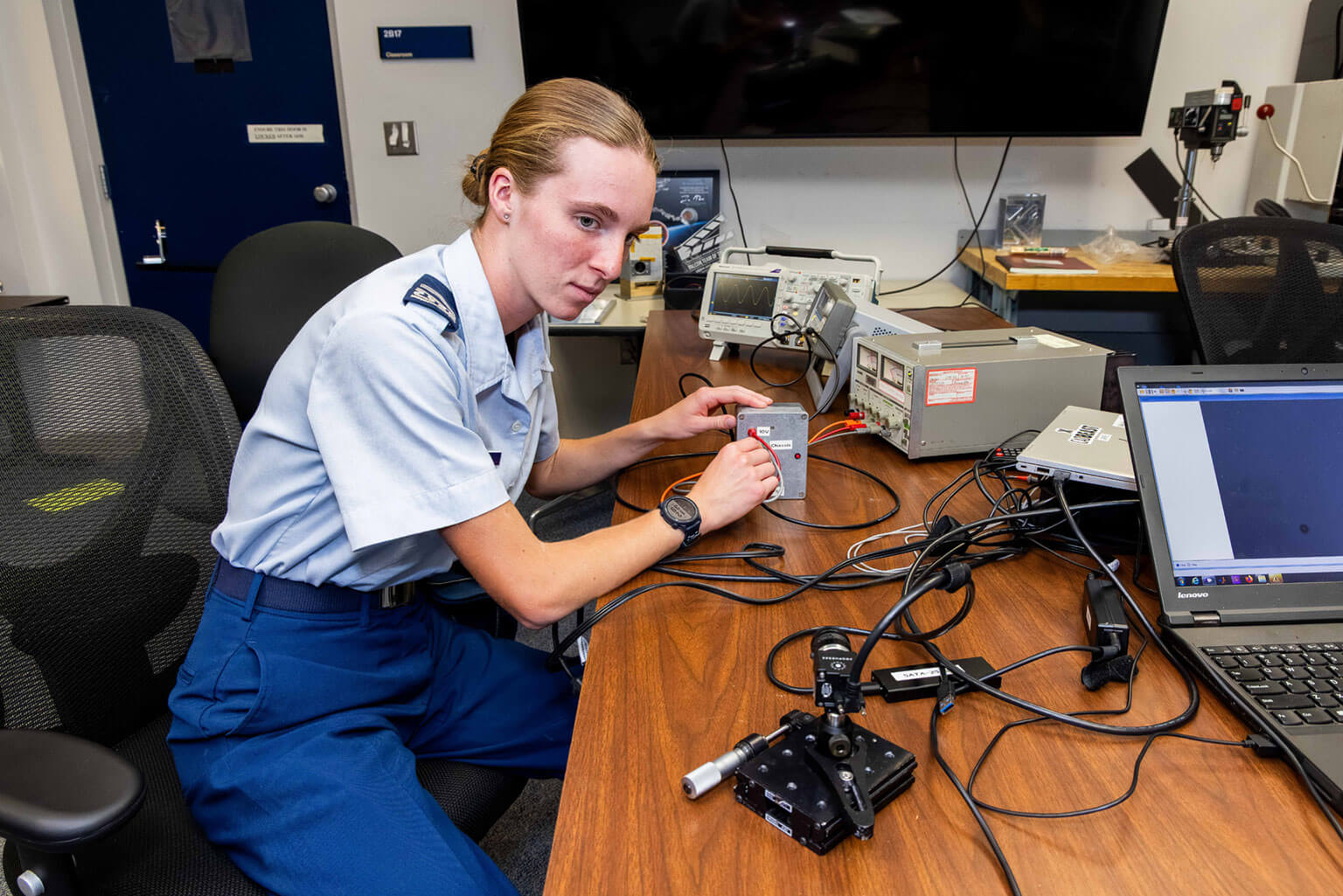
Cadet 2nd Class Anna Harden works with an event-based sensor, Space Physics and Atmospheric Research Center, U.S. Air Force Academy, Colo., Sept. 16, 2025. The sensor is used to detect nuclear detonations when monitoring the geospace environment. (U.S. Air Force photo by Trevor Cokley)
By Harry Lundy
U.S. Air Force Academy Strategic Communications
U.S. AIR FORCE ACADEMY, Colo. – In the Department of Physics and Meteorology at the U.S. Air Force Academy, cadets gain experience building payloads. In the department’s Space Physics and Atmospheric Research Center (SPARC), their latest project in the International Space Station is the Falcon Optical Defense and Intelligence through Neuromorphics (ODIN) camera. With this technology, cadets gather and analyze data to predict events in the near-Earth orbit of space, increasing awareness in the contested space domain.
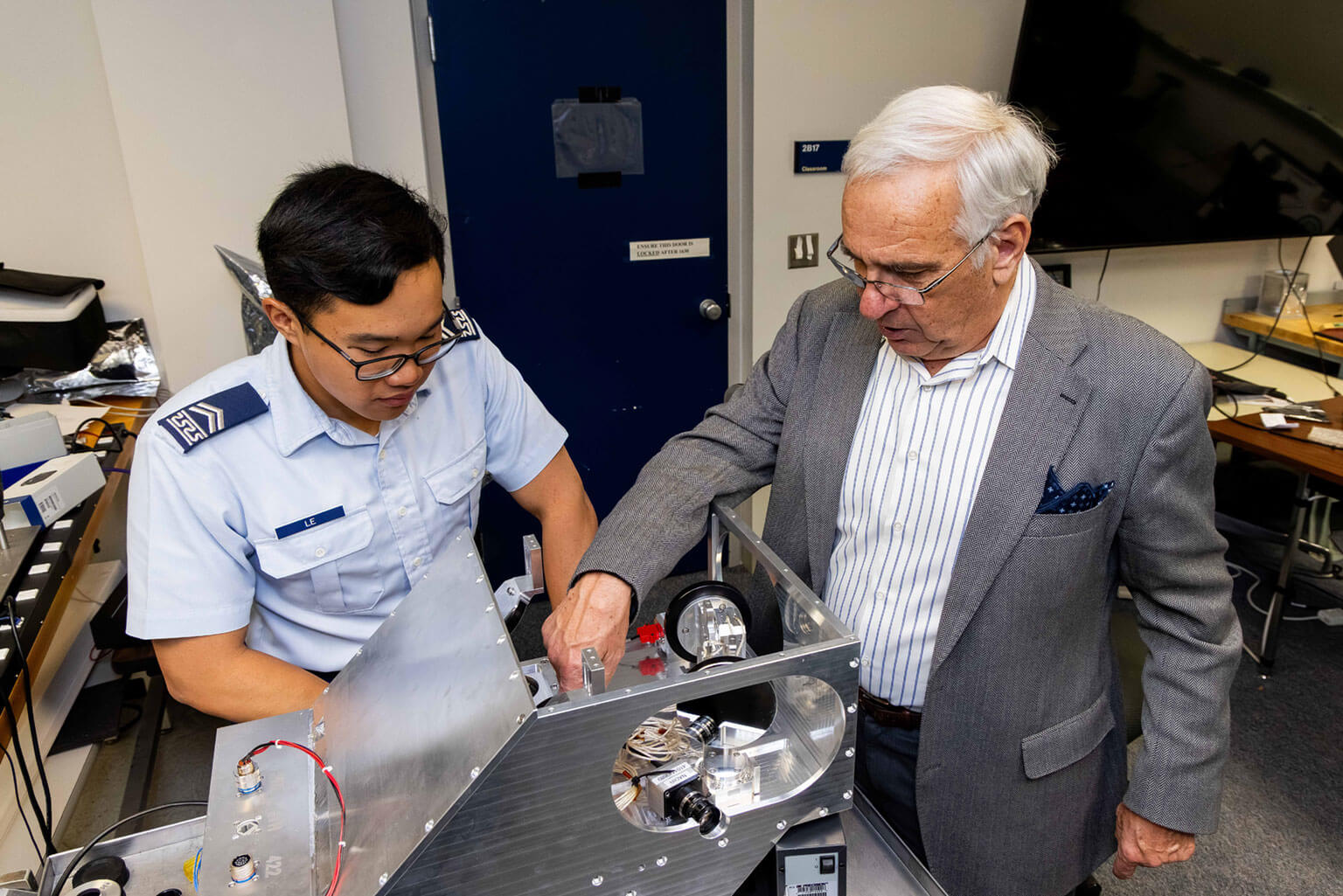
Cadet 2nd Class Alexander Le and Dr. Matthew McHarg examine the optics on the engineering unit of Falcon Optical Defense and Intelligence through Neuromorphics, Space Physics and Atmospheric Research Center, U.S. Air Force Academy, Colo., Sept. 16, 2025. Le is the lead cadet compiling data monitoring the geospace environment. (U.S. Air Force photo by Trevor Cokley)
Critical thinking is challenged
Falcon ODIN is an event-based camera attached to the International Space Station. It uses a neuromorphic camera that operates more like the human eye than a regular camera. It can track items that move fast across its field of view.
With this new technology comes new problems that challenge what cadets learn in the classroom and require them to use critical thinking, according to Cadet 2nd Class Alexander Le, a double major in astronautical engineering and physics.
“Our critical thinking skills are challenged by data that is non-uniform and non-linear,” said Le. “This has made me go back to the fundamentals from class and take a deeper look at how to interpret data.”
This experience has impacted his future plans and goals.
“It also made me realize that I want to be a physicist.”
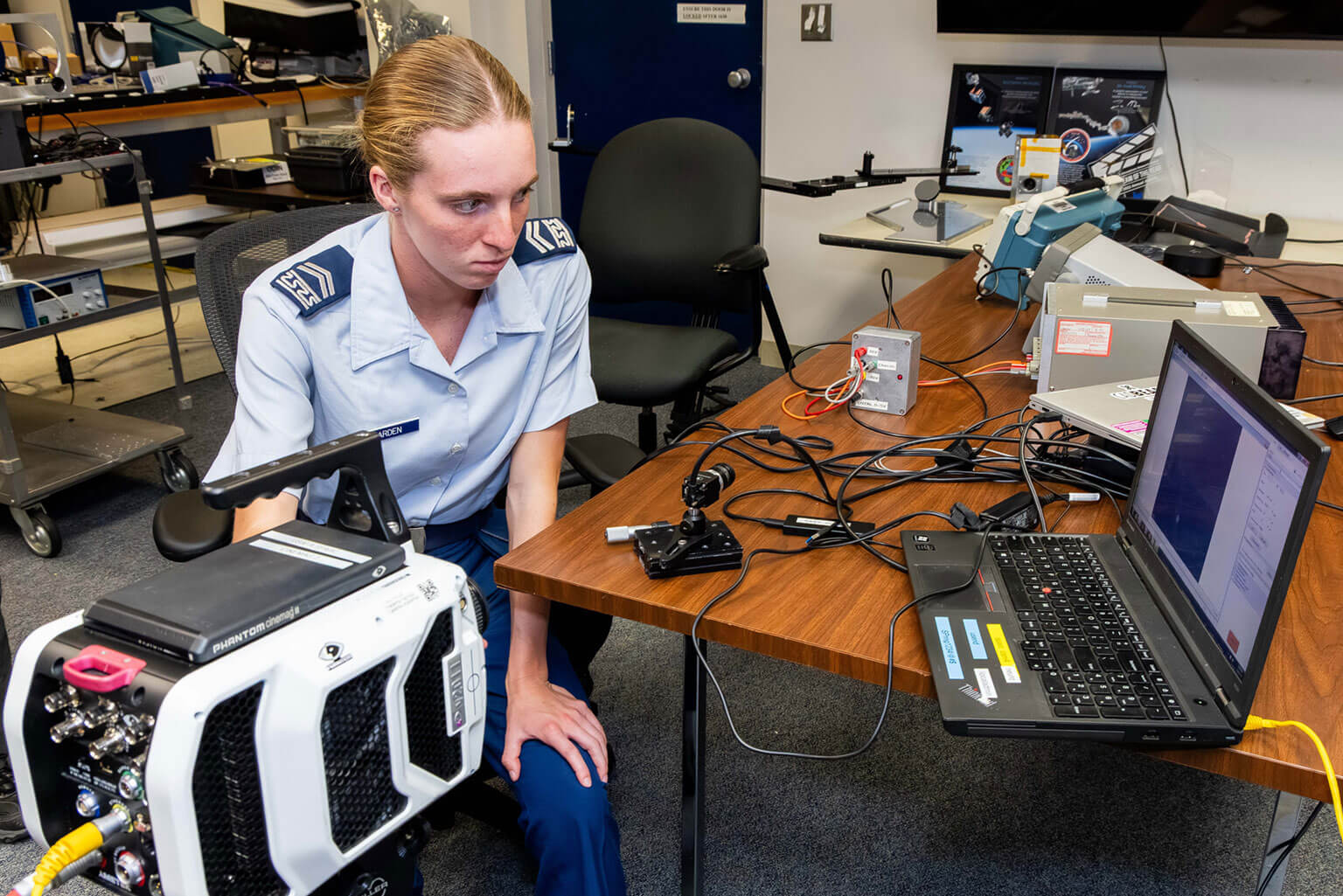
Cadet 2nd Class Anna Harden compares the high-speed Phantom camera, left, with the event-based sensor camera, right, Space Physics and Atmospheric Research Center, U.S. Air Force Academy, Colo., Sept. 16, 2025. The compact event-based camera monitors the geospace environment at 10,000 frames per second compared to the 1,850 fps of the Phantom. (U.S. Air Force photo by Trevor Cokley)
Increasing capabilities and reliable nuclear detection in space
Since its launch in April, cadets and faculty employ the Falcon ODIN camera to develop innovative methods for utilizing data to monitor spacecraft and detect fast-moving objects within the atmosphere.
The new technology also enables the camera to function as a bhangmeter- a specialized imaging radiometer- which detects atmospheric nuclear detonations.
“The research we are doing is important because reliable nuclear detection in space or the atmosphere is critical for national security and defense,” said Cadet 2nd Class Anna Harden, an electrical and computer engineering major. “This project supports developing more advanced detection methods.”
Harden is also learning skills that will apply to her future career.
“This is teaching me the valuable skills of critical thinking, decision making and understanding rapidly changing situations,” Harden said. “All of these are important in any operational environment I may be in after graduation.
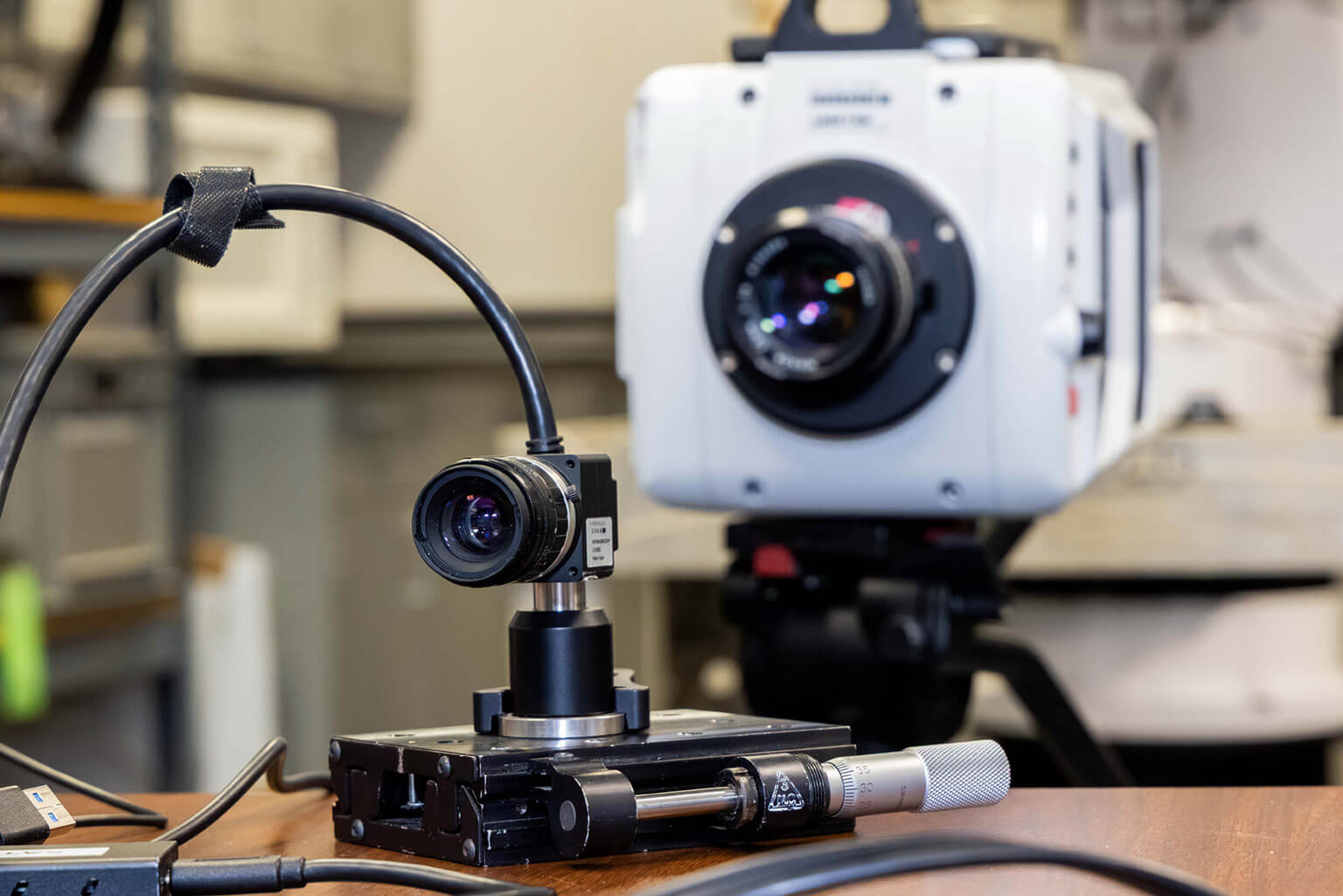
The $4,500 event-based camera, foreground, has the same effective capability as the Phantom camera, in monitoring the geospace environment, Space Physics and Atmospheric Research Center, U.S. Air Force Academy, Colo., Sept. 16, 2025. The event-based camera provides a lighter payload and provides cost savings of $180,500. (U.S. Air Force photo by Trevor Cokley)
Partners with purpose
The event camera on Falcon ODIN has a faster-than-real-time recording capability, running at 10,000 frames a second. This is important for detecting challenging threats such as hypersonic re-entry vehicles, missiles or fast-moving aircraft.
The Air Force Research Laboratory Space Vehicles Directorate works with SPARC, helping design experiments that cadets can analyze and use in their research.
“Our partnership has a lot to do with space domain awareness, which is very important to the Space Force,” said Dr. Mathew McHarg, director of SPARC. “We can also track fast-moving things on earth, which is important to the Air Force.”
The technology helps achieve a Department of War priority of deterrence through defending our homeland in the space domain.
Additionally, McHarg and the cadets hope that this experiment will help the Space Force improve the tracking of active and inoperable satellites, as well as debris, and better distinguish between them, including their locations and activities.
“By analyzing real national security problems, this project emphasizes the need for military readiness,” said Harden.
Learn more about the Academy’s research centers.
Search
RECENT PRESS RELEASES
Related Post