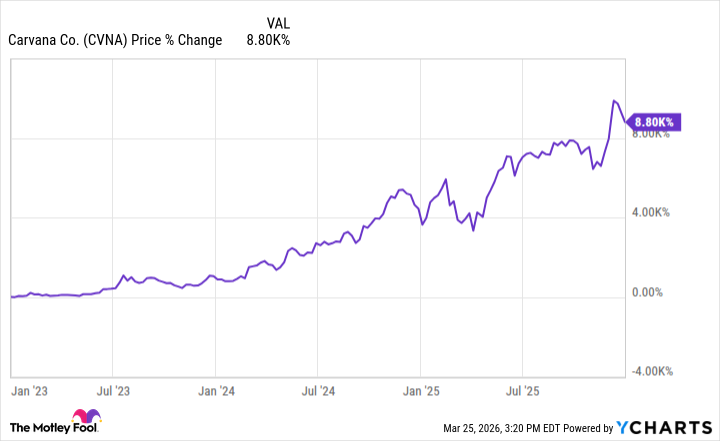
Carvana Soared 8,800%, but Is Amazon About to Put a Stop to Its Lucrative Growth?
March 26, 2026
Investors who saw Carvana‘s (CVNA 2.33%) vision and believed in it were brave and risk-tolerant. And if they were lucky enough to invest at the beginning of 2023, they enjoyed a huge turnaround in the business, with a hypothetical $10,000 investment growing to roughly $890,340 by the end of 2025.
That growth caught the eye of investors as well as competitors, with Amazon (AMZN 1.97%) flexing its e-commerce muscles and joining the fray. But don’t panic, Carvana investors! Here’s why.
Data by YCharts.
Amazon joins the fight
While the core automotive industry is quickly evolving toward electric vehicles (EVs), software-defined vehicles, and driverless cars, the retail side of it is also shifting rapidly. The sector was ripe for disruption: It was highly fragmented, and consumers had grown tired of the typical time spent with dealerships and salespersons. Carvana took quick advantage of this, and with its e-commerce vehicle buying strategy, it made quick but expensive progress expanding its business.
According to Allied Market Research, the trend is still in its early stages, and online car buying is expected to triple by 2030. But now, Carvana investors have a new challenge to consider: Amazon.

Carvana
Today’s Change
(-2.33%) $-7.19
Current Price
$301.37
Amazon Autos is a dealer-first digital marketplace that’s helping the traditional brick-and-mortar retailers expand their reach through its e-commerce prowess.
More specifically, local dealers will list their vehicle inventory on the Amazon Autos marketplace and will retain control of the transaction, pricing, service agreements, and financing. Buyers will be able to browse Amazon vehicle listings, process a trade-in, submit a down payment, apply for financing, and schedule a pickup time through a typical Amazon shopping experience.
The good news for Carvana investors is that Amazon isn’t yet competing directly with its business.
Complement or competition?
Here’s the kicker regarding Amazon’s auto entry: The company isn’t taking a cut of the transaction, and dealers keep the profit — so far, it is only monetizing this effort through advertising.
Where Carvana is vertically integrated and replaces the traditional dealership, Amazon is instead building a marketplace in partnership with dealerships.
Carvana’s business is designed to give a buyer in any location access to inventory across the U.S. and have it delivered. Amazon Autos currently doesn’t replicate this ability; it simply gives users the ability to browse and complete transactions with local dealerships’ inventory, and is still limited to the distance consumers are willing to travel for pickup.

A Carvana vending machine. Image source: Carvana.
What it all means
Carvana has built a very effective auto retail business, and it’s currently thriving and poised to continue as the highly fragmented retail auto industry consolidates. Its competitive advantages scale up in many ways that brick-and-mortar dealerships don’t, and for now, Amazon isn’t helping dealerships fight that battle.
Investors who should be a little more concerned are likely those who own shares of online listing sites, such as CarGurus and Cars.com, rather than fully integrated retailers. That said, Amazon dipping its toes into the retail auto market means it’s really only a step away from becoming a true threat to Carvana, and investors would be wise to consider this when starting a long-term position.
Search
RECENT PRESS RELEASES
Related Post