China has become ‘training ground’ for global carmakers
May 6, 2026
Home>>People’s Daily Online Exclusives
By He Yin (People’s Daily) 11:03, May 07, 2026
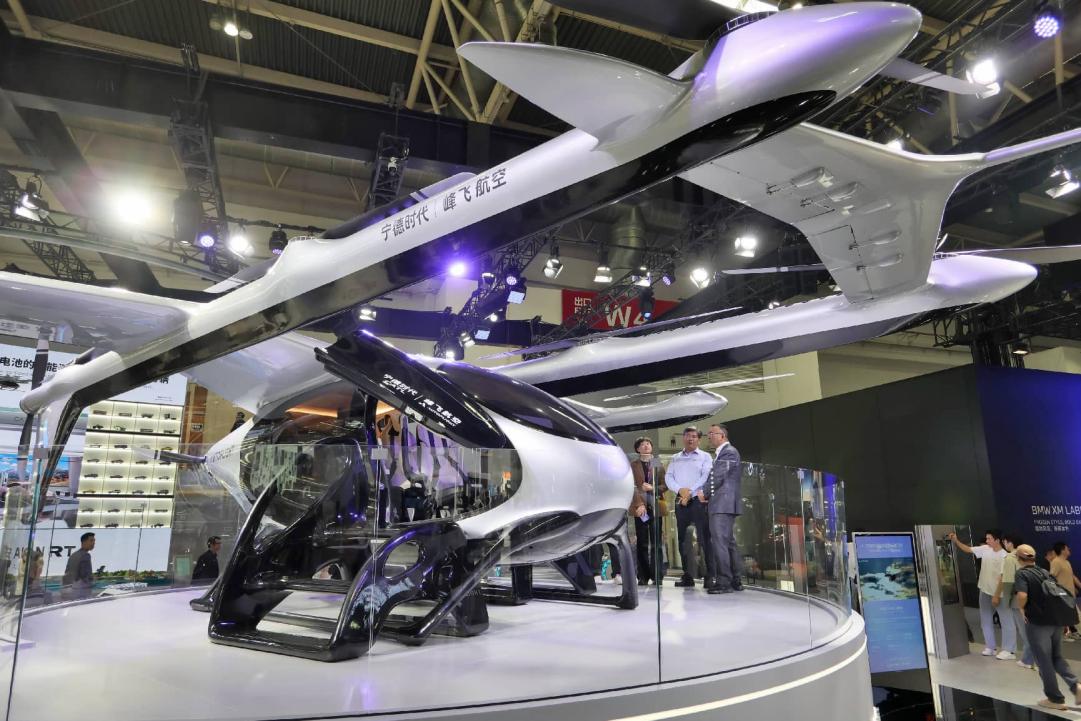
A V2000EM, a manned electric vertical take-off and landing aircraft, is exhibited at the booth of Chinese power battery company CATL at the Auto China 2026. (Photo/Tang Ke)
China has become an indispensable “training ground” for global carmakers, an arena where rapid technological iteration and fast-changing consumer demand are pushing the industry to evolve at unprecedented speed.
At the just-concluded 2026 Beijing International Automotive Exhibition (Auto China 2026), which once again set a new record for scale among global auto shows, this dynamic was on full display.
“China is like a ‘gym’ for the automotive industry. Nowhere else sees such fast technological iteration or such rapidly shifting user demand,” said Oliver Blume, chairman of the Board of Management of Volkswagen AG.
His analogy captures the unique appeal of the Chinese market. As some international observers have noted, “the Auto China 2026 confirmed China as the new center of the automotive industry,” “China is becoming a key hub for exporting next-generation vehicles to global markets,” and “this is not just an auto show, but a story of industrial transformation.”
What makes China such a critical “gym” for global automakers? Beyond the buzz of packed exhibition halls, the answer lies in a shift from the traditional “scale dividend” to a more competitive “ecosystem dividend.”
Chinese brands, leveraging advances in intelligent technologies, are achieving leapfrog development and moving steadily toward the mid-to-high end of the global value chain, demonstrating strong competitiveness worldwide.
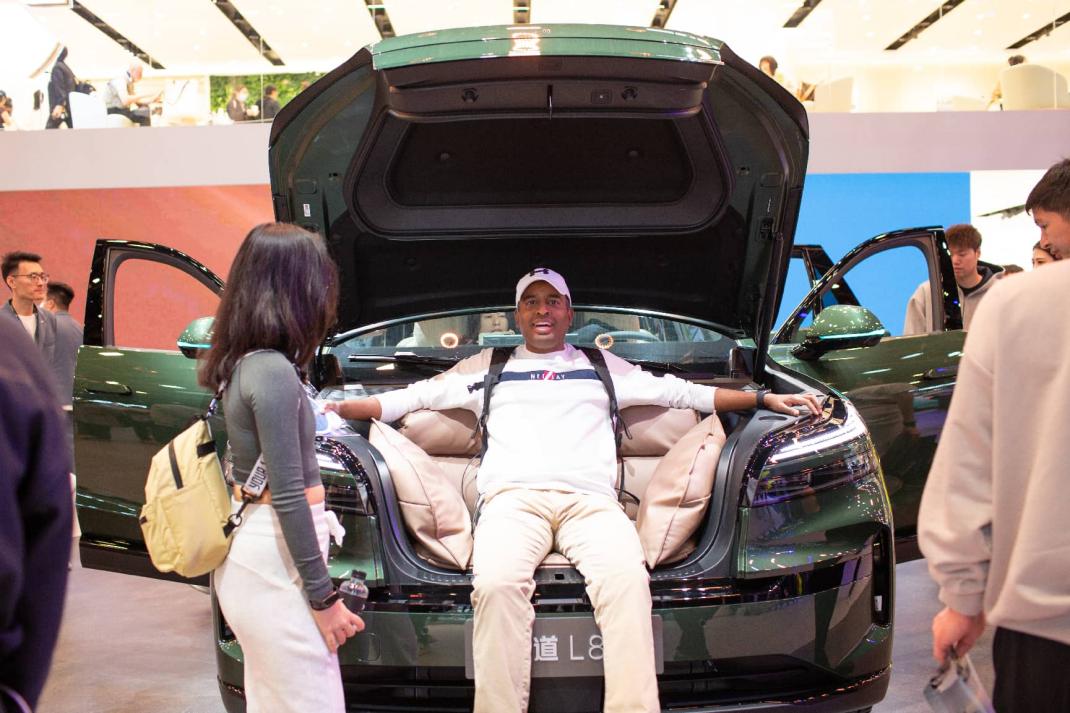
A foreign visitor poses for a picture with an L80, a pure electric model developed by Chinese automaker ONVO, at the Auto China 2026. (Photo/Zhang Lixin)
At the Auto China 2026, Chinese automakers unveiled a series of flagship models featuring innovations such as power batteries with ranges of up to 1,500 kilometers, AI-driven intelligent cabins, and advanced driver-assistance solutions geared toward Level-3 autonomous driving. These technologies highlighted China’s leading edge in intelligent, connected new energy vehicles.
An executive from a foreign automaker noted that while traditional multinational companies once took four to five years to develop a new vehicle model, a development cycle of 2 to 2.5 years has now become the new norm in China.
By deeply engaging with the Chinese market and fully understanding local demand, many development challenges can be resolved more efficiently, producing a powerful “amplification effect,” the executive added.
China’s vast, open and inclusive market provides fertile ground for deep collaboration between domestic and international companies. Since the Auto Shanghai 2023, many multinational automakers have come to recognize China’s advantages in key technologies and supply chains for smart electric vehicles, prompting them to shift more of their research and development (R&D) functions to China. At the Auto China 2026, these companies have entered a phase of intensive launches of “localization 2.0” products.
The logic of cooperation between Chinese and foreign automakers has also undergone a profound transformation. Foreign companies have moved beyond simple vehicle manufacturing or basic technology transactions, choosing instead to integrate deeply into China’s innovation ecosystem and pursue comprehensive collaboration.
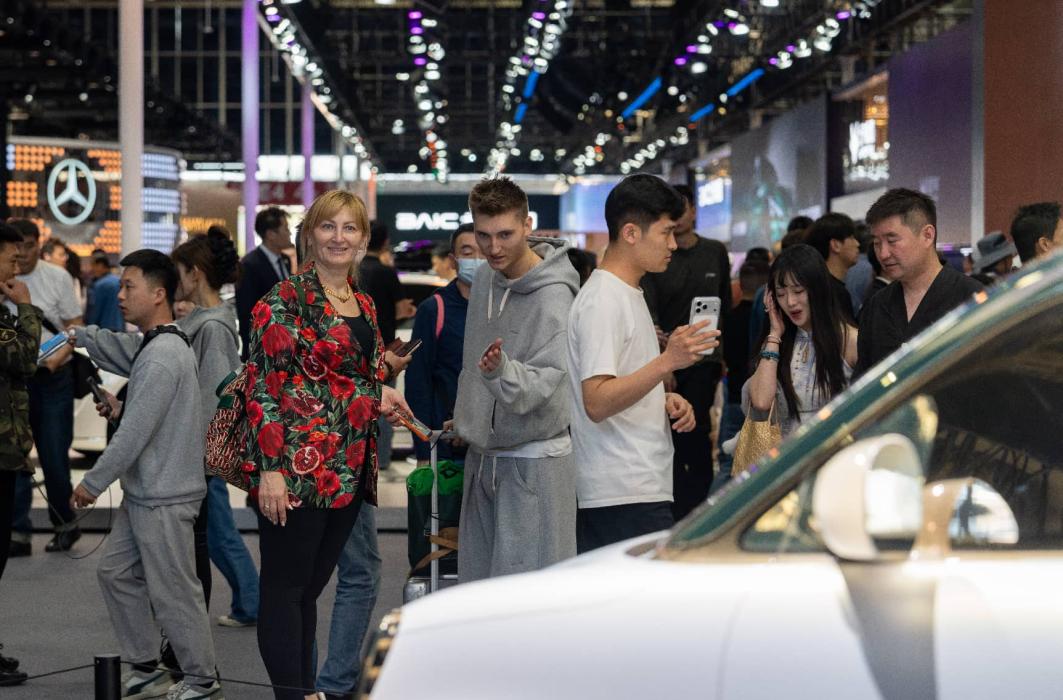
Chinese and foreigners visit the Auto China 2026. (Photo/Zhou Xiaoqin)
Volkswagen offers a clear example: through close cooperation with Chinese partners, it developed a new localized electronic and electrical architecture in just 18 months. Its advanced driver-assistance competence center in China has shortened R&D cycles by 30 percent and reduced platform development costs by 50 percent.
From “in China, for China” to “in China, for the world,” multinational automakers are no longer treating China merely as a sales market but as a global hub for innovation and exports. Some Japanese and German automakers plan to introduce new energy vehicles developed and produced in China to international markets, while several French companies have identified China as a global testing ground and innovation incubator to support worldwide vehicle development.
As the industry shifts from “product exports” to “system exports,” technologies and management models refined through the Chinese market are comprehensively empowering the global automotive industry.
An open arena allows all participants to leverage their strengths and share progress. Looking ahead, China will continue to foster a fair, efficient, and dynamic development platform with an open and inclusive approach, working with all parties to advance the global automotive industry and inject fresh momentum into the world economy.
(Web editor: Zhong Wenxing, Liang Jun)
Search
RECENT PRESS RELEASES
Related Post