China’s desert solar farms are reshaping entire ecosystems
December 12, 2025
In China’s high-altitude deserts, utility-scale solar is doing more than making electricity—it’s cooling soils, trapping moisture, and giving hardy plants and microbes a foothold. New field data suggest that, when well sited and managed, large photovoltaic parks can nudge degraded land toward recovery.
From Barren Sands to Thriving Landscapes
For years, solar energy has been hailed as one of humanity’s best answers to the climate crisis. But what if solar panels did more than just power homes and cities? What if they could also breathe new life into the very landscapes they occupy? That’s exactly what scientists in China have explored—and their findings could change how we think about renewable energy.
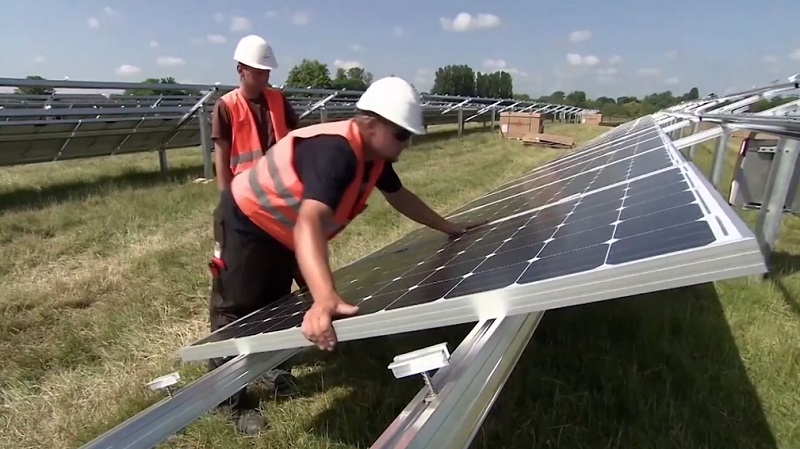
In the vast Talatan desertified zone of Qinghai Province, a sea of panels stretches across the horizon. This is the Gonghe Photovoltaic Park—assessed in recent studies at roughly the gigawatt scale on site¹—whose significance goes far beyond electricity.
Researchers affiliated with Xi’an University of Technology have monitored the park for years. Their on-the-ground measurements indicate that beneath and around the arrays, formerly barren land shows signs of recovery: vegetation is returning, soils are improving, and small ecosystems are re-forming. In quantitative terms, the on-site ecological index was rated “general” and substantially higher than nearby transition and off-site areas (on-site ≈0.439 vs. ≈0.286/0.280), with gains tied to microclimate moderation, soil properties, and biodiversity.²
How Shade Creates Life in the Desert
A little shade goes a long way. By intercepting direct sun, panels lower ground temperatures and slow evaporation, helping precious moisture linger in arid soils. That moisture supports hardy plants and the microbial communities that kick-start nutrient cycles—creating a self-reinforcing microclimate where life can take hold.
Did you know?
At Gonghe, on-site areas classified as “general” outscored adjacent desert rated “poor,” reflecting cooler soils and higher moisture that favor plant and microbe recovery—signals of early ecological renewal.
A Symbiosis Between Technology and Nature
To evaluate impacts systematically, researchers applied the DPSIR framework—Driving forces, Pressures, State, Impacts, Responses—originally developed and widely used by the European Environment Agency.³ The approach let them track 50+ indicators spanning climate, soils, vegetation, and management. The headline result: under these conditions, desert solar development correlated with better local ecological scores than surrounding land, suggesting coexistence—and even mutual benefit—when projects are thoughtfully designed and operated.
Complementary reviews have reported similar patterns at other desert sites in China, including reduced wind erosion, more stable soils, and localized “greening” linked to photovoltaic programs that pair energy generation with land restoration.⁴
The Importance of Balance and Foresight
None of this is a license to build anywhere. The relationship between solar arrays and desert ecosystems is complex and still evolving. Long-term monitoring remains essential to confirm durability of benefits and catch trade-offs early. Site selection matters, too: avoiding sensitive habitats and migration corridors, minimizing fragmentation, and planning for decommissioning are all part of designing with ecology in mind—not only efficiency.
A New Vision for the Planet’s Driest Places
The notion that deserts—once shorthand for emptiness—could host both clean-power hubs and pockets of life is compelling. With careful planning, the world’s harshest regions may serve double duty, generating electricity while supporting ecological renewal.
As the global shift to renewables accelerates, China’s desert solar complexes offer a clear reminder: progress and preservation don’t have to be at odds. Sometimes, innovation changes more than our technology—it changes the ground beneath our feet.
Footnotes
- PV Magazine — “Large-scale PV has positive environmental effect on desert areas” — URL: https://www.pv-magazine.com/2024/10/10/large-scale-pv-has-positive-environmental-effect-on-desert-areas/
- Scientific Reports (Nature) — “Assessment of the ecological and environmental effects of large-scale photovoltaic development in desert areas” — URL: https://www.nature.com/articles/s41598-024-72860-8
- European Environment Agency — “DPSIR” — URL: https://www.eea.europa.eu/help/glossary/eea-glossary/dpsir
- Sustainability — “Solar photovoltaic program helps turn deserts green in China” — URL: https://krichlab.ca/wp-content/uploads/2023/06/Xia-et-al.-2022-Solar-photovoltaic-program-helps-turn-deserts-gree.pdf
Similar Posts

Brian is a journalist who focuses on breaking news and major developments, delivering timely and accurate reports with in-depth analysis.
[email protected]
The first 10 people to submit it via the form that appears after you share will win a surprise prize!
Good luck
Search
RECENT PRESS RELEASES
Related Post