Cross-Cutting / Intersectional Impact: May 2026 Funding Opportunities (16 new opportunitie
May 4, 2026
86 active signals; $200M+. The DIV Fund reopens as USAID DIV’s successor while capital infrastructure for the missing middle emerges as a distinct funding category.
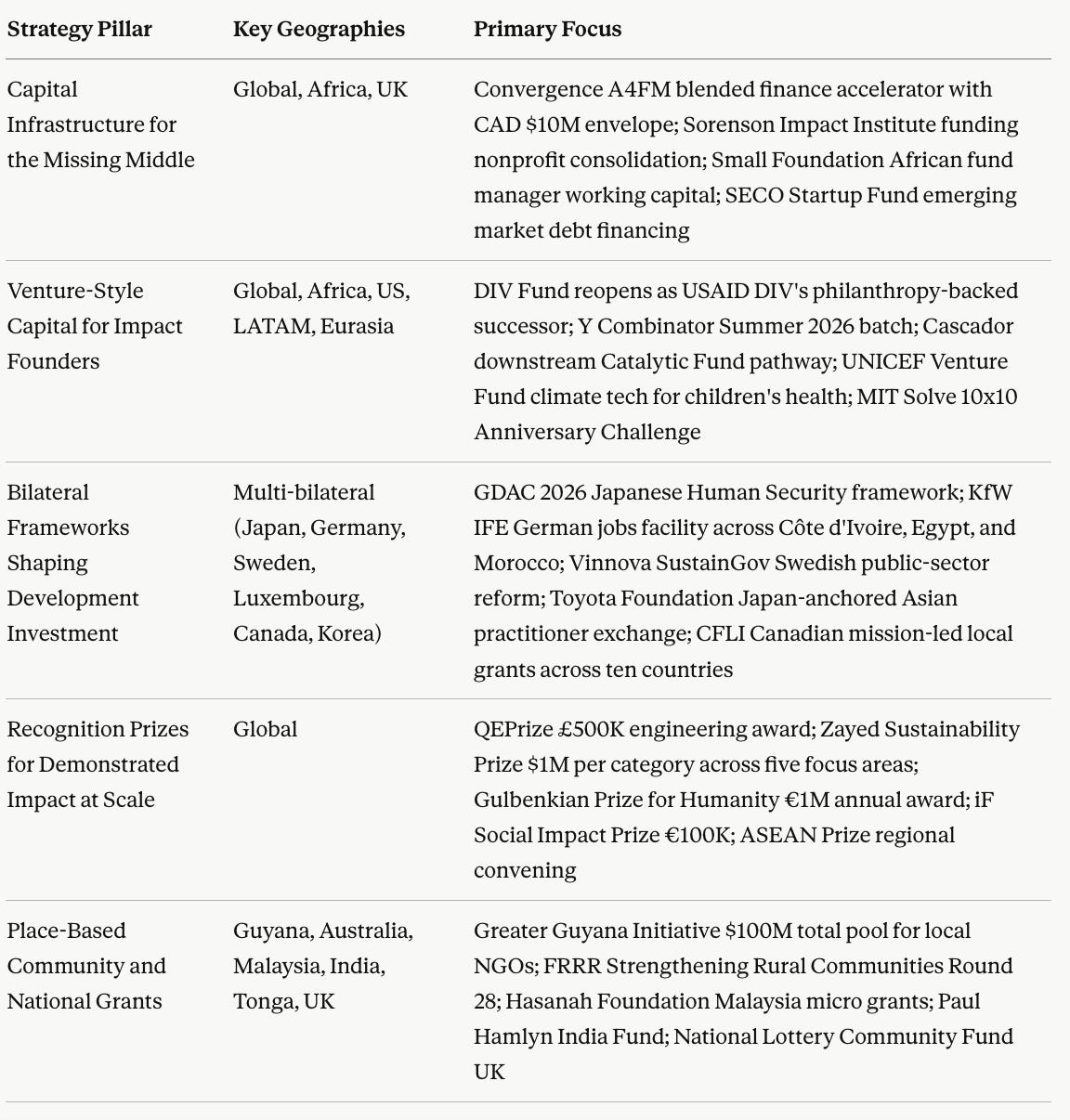
The May update for Cross-Cutting / Intersectional Impact brings new calls that cluster around three distinct movements: capital infrastructure work moving upstream into a distinct funding category of its own, venture-style capital for impact founders consolidating across emerging markets with the DIV Fund’s reopening as the headline event, and bilateral funder frameworks becoming the structural spine of project design rather than a context to acknowledge.
In Capital Infrastructure for the Missing Middle, the dominant signal this month is that funders are investing in the infrastructure that deploys capital, not just deploying capital themselves. Convergence Blended Finance’s new A4FM accelerator (CAD $10M envelope) provides catalytic grants and capacity building specifically for fund managers structuring blended finance vehicles, with staged support from scoping through scale-up. Sorenson Impact Institute’s Collaboration Fund explicitly funds nonprofit consolidation and field-level integration in impact investing, treating mergers and shared services as field-building strategy rather than organizational decline. Small Foundation has launched two pilot facilities to provide working capital for African fund managers reaching first close. SECO’s Startup Fund deploys CHF 5M in debt financing to post-revenue companies across emerging economies. CAF Venturesome’s £50K-£1M repayable finance facility offers blended options for UK charities and social enterprises. The pattern: funders are increasingly betting that capacity-building for the financial intermediaries who deploy capital multiplies impact across entire vehicle ecosystems more efficiently than direct grantmaking alone.
In Venture-Style Capital for Impact Founders, Geographically Distributed, the headline event is the DIV Fund’s reopening as USAID DIV’s philanthropy-backed successor, preserving the tiered evidence-driven architecture (Stage 1 pilots up to $200K, Stage 2 testing up to $750K, Stage 3 scale up to $1.5M) that made DIV one of the most influential innovation grant mechanisms in development. Around it, an unusually crowded competitive set of founder-stage capital programs converges: Y Combinator’s Summer 2026 batch with its $500K standard deal, Cascador’s ScaleUp Program with downstream access to its $2-5M annual Catalytic Fund deployed through Sterling Bank, 500 Global Eurasia (post-Soviet markets), Baobab Network ($100K seed for African startups), Ganas Ventures (LATAM community-driven), Beta Boom (US software explicitly outside the Bay Area), Blue Ridge Labs Founder Fellowship (NYC tech-for-good), MIT Solve’s 10×10 Anniversary Challenge ($100K x 10 winners), and UNICEF Venture Fund’s new Climate Tech for Children’s Health call. The pattern: equity-free and equity-light deal flow is consolidating around founders building for emerging markets, and non-Silicon Valley geography is increasingly an explicit feature of the thesis rather than a barrier to overcome.
In Bilateral Frameworks Shaping Development Investment, several calls this month explicitly anchor in funder frameworks rather than treating the funder’s identity as incidental. GDN’s GDAC 2026, backed by Japan’s Ministry of Finance through the World Bank-managed PHRD Trust Fund, requires applicants to explicitly frame proposals around the Japanese “Human Security” principle. The Toyota Foundation’s International Grant Program is structurally Japan-anchored, requiring the team representative to be Japan-based even as projects span East, Southeast, and South Asia. Japan’s GGP grassroots human security mechanism is running parallel calls in Zambia and Uganda. Sweden’s Vinnova has launched its SustainGov public-sector reform call, requiring multi-level public sector ownership across organizational boundaries. Germany’s KfW IFE deploys €800K-€10M per project across Côte d’Ivoire, Egypt, and Morocco with optional German labor market pathway components. Luxembourg’s LuxAid BPF requires partnerships led by a Luxembourg or EU enterprise. Canada’s CFLI runs ten parallel mission-led calls across Morocco, Kosovo, Ecuador, Venezuela, Belize, Guatemala, Ghana, Sierra Leone, Togo, and Armenia. The pattern: funder framework is becoming the spine of project design, not a context to acknowledge. Applicants who can articulate work natively in the funder’s home framework have a structural advantage over those who translate an existing program into the funder’s language at the application stage.
For practitioners building or running an impact venture, this month’s lineup is unusually deep. The DIV Fund’s reopening alone is a major signal: the same evaluation rubric and cost-per-outcome standards that USAID DIV used are now back in play through philanthropic capital, and prior DIV grantees have a structural advantage given the inherited model. Pair DIV applications with the founder-stage opportunities most aligned to your geography (Cascador for Sub-Saharan Africa, Baobab for Africa, Ganas for LATAM, 500 Global for Eurasia, Beta Boom for US-outside-the-Bay), and consider MIT Solve 10×10 if your venture is past pilot and approaching scaling capital. For organizations sitting in the impact investing infrastructure layer (fund managers, intermediaries, ecosystem-building nonprofits), Convergence A4FM, Sorenson Collaboration Fund, and Small Foundation are the three most directly relevant calls, and the alignment requires showing how your work strengthens the field’s capacity to deploy capital, not just your own organization’s effectiveness. For applicants pursuing larger institutional grants, the bilateral framework calls (GDAC, KfW IFE, Vinnova SustainGov, LuxAid BPF) reward applicants who can write natively in the funder’s home framework. For US-headquartered nonprofits implementing in LMICs, The International Foundation Grant 2026 is the cleanest small-grant program of the month at $50K-$100K, with full proposals due June 1 from invited LOI applicants.
Snapshot of New Opportunities
Total Estimated Funding Pool: $200 Million+ USD
The grants are organized into three categories:
-
Open Calls: Current grant and opportunities with a deadline. Grants are listed by closing date. 35 open opportunities- 16new opportunities added!
-
Rolling Applications: current grant and opportunities with rolling applications (but it’s still best to submit as early as possible). 43 rolling opportunities!
-
Long term planning: Grants that have closed their current rounds, but are expected to open new windows. 8 long term opportunities!
A quick tip for returning readers: if you want to jump straight to the newest additions, use CTRL F to search for “New!” and navigate quickly to the latest funding opportunities
This post is for paid subscribers. This helps support the time and effort it takes to curate and organize these opportunities.
To keep this accessible to everyone who needs it, we’re happy to offer pay what you can rates. You can find more details here.
Open Calls:
Canada Fund for Local Initiatives (CFLI) – Open calls, Global Affairs Canada. *New!* *Multiple opportunities closing soon*
Canada’s CFLI is a small-grants mechanism run through Canadian embassies and high commissions to fund locally led, implementation-ready projects that can demonstrate measurable results under Canada’s international assistance priorities. The fund’s logic is catalytic: it favors tightly scoped initiatives that translate a clear problem statement into a practical activity plan, credible local delivery capacity, and outcomes that can be communicated cleanly to mission decision-makers. While each country program sets its own thematic emphasis and grant-size norms, most calls prioritize combinations of inclusive governance, peace and security, gender equality, human dignity, growth that works for everyone, and environment and climate action, with selection typically made by an embassy-led committee. The most reliable workflow is: pick the mission page for your country, confirm thematic fit, and submit using the mission’s required template and channel (often email), by the mission’s time-zone deadline.
-
Geographies: Morocco, Kosovo, Ecuador, Venezuela, Belize, Guatemala, Ghana, Sierra Leone, Togo, Armenia.
-
Who can apply: Local nonprofits/NGOs and academic institutions; eligible local government institutions or agencies implementing locally focused projects.
-
Funding amount: Grants range CAD $15,000-49,000.
-
Targeted Sectors / SDGs: Community Development; Focus areas: inclusive governance, peace and security, gender equality, human dignity, environment and climate action.
-
Deadline: Morocco (May 1), Kosovo (May 6), Ecuador (May 6), Venezuela (May 8), Belize (May 8), Guatemala (May 8), Ghana (May 10), Sierra Leone (May 10), Togo (May 10), Armenia (May 15).
CFLI selection is “mission logic” funding: the strongest proposals read like a practical memo to the embassy committee, showing tight alignment to that mission’s priorities, realistic deliverables within the grant period, and clear, verifiable results.
Blue Ridge Labs Founder Fellowship (2026 Cohort), Robin Hood. *Closing soon!*
Blue Ridge Labs, Robin Hood’s venture studio, seeks to convert high-conviction ideas into fundable, tech-enabled ventures that expand economic mobility. The Founder Fellowship is structured to reduce the classic early-stage failure points (unclear problem-solution fit, weak user insight, and limited build capacity) by pairing weekly operator-led programming with hands-on support from engineers, designers, and product experts, plus direct user feedback via Blue Ridge Labs’ community research access. The $20,000 stipend is positioned as execution capital: it helps founders go heads-down on validation and MVP-building while leveraging Robin Hood’s network for visibility and early credibility. The selection logic favors founders who can articulate a problem tied to Robin Hood’s poverty-fighting priorities and demonstrate lived or learned proximity to the communities they aim to serve.
-
Geographies: United States (program includes co-working at the BRL Lab in Brooklyn).
-
Who can apply: Early-stage founders aligned to Robin Hood issue areas; no prototype or co-founder required.
-
Funding amount: USD $20,000 stipend.
-
Targeted Sectors / SDGs: Innovation & Technology; Focus areas: economic mobility, tech for good, idea-to-MVP venture building, user research, fundraising readiness.
-
Deadline:May 3, 2026.
This fellowship rewards “validated empathy”: the strongest applicants pair proximity to the problem with a clear plan to test, learn fast, and ship an MVP that low-income communities actually want to use.
Y Combinator Summer 2026 Batch Application,Y Combinator. *Closing soon!*
Y Combinator is seeking early-stage companies for its Summer 2026 batch, structured as an intensive, in-person program in San Francisco that pairs partner-level coaching with a tightly networked peer cohort and a culminating investor-facing Demo Day. The funder’s model is built around speed and execution: YC invests at acceptance, then helps founders sharpen product, iterate fast, and make fundraising and scaling decisions with experienced guidance and high-signal introductions. The program’s value proposition is less about curriculum and more about concentrated feedback loops, founder accountability, and access to a durable alumni community that continues well beyond the batch. Strong applications typically communicate a clear problem, a compelling user or customer wedge, and evidence the team can build and learn quickly under pressure.
-
Geographies: Global (program in San Francisco, USA).
-
Who can apply: Startups worldwide (eligibility details vary; refer to the application portal and FAQs).
-
Funding amount: USD $500,000 investment (standard deal).
-
Targeted Sectors / SDGs: Innovation & Technology; Focus areas: startup accelerator, seed investment, founder mentorship, SAFE financing, investor access.
-
Deadline:May 4, 2026 (8:00 PM PT).
This opportunity is optimized for founders who want to compress years of network-building and iteration into a single, high-intensity quarter.
Business Partnership Facility (BPF) Call for Proposals, 1st Edition 2026, LuxAid Business4Impact (LuxDev). *Closing soon!*
The BPF is designed to crowd in private-sector execution and local partnership capacity by co-financing commercially viable, SDG-aligned projects implemented in ODA-eligible developing countries. Its investment logic centers on additionality: the facility aims to unlock market validation and partnership-driven implementation work that companies are unlikely to finance alone, while requiring a credible pathway to financial sustainability beyond the co-funding period. BPF prioritizes partnerships that transfer know-how or technology, demonstrate shared value for all partners, and can move from pilot evidence to scalable delivery in a new market context. The structured process signals a preference for disciplined partnerships that can translate an initial concept into a robust business case and implementation plan backed by due diligence and selection review.
-
Geographies: ODA-eligible developing countries (OECD DAC list) with a Luxembourg or EU enterprise lead partner.
-
Who can apply: Partnerships with a Luxembourg or EU private enterprise (lead) plus a local partner established in an eligible developing country (public or private entity, university, research institute, or civil society).
-
Funding amount: Co-financing up to EUR €300,000 (max 50% of total project costs).
-
Targeted Sectors / SDGs: Economic Development & Livelihoods; Focus areas: feasibility studies, pilot implementation, market validation, technology and know-how transfer, commercial viability.
-
Deadline:May 8, 2026.
BPF is a “prove it and position it” facility, so the strongest submissions will show both why co-funding is necessary now and how pilot evidence converts into commercially sustainable scale.
Search
RECENT PRESS RELEASES
Related Post