DAILY DIGEST, 1/20: How long will extended dry spell continue?; As EPA ponders Clean Water
January 20, 2026
Several news sources featured in the Daily Digest may limit the number of articles you can access without a subscription. However, gift articles and open-access links are provided when available. For more open access California water news articles, explore the main page at MavensNotebook.com.
On the calendar today …
- WEBINAR: Basin Characterization Exchange: Working with AEM Data: Recovering the Information We Want from the Measurements We Make from 12:30pm to 1:30pm. With 25,000 line-kilometers of airborne electromagnetic (AEM) data in California there is an incredible opportunity recover from these measurements the information we need to advance sustainable groundwater management. Three examples will be described: 1) We are exploring approaches to mapping out the large-scale architecture, focusing at present on the major confining unit, the Corcoran Clay. 2) We are developing an improved methodology to transform measurements of electrical resistivity to models of sediment type. 3) Starting with derived sediment type models, we are using an efficient algorithm to find areas with “fastpaths” of coarse-grained material which can serve as suitable sites for recharge of the shallow aquifer. Presented by Rosemary J. Knight, Stanford University. Click here for more information and to register.
- Plastic pollution 101: History, impacts, and solutions for change from 2pm to 3pm. How did plastic become one of the most pervasive environmental challenges of our time—and what can we do about it? Plastic pollution has recently become a household topic, but this issue is so much more than a straw in a sea turtle’s nose or an sea bird’s belly fully of bottle caps. The real story behind plastic goes far deeper than meets the eye, and to understand, we must first travel back in time. Join Emily Parker, marine scientist and local plastic pollution expert, in an exploration of the history of plastic production and how we got to the modern era of plastic. She will cover the myriad of impacts plastic pollution has on both ecosystems and communities and the best solutions we have at our fingertips solve this prolific problem.” Click here to register.
In California water news today …
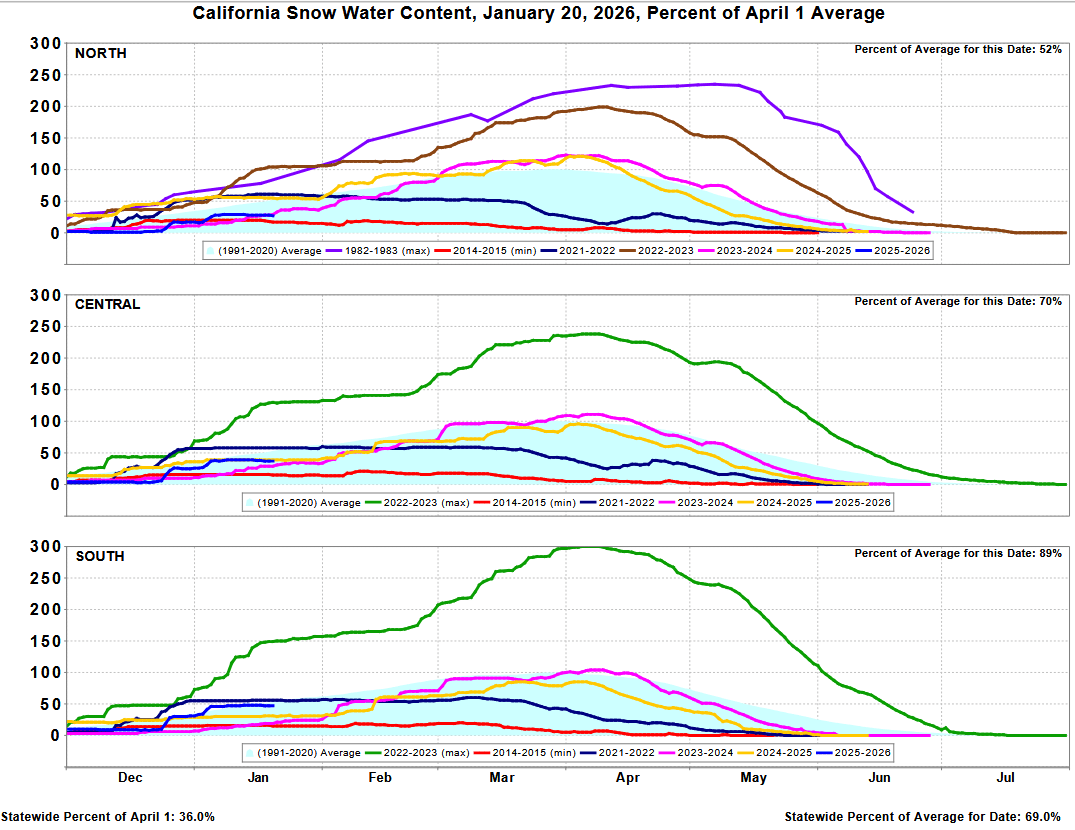
California weather: How long will extended dry spell continue?
 “California’s midwinter respite from storms is turning into a lengthy dry spell. Los Angeles’ most recent rain came Jan. 4, San Francisco hasn’t picked up a drop since Jan. 7, and the Sierra Nevada snowpack is slowly slipping away. While a fortnight without rain isn’t uncommon in California in January, the dry weather shows no signs of significant change this week. Below-normal precipitation is favored for the next 10 days as storms remain far away from California. Without strong jet stream winds to push weather systems along, the current pattern will remain locked in place. Patchy fog will linger in the Central Valley, with partly to mostly sunny skies everywhere else. … ” … ” Read more from the San Francisco Chronicle. | Read via Yahoo News.
Western US faces worsening snow drought, with California being the rare exception
“California is the only state in the United States starting 2026 without drought or abnormally dry conditions, after a parade of atmospheric rivers delivered heavy rain and mountain snow early this winter. However, drought remains a major concern across much of the rest of the West, where snowpack levels are near record lows. It marks the first time since 2000 that California has been completely free of at least a D1, or moderate, drought anywhere in the state. While there have been brief drought-free periods over the past 25 years, small areas of the Golden State typically remained classified as abnormally dry, the lowest category on the U.S. Drought Monitor’s five-level scale. … While rainfall has erased drought conditions in California, large portions of the West continue to feel the impacts of a decades-long snow drought that began in the early 2000s. Pastelok said a year with “a good amount of rain with less snow is just as bad as having no snow.” … ” Read more from AccuWeather.
“Warm West/Cool East” dipole to develop over North America in late January; mostly dry/warm conditions lead to record-low Western U.S. snowpack
Dr. Daniel Swain writes, “I’ll keep this part pretty short: it has been an absurdly warm winter thus far across nearly the entire American West, including most of California. One of the only exceptions has been CA’s Central Valley, where episodes of tule fog have kept conditions colder/damper for days at a stretch (but even here, episodes of record warmth interspersed within the foggy periods and lack of any major cold outbreaks have kept conditions among the top-5 warmest winters on record to date). This is all the more remarkable given that it has actually been quite a wet start to the season across much of the Pacific Northwest and Southern California; here, it has been warm and wet (as opposed to the more recently familiar warm and dry). But anomalous-to-record warmth remains the rule, and I don’t see that changing over the next couple of weeks … ” Read more from Weather West.
SEE ALSO:
- Will California see more rain or warm weather this spring? What experts predict, from the Sacramento Bee
- NOAA February 2026 Outlook: Pattern Change Could Finally Bring Relief to the Snow-Starved Western United States, from Snow Brains
Lake Oroville reduces outflow by 40%, officials say
“One of the state’s largest water storage facilities has reduced its outflow by about 40%. Starting Monday, Lake Oroville is releasing about 3,000 cubic feet per second into the Feather River, down from 5,100 cfs. The change is a result of reduced runoff and dry conditions, officials with the state’s Department of Water Resources said late last week. The federal government requires the agency to release water from the reservoir for flood-control purposes. The regulations establish a set storage space reserved for capturing inflows from rain and snowmelt. … ” Read more from Fox 40.
Action News goes to top of Pine Flat Dam with Asst. Sec. of Army to discuss water policy, management

“Action News got a rare and exclusive look at Pine Flat Dam on Friday as federal leaders from Washington arrived for a visit. At 429 tall, the government considers the dam “critical infrastructure,” necessary to the state and country. It can hold back one million acre-feet of water and release thousands of gallons per minute from Pine Flat Lake into the Kings River about 35 miles east of Fresno. “It’s a beautiful place,” Assistant Secretary of the Army for Civil Works Adam Telle told Action News. “It’s great to be here in January.” … ” Read more from ABC 30.
Contract for $6 billion Sites Reservoir advances amid protest, labor concerns
“For decades Sacramento Valley farmers and water agencies throughout California have championed the need for another reservoir to bolster the state’s water supply. But deciding who should build it, as of late, has become more controversial, complicated by pushback from local labor unions. The crowded room where officials gathered to make that decision Friday morning was greeted by more than 100 protesters. Wearing neon vests, work boots and sunglasses, the laborers assembled outside the nondescript building in Maxwell, a small town in Northern California’s Colusa County about 10 miles east of the valley where construction will begin on Sites Reservoir, which is estimated to cost more than $6 billion. Protest chants, claps and accompanying sounds drowned out about 20 minutes of the meeting before organizers quieted the crowd, and the topic shifted to the question of most concern: Who should officials choose for a contract whose scope may eclipse $3 billion of construction over the next several years? … ” Read more from the Sacramento Bee (gift article).
Rollins fights Potter Valley dam removal plan
“A battle over water storage, irrigation and wildfire protection in Northern California moved onto the national stage last week as Agriculture Secretary Brooke Rollins challenged plans backed by California officials to remove a pair of 100-year-old dams. In a state where water reservoir resources would seem precious, California officials support an effort by utility giant Pacific Gas & Electric (PG&E) to remove a pair of dams — the Scott Dam and Cape Horn Dam — about 14 miles apart on the Eel River. Known as the Potter Valley dams, the two dams originally built for hydropower also support irrigation for nearly 307,000 acres downstream. … ” Read more from Progressive Farmer.
As EPA ponders Clean Water Act, activists say business eclipsing environment
“The long-term health of the ocean off the coast of Southern California, and the health of the region’s freshwater streams and rivers and lakes, soon could hinge on the Trump administration’s definition of a single word: ditch. The Environmental Protection Agency is in the midst of sorting out which of the “waters of the United States,” or WOTUS – the creeks, streams, rivers, ponds, lakes, wetlands, oceans, and, yes, in a few cases, ditches – should still be protected from pollution by the Clean Water Act of 1972. At least some of the proposed new rules could result in more pollution in Southern California’s vast network of paved flood control channels, which soon could be viewed by the federal government as “ephemeral ditches.” That, in turn, could translate into a dirtier Pacific and dirtier rivers and creeks. … ” Read more from the OC Register.
Has a gas station near you closed? This California law may be why
“As of Jan. 1, California is mandating that underground fuel tanks have two protective shells to prevent soil or groundwater contamination. The single-walled cylinders at the Bay Farm station are considered archaic and possibly hazardous, prone to leaks like the one that recently caused a major road closure in Burlingame. To state environmental officials, it’s a necessary upgrade that they say gas station owners had ample time to make, given that the law passed in 2014. Efforts to idle single-walled tanks have in fact been ongoing for decades in California and nationwide. Yet Kim and other gas station franchisees see these construction projects as so expensive and onerous that they aren’t worth pursuing. They can also be risky: In December, a tank caught fire at a gas station in San Francisco’s Mission District, just as crews dug it out of the ground. … ” Read more from the San Francisco Chronicle.
State of the Estuary: Health of Delta fish rated “poor” as freshwater flows decline
“A new scientific report published by the San Francisco Estuary Institute finds that fish populations in the Sacramento-San Joaquin are in “poor shape,” citing “poor freshwater conditions” and other factors behind the collapse. The report, “State of the Estuary,” has provided a comprehensive assessment of the health of San Francisco Bay and the Sacramento-San Joaquin River Delta for many years. The Institute’s latest report confirms the dramatic decline of Delta fish species that is revealed in my story detailing the most recent results of the Fall Midwater Trawl by the California Department of Fish and Wildlife (CDFW). The report gives a “poor” rating for the health of Delta fish species and a “good” rating for Bay fish species, based on abundance, species diversity, native fish composition and the distribution of native fishes. … ” Read more from the Daily Kos.
California brought back beavers for the first time in 70 years, and the results are already amazing
 “Deep in the Sierra Nevada foothills on the Tule River Indian Reservation, tribal member Kenneth McDarment had passed by an ochre-red pictograph countless times throughout his life—a simple yet unmistakable image of a beaver with four paws and a distinctive paddle tail. Estimated to be between 500 and 1,000 years old, this ancient artwork adorned the walls of a rock shelter alongside other paintings of wildlife, humans, and geometric designs created by the Yokuts people. To McDarment, this beaver image seemed like just another beautiful piece of Native art. That is until he looked at it again—this time seeing it clearly with fresh eyes. When severe drought struck the reservation about a decade ago, McDarment and other tribal leaders began searching for innovative ways to conserve water. The answer, it turned out, had been staring at them from the cave walls all along.Glancing back up at the beaver, the pictograph suddenly took on new meaning as McDarment and the other tribal leaders began to recognize the ancient wisdom embedded in their ancestors’ art. … ” Read more from Upworthy.
Resilient California fishes: Tule Perch
This is the second blog in a series on native California fishes that seem to be doing well despite multiple threats. They are still common and widely distributed, despite major changes to their habitats. The Tule Perch (Hysterocarpaus traskii) is an interesting species to include in this series because it contains three distinct subspecies, two of which seem to be doing well and one that is not. The first, Sacramento Tule Perch (H. t. traskii), has lost some habitat in the Sacramento River system (e.g., San Joaquin River on the Valley floor) but is still common in the main rivers below dams and has also colonized “new” habitats where they can be abundant (e.g., hydropower reservoirs). The second, Russian River Tule Perch (H. t. pomo), is widespread and abundant in the river and may have benefited from water projects that increased summer flows (Cook et al. 2010). The third, Clear Lake subspecies (H.t. lagunae), appears to be scarce in the lake, in contrast to the 1970s when we sampled the lake and found Tule Perch to be fairly common. … ” Read more from the California Water Blog.
Simsonar FishCounter: Fish monitoring in the age of AI
“Counting fish is no easy task, but it is a key part of research and management for many species. For the migratory salmonids that move through our rivers, scientists employ a variety of strategies to produce estimates of fish numbers, often using some variation of mark-recapture that relies on internal or external tags, manual traps, or carcass collections. Nowadays, modern technology can provide an underwater view of when, how many, and which species of fish are on the move. This allows scientists to collect direct counts of migrating fish in real-time to better inform important management decisions. FISHBIO has been using camera systems developed by Simsonar, a Finland-based company that combines underwater video, cutting edge software, and neural network (AI) learning to meet management needs. Simsonar’s two main products, the FishCounter and LiteCounter, provide 24/7 video monitoring and automatic fish detection, measurement, and reporting. … ” Read more from FishBio.
Sea otters are California’s climate heroes
“When Jessica Fujii was in kindergarten, she drew a picture of her future. In a “What do you want to be when you grow up?” booklet, she skipped ballerina and veterinarian and wrote down something else entirely: sea otter biologist, complete with cartoon-like otters in the great tide pool at the Monterey Bay Aquarium. Fujii grew up in California’s Bay Area, and trips to Monterey and its aquarium became a regular part of her childhood. She remembers paddling alongside her dad in a kayak on Monterey Bay, watching wild otters float on their backs as they cracked open crabs and let the shells sink. Back then, she mostly took their presence for granted. Today, as a sea otter researcher and program manager at the aquarium, she knows how close California came to losing them – and how much now depends on the fragile population that remains. Along Northern California’s coasts, sea otters help habitats endure climate impacts like warming oceans, shifting predator ranges, and harmful algal blooms by keeping underwater plant life healthy and supporting resilient ecosystems. … ” Read more from Yale Climate Connections.
Monarch butterflies face real trouble in California, new numbers show
“One of California’s most iconic animals is in trouble. A preliminary tally of monarch butterflies that spend the winter along California’s coast looks near the record low. That’s a blow for the beloved pollinator species, which faces an incredibly high risk of extinction. “Based on our very initial count, it’s looking like this year is either going to be the second- or third-lowest on record, unfortunately,” Scott Black, the executive director of the Xerces Society for Invertebrate Conservation, told SFGATE. As the migratory western population of monarchs takes shelter every winter from Mendocino County to Northern Baja, Mexico, the Xerces Society manages a monumental collaboration to count the butterflies. These annual counts have documented a drastic decline. … ” Read more from SF Gate.
California Forever, regional coalition push for federal designation to revive shipbuilding
 “There is a new push by a coalition of regional stakeholders to revitalize shipbuilding in Solano County and the surrounding area, asking the federal government to designate the California Delta as a “maritime prosperity zone.” “We’ve seen what happens when jobs go away. It’s going to be great to see if shipbuilding, maritime jobs come back to the region,” said Chris Rico, president and CEO of the Solano Economic Development Corporation. The effort is backed by the Solano EDC, Cal Poly’s Maritime Academy, the owners of Mare Island, the Nimitz Group, the Bay Area Council, and California Forever, which released the announcement Thursday. … ” Read more from CBS News.
Wildfire prevention in California gets the proof it needs to drive funding
“For the first time, California can show with data, maps, photos, and reports whether taxpayer-funded wildfire mitigation projects are delivering a return on investment. Fire managers have long considered fuel treatment to be beneficial. Their crews would clear dry brush from forests, create fuel breaks, and conduct prescribed burns. When wildfires eventually tested those treatments, oftentimes the flames moved slower, giving firefighters more time to battle the blaze. But there was a problem. While firefighters and foresters saw the advantages on the ground, they couldn’t consistently prove those outcomes to the legislators and policymakers in charge of critical funding. Today, the California Department of Forestry and Fire Protection (CAL FIRE) uses a new data-driven system built with geographic information system (GIS) technology to track the real-time impact of fuel treatment activities. … ” Read more from the ESRI blog.
In commentary today …
San Joaquin County’s court victory against the Delta Tunnel a win for common sense
San Joaquin County Supervisor Steve Ding writes, “On New Year’s Eve, the Third District Court of Appeals handed the Delta a decisive victory. The court ruled that California lacks legal authority to issue billions in bonds for the Delta Tunnel without explicit legislative approval. This is not a technicality — it is a fundamental reaffirmation that major projects affecting our communities cannot be engineered in backrooms by bureaucrats. As lead supervisor of the Delta Counties Coalition, I could not be prouder of what San Joaquin County accomplished alongside four other Delta counties. We fought this battle because rural communities deserve to be heard when decisions affecting our future are made. And we won. … ” Read more from the Lodi News-Sentinel.
Laws protecting endangered plants are now endangering lives and property
Columnist Susan Shelley writes, “Earlier this month, the outgoing chief of the San Ramon Valley Fire Protection District wrote a blistering letter to Gov. Gavin Newsom and Department of Parks and Recreation Director Armando Quintero. “Governor Newsom, this letter is a direct request for your intervention,” Chief Paige Meyer wrote. The fire chief asked for immediate executive action to address wildfire risk after the California State Parks largely blocked a life-saving wildfire mitigation program. The fire district developed and funded a “comprehensive, science-based” plan to identify and mitigate wildfire risk in areas the state itself had identified as Very High Fire Hazard Severity Zones. But because some of the land was State Parks-owned, the plan didn’t work out as planned. Due to restrictions on what could be cut, where and under what conditions, the wildfire mitigation that was planned for 300 acres was completed on only 22. … ” Read more from the LA Daily News.
This is why our rivers are turning into sewers
Opinion writer Michael Grunwald writes, “America’s factory farms generate nearly a trillion pounds of manure every year, and way too much of it ends up in rivers, lakes and estuaries. Animal waste is a major reason half of America’s water bodies are too dirty for fishing or swimming. It’s the most persistent driver of destructive algal blooms in beloved waterways such as Lake Erie and the Chesapeake Bay, which both just fell far short of their 2025 water quality targets. It’s a dirty, smelly, sickening mess, and the cause is quite simple. Unlike factories, most factory farms aren’t legally responsible for their pollution. Unlike human poop, animal poop isn’t legally required to be treated before it is released into the environment. America’s concentrated animal feeding operations, the industrial livestock farms known as C.A.F.O.s, produce twice as much waste as America’s toilets, but nobody is tracking where or how it gets flushed. … ” Read more from the New York Times.
In regional water news and commentary today …
NORTH COAST
Klamath Water Users Association calls new water framework ‘a path forward’ for Basin
 “In what the Klamath Water Users Association is calling “a major step toward securing the future of the entire Klamath Basin,” the Bureau of Reclamation has completed a reassessment of how the Endangered Species Act is applied to the Klamath Project. “Following bipartisan federal legislation in early 2025 and updated guidance from the Department of the Interior, this reassessment takes a detailed look at over 150 water supply contracts and analyzes where Reclamation does and does not have discretion over water deliveries under existing contracts,” the KWUA stated in a news release. KWUA called the action a necessary step to defining Reclamation’s authority in the Klamath Project before Reclamation develops an operation plan to deliver water to farms and national wildlife refuges. “Most importantly, it ensures water is managed to support farms, wildlife, refuges, and local communities while staying fully compliant with federal law,” KWUA explained. … ” Read more from the Herald & News.
Commentary: The Endangered Species Act meets the Klamath River Basin
Jacques Leslie, author and Los Angeles Times contributing opinion writer. writes, “Until I began covering the Klamath River basin as a journalist in 2007, I took for granted that the Endangered Species Act was, as many environmentalists believed, the bedrock of American environmental law. For most of this century, the Klamath, which traverses the California-Oregon border, has been considered the nation’s most embattled watershed, and as I learned more about it, I realized that for all of the Act’s good intentions, its deficiencies were as consequential for the basin as its strengths. In this way, as in many others, what happened in the Klamath represents a microcosm of the country. … ” Read more from USC Dornsife.
Recovery efforts continue after record tides inundated King Salmon
“Residents of King Salmon continue to recover from record-high tidal flooding earlier this month. This Sunday, relief workers, elected officials and Cal Poly Humboldt researchers met with community members to distribute resources and hear from residents about what the ensuing weeks have been like after record-high tides resulted in unprecedented flooding in the area. Supervisor Rex Bohn, who was at King Salmon during the coastal flooding, working to mobilize resources to the scene, said he appreciated people coming out to help in the wake of the disaster. Still, he said, that response took time, and in the interim, he was impressed by the King Salmon community working to take care of one another. … ” Read more from the Eureka Times-Standard.
SEE ALSO: The forgotten disaster: King salmon was smashed by king tides at the beginning of the year. Why is no one talking about it?, from the Lost Coast Outpost
Investigation, environmental assessment continue in the wake of Arcata block fire
“The fire that ravaged nearly a city block of downtown Arcata just north of Arcata Plaza early this month continues to challenge local authorities. The city, in conjunction with local and state partners, is continuing its ongoing efforts to investigate the cause of the fire, support displaced people and organizations, and assess and mitigate environmental impacts of the fire — which poured over two million gallons of runoff into storm drains that filter into Arcata’s surrounding sensitive estuarine environment. The city is currently working in cooperation with state and local agencies, nonprofits and community members to recover from what is an ongoing emergency situation. Arcata Mayor Kimberley White, who was appointed Mayor in December, having served on city council since 2022, described the fire as a “devastating event for our community.” … ” Read more from the Eureka Times-Standard.
High fire-risk rural Covelo to get its fire first-ever fire hydrant system
“A fire hydrant system will be installed in the rural community of Covelo to help reduce wildfire risk and improve community safety, state Sen. Mike McGuire, D-Healdsburg, announced. According to the U.S. Forest Service, Covelo faces a “very high risk” of wildfires — higher than 92% of communities nationwide. Despite that risk, the community has never had a fire hydrant system. Located in northeastern Mendocino County, Covelo comprises about 1,400 residents and includes the Round Valley Indian Reservation. Covelo is served by a volunteer fire department and relies on mutual aid from Cal Fire when additional resources are needed during emergencies. … ” Read more from Local News Matters.
Clearlake sewage spill advisory area expands
“After advising some Clearlake residents to leave their homes Friday following a raw sewage spill, Lake County health officials have revised the area affected by the spill as some residents say they are still struggling to get clear information about how long they may need to remain away from their homes. The spill, caused by a broken sewer pipe reported in the early hours of Jan. 11, prompted a local state of emergency and advisories for residents near Robin Lane. On Friday evening, the county released an updated map expanding the advisory area to include residents east of Smith Lane, west of Old Highway 53, and south of Pond and north of Bowers who rely on private drinking water wells. County officials said the revised boundaries reflect recent test results but cautioned the map shows only an approximate area and is subject to change. … ” Read more from the Santa Rosa Press Democrat.
Sewer spill cleanup continues; residents offered resources
“The county of Lake on Sunday evening issued its latest update in the ongoing response to a massive sewage spill that began a week ago. The 2026 Robin Lane Sewer Spill incident, which began on the morning of Sunday, Jan. 11, resulted when a 16-inch force main ruptured and continued until Monday night. That equipment is operated by Lake County Special Districts. County officials reported that 2.9 million gallons of sewage were spilled during the 37.5-hour incident, which has impacted wells and property over an area that is east of Smith Lane, west of Old Highway 53, south of Pond Road and north of Bowers Avenue. The area impacted by the spill originally was estimated at 40 acres, but late last week was expanded to about 357 acres, as Lake County News has reported. … ” Read more from the Lake County News.
SACRAMENTO VALLEY
Paradise residents to see water system flush
“Starting Tuesday, Jan. 20, Paradise Irrigation District (PID) will commence its annual water system flush, which may cause temporary changes in water appearance for residents. The flushing process, expected to conclude by the end of spring, will move south through neighborhoods, beginning from the northern part of the district. The procedure involves forcing water through pipe sections under high pressure to remove oxidation, which may result in cloudy water due to air bubbles. … ” Read more from KRCR.
NorCal gas stations facing $1.16M settlement in fuel-spill case
“The owners of three Northern California gas stations are facing penalties after a settlement was reached in an environmental protection lawsuit, including an incident where over 50 gallons spilled near the North Yuba River. Sherali Gas Corp., which operates gas stations in Davis, Woodland and Downieville, was imposed with $1 million in civil penalties, the Yolo County District Attorney’s Office announced Wednesday, a portion of which will only become due if the owners violate laws in the future. The company is alleged to have violated environmental laws from 2014 through at least October 2025. $160,000 in investigative and enforcement costs were also imposed. … ” Read more from KTXL.
SEE ALSO: District Attorneys Settle Environmental Protection Lawsuit Against Sherali Gas Corp., press release from Yolo County
NAPA/SONOMA
An aging Guerneville treatment plant is behind the largest Russian River wastewater spill in 41 years. What’s to be done?
“An estimated 5.5 million gallons of wastewater, including untreated sewage, overflowed early this month from a Guerneville treatment plant into the lower Russian River over three days, making for the largest such spill in the river in more than four decades. Despite the absence of major flooding, a series of heavy storms managed to inundate the intake system of the aging Neeley Road wastewater plant that has been linked to a series of weather-related spills over the years. The fallout led water and public health officials to issue advisories closing beaches along more than 13 miles of the lower river and a 40-mile stretch of the Sonoma Coast. State water quality regulators in Santa Rosa say they are looking into the spill and will determine if any enforcement action is warranted, including potentially a fine.“Something needs to change,” said Sonoma County Supervisor Lynda Hopkins, who represents lower Russian River communities and the coast. … ” Read more from the Santa Rosa Press Democrat.
BAY AREA
North Bay reservoirs reach capacity after winter storms, ending drought fears
“After near record rainfall, Marin and Sonoma counties are giving a status report on reservoir levels and the news is encouraging for our water supply. Alpine Lake on Mt. Tam is spilling over. Cyclists Mik and Logan from San Francisco admit, they’ve never seen so much water here. “I we’ve been in a drought for a long time, so it’s great to see a lot of water- it’s really beautiful, said Mik Khean. No drought here. Marin Water says all seven of its reservoirs are now at capacity. … ” Read more from Channel 7.
Marin County to seek federal funds for flood damage
“Marin County plans to seek federal funds to help cover costs incurred during storms and flooding this month. Derek Johnson, the county executive, authorized an emergency declaration on Jan. 13 as an initial step. He will ask the Board of Supervisors to ratify the proclamation at its meeting on Tuesday. The proclamation states that prolonged rainfall, king tides, storm surges and levee failures during the first few days of the year caused flooding, road closures, utility disruption, landslides, hazardous materials releases and the displacement of residents. The proclamation includes the unincorporated area overseen by the county, plus Corte Madera, Larkspur, Sausalito, the Southern Marin Fire Protection District and the Ross Valley Sanitation District. … ” Read more from the Marin Independent Journal.
SEE ALSO:
- Southern Marin flood control projects inch forward, from the Marin Independent Journal
- Supervisor shares next steps after tidal flooding in Santa Venetia, from the Marin Independent Journal
Report delivers ominous data on Marin shorebirds
“The bird population that relies on estuarine habitats in Marin and throughout the Bay Area is dwindling and needs help, according to a new report. Shorebirds, which thrive in expansive tidal flats, are experiencing the most concerning decline in the region, the report says. “It’s quite an alarming drop — anywhere from about 25% to about 85%,” said Julian Wood, a program leader at Point Blue Conservation Science, one of the report’s authors. The bird population data are an indication that something is wrong in the ecosystem, a particularly worrisome development as the Trump administration shifts focus away from conservation efforts, Wood said. … ” Read more from the Marin Independent Journal.
Baykeeper sues San Leandro scrap recycler over alleged San Francisco Bay pollution
“An environmental organization has filed suit in federal court in San Francisco asserting that polluted stormwater from a San Leandro scrapyard operation is draining into San Francisco Bay. San Francisco Baykeeper, a nonprofit based in Oakland, alleges that Alco Iron & Metal Co., headquartered in San Leandro, has repeatedly violated the federal Clean Water Act by allowing stormwater runoff contaminated with metals from its recycling operations to be discharged into the Bay. … ” Read more from Local News Matters.
Residents raise concerns over new data center in Gilroy
“More than 1,000 people have signed a petition to stop the construction of an Amazon Data Services data center in northeast Gilroy. Although the project has already obtained all the permits and approvals it needs from the City of Gilroy, data center opponents are hoping to appeal to the project developer to reconsider or revise their plans. The petition, started at change.org by Gilroy resident Britt Smith, also asks the city to make a commitment that it will “never approve development of a data center within city limits.” “Recognizing Gilroy’s rich agricultural history, beautiful parks, and California’s fragile ecosystem it is our responsibility to ensure that the town we love can be enjoyed for generations to come without risks of environmental pollution that would degrade the quality of life,” says the petition, in part. … ” Read more from the Gilroy Dispatch.
CENTRAL COAST
Cal Am asks regulators to OK rate increases
“California American Water Co. is seeking to increase water rates to Monterey Peninsula households by a significant amount next year and then lower amounts in the following two years. The filings are requests with the California Public Utilities Commission. No action will be taken until November at the earliest when the full commission meets. The double digit spike next year is for the company’s Central Division, in which the Monterey Peninsula is the largest area. Monterey Peninsula ratepayers will see a jump of 16.1%, or roughly $25.4 million, next year. In 2028 households will be charged another 3%, followed by 3.8% more in 2029, according to filings with the CPUC. The Central Division consists of the larger water systems of Monterey, Pacific Grove, Pebble Beach, Seaside, Carmel, Carmel Valley and other smaller systems around the Central Coast such as Garrapata, Hidden Hills and Ryan Ranch. … ” Read more from the Monterey Herald.
Restoring and conserving Elkhorn Slough through science, resource protection and stewardship
 “Elkhorn Slough, a coastal wetland visible from the Highway 1 bridge in Moss Landing, CA is a breeding ground for many ocean species and a safe haven and food source for sea otters and other marine organisms. This wetland is a rich ecosystem with a diverse group of species and complex food webs. More than 340 species of resident and migratory birds use Elkhorn Slough as a vital habitat, including over 20,000 shorebirds annually. The entire waterway of Elkhorn Slough up to mean high tide is part of Monterey Bay National Marine Sanctuary’s 6,094 square miles of federally protected area. The slough starts 7 miles inland at Carneros Creek and empties into Moss Landing Harbor and the head of the Monterey Canyon. NOAA’s National Estuarine Research Reserve system, California Department of Fish and Wildlife and the California’s State marine protected areas (MPAs) also provide additional protection of this natural resource. … ” Read more from the Monterey Herald.
Urgent decisions carefully planned to save the Santa Barbara harbor entrance from clogging with sand
“The dredging schedule, normally done twice a year to clear the Santa Barbara harbor entrance of sand, is no longer a budget guarantee. This year it is the worst in many years. It is usually part of the Presidential budget for the Army Corps of Engineers. Last year funding was removed from several harbors including Santa Barbara. The Waterfront Department usually gets about $4 million a year. January 28th of 2025 was the last time dredging took place. The two dredging operations a year plan is now down to one – and possibly after February, none. “It is starting to pinch the channel,” said Waterfront Director Mike Wiltshire. … ” Read more from KEYT.
California city, Carollo to upgrade water resource recovery facility
“The City of Oxnard, California, has selected Carollo Engineers to provide construction management and inspection services for upgrades at the city’s Water Resource Recovery Facility (WRRF). A press release from Carollo notes the project represents a major investment in safeguarding the community’s water and wastewater infrastructure while meeting all regulatory requirements cost-effectively. The WRRF serves Oxnard’s growing community of approximately 210,000 residents. The city operates an extensive wastewater system that includes more than 400 miles of sewer lines, 15 lift stations and a 31.8 million gallons per day treatment plant. … ” Read more from Water Finance & Management.
SAN JOAQUIN VALLEY
Kings County Water District seeks new board member
“The Kings County Water District Board of directors is looking for a new member to replace longtime member Joe Freitas who died Dec. 21. He was 78. An application period for the vacant District 4 seat, which covers south of Lacey Boulevard and west of 11th Avenue in Hanford, will be open until Feb. 2. To qualify, a person must be 21 or older, a resident of the district and a U.S. citizen. A resume or a statement of interest may be submitted to the district for consideration. … ” Read more from SJV Water.
Cawelo board members balk at paying costs for “white lands” groundwater agency
“Cawelo Water District board members called the 2026 budget for the Kern Non-Districted Land Authority (KNDLA) inflated, “full of fluff” and questioned specific line items, such as $100,000 for attorney support during their Jan. 8 meeting. Assistant General Manager Dave Halopoff said he had brought up that particular line item to KNDLA representatives but that it went nowhere with the greater group. John Gaugel theorized that KNDLA’s expenses may be a reflection of whose wallet they were coming out of.
“If we made them pay for it themselves, in that group, then they’d probably kind of tighten the budget?” Gaugle said. “They’d cut their budget up and that is where I am: We shouldn’t be subsidizing them anymore. There has to come a point where they are on their own.” … ” Read more from SJV Water.
Tehachapi: Private mediation between city, water district extended
“A post mediation status conference between the city of Tehachapi and the Tehachapi-Cummings County Water District originally scheduled for Jan. 23 in the ongoing case over the former’s approval of the proposed Sage Ranch residential subdivision has been postponed to April 3. The case in question was filed by the water district against the city in September 2021, alleging that the city approved the project without verifying that enough water was available for the new residential units in the subdivision. Three of the four causes of action in that litigation were settled in favor of the water district in June 2024 and the fourth — that the city has a “pattern and practice” of violating state law — is still pending, with Sacramento County Superior Court Judge Stephen Acquisto announcing his intent to “command the city … to set aside Resolution No. 42-21 with respect to verification of a sufficient water supply … and any resulting project approvals” after that fourth cause of action is resolved. … ” Read more from the Tehachapi News.
SOUTHERN CALIFORNIA
Boeing wins in Santa Susana cleanup fight while some insist toxins persist
“A Ventura County Superior Court judge ruled Jan. 8 in favor of the California Department of Toxic Substances Control and Boeing, rejecting a lawsuit brought by community and environmental groups challenging a cleanup agreement at the Santa Susana Field Laboratory. The groups—Parents Against Santa Susana Field Lab, Physicians for Social Responsibility–Los Angeles, and Public Employees for Environmental Responsibility— said a 2022 agreement between DTSC and Boeing improperly paved the way for soil cleanup decisions by presuming future land use ahead of the full environmental review required under the California Environmental Quality Act. The 2,850-acre SSFL, located in the hills above Simi Valley, has long remained one of California’s most controversial toxic sites. Used during the Cold War for rocket engine testing and nuclear research, the site over time became contaminated with radioactive materials and hazardous chemicals, prompting decades of community concern and demands for a full cleanup. … ” Read more from The Acorn.
Edison sues L.A. County and other agencies, saying they share blame for Eaton fire deaths, destruction
“Southern California Edison sued Los Angeles County, water agencies and two companies including SoCalGas on Friday, saying their mistakes contributed to the deadly and destructive toll of last year’s Eaton wildfire. Edison now faces hundreds of lawsuits by victims of the fire, which claim its transmission line started the devastating fire that killed at least 19 people and destroyed thousands of homes in Altadena. The cost of settling those lawsuits could be many billions of dollars. Doug Dixon, an attorney who represents Edison in the fire litigation, told The Times that Edison filed the lawsuits “to ensure that all those who bear responsibility are at the table in this legal process.” … ” Read more from the LA Times.
SEE ALSO:
- Edison Files Claims Against Los Angeles County and Others on Eaton Fire, from the New York Times
- Edison Sues Pasadena Water & Power, LA County, Alleging They Share Blame for Eaton Fire Destruction and Deaths, from Pasadena Now
Homes that survived the 2025 LA fires are still contaminated
“After the devastating Eaton and Palisades fires, federal officials and private companies led a patchwork of efforts to remove debris and contaminated material from areas that burned and others covered in toxic ash. One year later, homeowners have had the inside of their houses tested after completing remediation and many found hazardous levels of chemicals including lead and asbestos. Community groups and scientists who have worked together on testing projects are now pushing for a more stringent certification system to ensure families don’t move into homes with dangerous levels of pollutants. … ” Read more from the LAist.
Santa Ana Watershed Project Authority marks half-century of regional water stewardship
“The Santa Ana Watershed Project Authority, or SAWPA, is a joint powers authority consisting of Eastern Municipal Water District, Inland Empire Utilities Agency, Orange County Water District, San Bernardino Valley Municipal Water District, and Western Municipal Water District. It was formed in 1975 with the stated mission to “develop and maintain regional plans, programs, and projects that will protect the Santa Ana River basin water resources to maximize beneficial uses within the watershed in an economically and environmentally responsible manner.” SAWPA member agencies collectively represent all the parties that were involved in a 1969 Superior Court decision that established water rights in the Santa Ana River watershed and established minimum flows in the river from Prado Dam into Orange County. The SAWPA Commission is composed of one board member from each of the five member agencies. SAWPA also has a variety of committees and subgroups that are made up of board members and staff of the member agencies. … ” Continue reading from the Raincross Gazette.
Seal Beach looking to team up on projects to stop trash washing down the San Gabriel River
“Anytime it rains, a river of trash flows straight toward the ocean, spitting out at the mouth of the San Gabriel River. The area between Long Beach and Seal Beach has long been a trouble spot as pollution from urban inland cities flows down the river and onto the beach and into the ocean where Orange County and Los Angeles County meet. Seal Beach city officials have taken a key step to finding a solution, they said, voting this week to move forward with a memorandum of understanding with Los Angeles County to tackle the trash troubles. At the same time, a consultant has finished a report exploring options and technologies, including cost estimates for innovative solutions. … ” Read more from the OC Register.
EPA has options for cleaning up contaminated water in north OC, public meetings this month to take input
“The U.S. Environmental Protection Agency is seeking public feedback on its options for cleaning up, at least in the interim, the Orange County North Basin Superfund site, where a large plume of contaminated groundwater continues to spread beneath Fullerton and Anaheim and has most recently reached into Buena Park. Extending more than six miles long and a mile wide, the plume contains harmful volatile organic compounds resulting from decades of degreasing solvents used in local manufacturing from the 1950s through the early 1980s. In 2020, the area made the list of federal Superfund projects — a program for addressing some of the nation’s most contaminated hazardous waste sites — and has been added to the EPA’s National Priorities List, because the contamination directly affects drinking water. … ” Read more from the OC Register.
IMPERIAL/COACHELLA VALLEYS
The Salton Sea has gone from massive accident, to resort destination, to pollution threat, to potential lithium bonanza
“The Salton Sea, 35 miles long and between nine and 15 miles wide, is the largest lake by surface area in California. Its history is complex—and an anomaly in the natural world. Today’s Salton Sea lies 228 feet below sea level, on the site of the much-larger ancient Lake Cahuilla. Peaking at 40 feet above sea level, Lake Cahuilla encompassed much of the Imperial, Mexicali and Coachella valleys, most recently between 500 and 1,000 years ago. With evaporation and no outlet, over the years, Lake Cahuilla dried up, leaving a huge 2,000-square-mile desert sink—from the Gulf of California to the Banning Pass. A horizontal dark band from the earlier shoreline is easily spotted along the cliffs near today’s Salton Sea. The ancient shoreline also left distinct terraces and tufa deposits around Travertine Point. The oral histories of the local bands of Native Americans include the existence of a large lake about 500 years ago. … ” Read more from the CV Independent.
SAN DIEGO
Two years after historic flooding, San Diego is still trying to fix its stormwater system. Is it enough?
“It’s been nearly two years since catastrophic flooding devastated San Diego communities, largely in working-class neighborhoods in the Chollas Creek watershed. Thousands of residents were displaced. Many are still recovering. And close to 2,000 are suing the city in more than 50 lawsuits, saying the city’s failure to maintain its storm channels is to blame. Since the Jan. 22, 2024, flooding, the city’s Stormwater Department has made progress clearing its storm channels, including performing repeated maintenance on channels in Southcrest and Mountainview that were overwhelmed in 2024. But the city is restricted by a general lack of funding for stormwater maintenance. Nearly half of its channel segments and infrastructure — including in the Los Penaquitos watershed, San Diego River watershed and Tijuana River watershed — haven’t been maintained in at least 15 years, according to recent city records. … ” Read more from the San Diego Union-Tribune.
Budget analysts tells San Diego how to help shrink county water rate hikes
“Budget analysts for San Diego say city officials should demand big changes at the cash-strapped County Water Authority, including a thorough re-thinking of its entire operations and urgent action on out-of-state water sales. The recommendations come with the city facing cumulative water rate hikes of 90% over six years, and the water authority predicting it will need to increase the rates it charges the city and other local agencies 100% to 150% by 2035. Those hefty rate hikes could possibly shrink substantially if the water authority limits large capital projects, reduces operating expenses and finds a way to “right size” its water supply, according to the city’s independent budget analyst. The fundamental problem facing the water authority is that it’s contractually obligated to buy more water than its member agencies typically need, forcing it to raise rates to cover its built-in costs. … ” Read more from the San Diego Union-Tribune.
Tijuana wastewater pipe repairs completed in 3 days, ending river discharge
“Repairs to a collapsed wastewater pipe in Tijuana have been completed, with flows to the Tijuana River now stopped, the U.S. International Boundary and Water Commission (IBWC) announced Monday. The Insurgentes Collector, part of the larger Tijuana Wastewater system, collapsed the night of Jan. 15, diverting about 11.5 million gallons per day of extra flow into the Tijuana River, according to the IBWC. IBWC Commissioner Chad McIntosh was informed by Comisión Internacional de Límites y Aguas (CILA) Commissioner Adriana Reséndez on Monday afternoon that repairs had been fully completed and flows to the Tijuana River had stopped, the IBWC said. CILA is monitoring the system to ensure proper operation. The repairs took three days to complete, faster than the originally estimated 10 days, the IBWC said. … ” Read more from the San Diego Union-Tribune.
SEE ALSO:
- Major pipe in Tijuana fails, dumping 11.5M gallons of raw sewage daily into Tijuana River, from the San Diego Union-Tribune
- Latest Tijuana sewage spill highlights ‘urgent need’ to end crisis, from KPBS
Along the Colorado River …
No Colorado River deal in sight after intense negotiations, Arizona’s water chief says
 “The federal government may have to impose a Colorado River management plan on the seven river basin states because of their lack of progress toward reaching their own agreement, Arizona’s water chief says. Four days of negotiations in the past week brought the states no closer to agreeing on the major issues dividing them, said Tom Buschatzke, director of the Arizona Department of Water Resources. He and other states’ water officials met in Salt Lake City in their latest of many meetings over the past two years. But in a news briefing Friday, Buschatzke held out hope the river’s Lower and Upper Basin states will stand a better chance of finding common ground when they meet in Washington, D.C. at the end of January along with the governors of their states. He and Arizona Gov. Katie Hobbs have been pushing for such a meeting since late last year. “I have a (plane) ticket and a hotel room” for the upcoming meeting, Buschatzke said. … ” Read more from the Arizona Daily Star.
Feds summon 7 Colorado River governors for last-ditch drought talks
“Negotiators for the seven states that share the shrinking Colorado River met in Salt Lake City but could not agree on a deal to split up the water, Arizona’s lead negotiator said. The states are approaching the point where federal Interior Department officials may impose their own plan for mandated cuts that could fall especially hard on Arizona, potentially triggering lawsuits. Talks that ran through most of the week don’t seem to have improved the outlook for a water pact. “I didn’t see enough progress,” Arizona Water Resources Director Tom Buschatzke said on Friday, Jan. 16, “or any major progress” suggesting a deal is imminent. Interior Secretary Doug Burgum has invited all seven governors and their negotiators to meet in Washington in late January, Buschatzke said. Perhaps getting the governors face-to-face could lead to a breakthrough, he added. “It’s worth a try, at least,” he said. … ” Read more from Arizona Central.
SEE ALSO:
- The feds unveiled possible plans for water cuts on the shrinking Colorado River. Here’s how they could affect Utah, from the Salt Lake Tribune
- Colorado River at the Crossroads: Why the Old Rules Are Breaking Down, from the Lake Powell Chronicle
- Solving The Gordian Knot Of The Colorado River Compact, from the National Parks Traveler
Lake Mead’s projected record low gets even lower
“New federal projections for Southern Nevada’s main water source were released Friday and paint an even more dismal picture amid a tight interstate negotiation over the future of the American West. The Bureau of Reclamation estimated in its most probable scenario that Lake Mead, the nation’s largest reservoir, will fall to 1,036.5 feet above sea level in November 2027. That’s about 5 feet lower than the level that the reservoir fell to in 2022, when experts sounded alarm bells about desperately needed conservation and solutions to the Colorado River’s overuse problem. It’s about 2 feet below the lowest level that forecasters predicted in November, as well. … ” Read more from the Las Vegas Review-Journal.
Winter drought continues to deepen across Colorado, threatening spring water supply
“The entire state is in a snow drought, with conditions expected to deepen due to record-breaking warm winter temperatures. Colorado’s snowpack is the lowest on record for this time of year, and major river basins are running at about 50 percent to 75 percent of normal. Much of the northwestern part of the state, including Pitkin, Eagle, Grand and Summit counties are in deep drought, according to the U.S. Drought Monitor, which forecasts the dry spell to deepen across the Western Slope in the coming weeks. The “snow drought” is already deeply affecting the winter outdoor industry, with some ski resorts taking extreme measures, like carrying buckets of snow from other areas and dumping them, to keep their slopes open. Snow cover across the West on January 4 was the lowest in recorded NASA satellite history, which started keeping such records in 2001. … ” Read more from Colorado Public Radio.
Colorado is on track for its worst snowpack on record
“Colorado, a state known for its mountains, is currently experiencing its worst snowpack in recorded history. Records only date back to 1987, but as we approach the midpoint of the season, things don’t look great. Why is snowpack so important? A lower snowpack could mean water cuts, but experts say not to worry yet. According to water managers in Colorado, the state usually only builds 20% of its snowpack by this time of year, with February, March, and April typically being the snowiest months. Unpredictable, changing conditions require communities to be adaptable. Lower snowpacks would mean less available water for residents–something especially important during the warm, dry, summer months. Landscapes will need to become more drought-resistant over time if they are to be sustainable, and water use will need to be strategically thought out as the resource becomes more and more valuable and limited. … ” Read more from SnowBrains.
SEE ALSO:
- Drought shifts across the Colorado River Basin, from Western Water
- Colorado River snowpack decline threatens water levels and costs in Southern Nevada, from Channel 3
- Ongoing snow drought could spell trouble for the Colorado River crisis, from KTNV
Can cloud seeding programs boost water supply in the West?
“Nevada and Utah are using cloud seeding operations in attempts to stretch their natural water supplies through weather modification technology. The Desert Research Institute operates cloud seeding at strategic sites throughout the West, supported by state funding within Nevada. In Utah, the largest cloud seeding research effort ever in the state is now underway to determine the technology’s effectiveness. Cloud seeding machines use 24/7 climatologists who watch weather patterns and remotely activate generators when appropriate storms appear. The technology shoots silver iodide into passing storms to increase precipitation. … ” Read more from Channel 13.
New cloud seeding study over northern Wasatch Range likely the largest in Utah history
“For decades, cloud seeding has been part of Utah’s strategy to stretch its water supply. This winter, scientists are taking a much closer look at whether the practice actually delivers measurable results. Cloud seeding involves pumping silver iodide into the atmosphere during a storm to generate a little more precipitation. Researchers from the University of Utah and Utah State University are leading the largest cloud seeding research effort ever conducted in the state, focusing on winter storms over the northern Wasatch Mountains. The goal is to better understand how cloud seeding affects snowfall and spring runoff. “We’re trying to understand winter storms in the northern Wasatch and the impacts of cloud seeding on those storms,” said Jim Steenburgh, a professor of atmospheric sciences at the University of Utah, “and whether or not it’s having a major impact on both snowfall and runoff.” … ” Read more from Fox 13.
Yavapai-Apache Water Settlement reintroduced in Senate
“After decades of negotiations and litigation, federal lawmakers are again moving to finalize a comprehensive water rights settlement for the Yavapai-Apache Nation in central Arizona. Legislation reintroduced in Congress in mid-January 2026 would ratify the Yavapai-Apache Nation Water Rights Settlement and authorize more than one billion dollars in federal funding for water infrastructure and related provisions. The Yavapai-Apache Nation is located in Arizona’s Verde Valley and includes more than 2,500 enrolled members across five communities. Like many tribes in the Southwest, the Nation has pursued formal recognition of its water rights for generations. Those claims have been tied up for more than 40 years in Arizona’s complex general stream adjudications. … ” Read more from Western Water.
Arizona weighs water security and farm costs in 2026
“Arizona entered 2026 facing continued pressure on its water supplies and rising costs for farmers and ranchers. In January, state leaders advanced a series of budget proposals and bills that address water conservation, long-term supply planning, and the cost of maintaining agricultural infrastructure. Together, these measures reflect how closely water policy and food production are linked in the state. Governor Katie Hobbs has released her fiscal year 2026-2027 executive budget proposal. The plan includes funding for several Arizona Department of Water Resources programs focused on conservation, water use reductions, infrastructure upgrades, and preparation for potential Colorado River shortages. A key feature of the proposal is a $30 million one-time deposit into the newly created Colorado River Protection Fund. The budget also calls for permanent funding for the same fund through a water usage fee assessed on data centers and administered by the Arizona Department of Water Resources. … ” Read more from Western Water.
Bennet, Neguse continue calls for review of Uinta Basin Railway project over concerns of potential for oil spills
“U.S. Sen. Michael Bennet and Rep. Joe Neguse are continuing their calls for a comprehensive review of the Uinta Basin Railway, a project that would ship crude oil along the headwaters of the Colorado River. Bennet and Neguse sent a letter to the federal Surface Transportation Board on Monday, urging the board to reject a motion that would reaffirm the board’s previous approval of the project with what the lawmakers in a news release described as a “truncated review.” “A train derailment that spills oil in the headwaters of the Colorado River would be catastrophic not only to our state’s water supplies, wildlife habitat and outdoor recreation assets, but also the broader Colorado River Basin,” the lawmakers wrote. The Surface Transportation Board originally approved the Uinta Basin Railway project, which would connect Utah’s rural Uinta Basin oil fields with a national railroad network that passes through Grand Junction, Glenwood Springs, Kremmling and Denver, in 2021. As many as five, two-mile-long trains per day could travel from Utah through Colorado to the Gulf Coast on the route. … ” Read more from Summit Daily.
In national water news today …
‘I’ve never seen anything like it’: A winter drought grips the U.S.
“January is known for cold weather, snow and a lack of daylight. It’s not known for drought. But that’s exactly what’s going on across much of the United States. More than two-thirds of the country is facing unusual dryness or drought, stretching from the Pacific Northwest to the East Coast, touching every state except California. The stretch since July has been the driest period nationally since 2012. The drought has come with record-low snowfall and unseasonably warm conditions across the West — including Utah, Wyoming and Colorado. In these parts of the country, snowpack typically develops during the winter months — helping drive the economy — and then melts in the spring, which is key for water supply and lowering wildfire risk, as it keeps landscape wetter and less prone to fire. But winter conditions so far have not cooperated. … ” Read more from the Washington Post.
Trump admin strips key science data from America’s national parks
“Aneth Wright was, until very recently, a data technician for the National Park Service. For more than two decades, Wright worked for the bureau’s inventory and monitoring program — a long-standing initiative that tracks the health of the country’s national parks through their plants, animals, waters and landscapes. The work felt important, she says, and she’d always taken pride in her group’s contributions, which informed the management of 16 parks across Colorado and Utah. But last year, Wright says the atmosphere turned sour. I&M employees got swept up in widespread government layoffs, and the word coming down from leadership was that the program, which is the largest science organization within the Park Service, might not survive. … Facing pressures from staffing and funding cuts by the Donald Trump administration, the I&M program of today is struggling to meet its mission of providing sound science for land managers, even as employees argue that this type of long-term, consistent data is more critical than ever. Amid a political tug-of-war over the nation’s parks, decisions are being made blindly that could impact public lands for decades to come. … ” Read more from SF Gate.
Huge amounts of extra land needed for RFK Jr’s meat-heavy diet guidelines
“The Trump administration’s new dietary guidelines urging Americans to eat far more meat and dairy products will, if followed, come at a major cost to the planet via huge swathes of habitat razed for farmland and millions of tons of extra planet-heating emissions. A new inverted food pyramid recently released by Donald Trump’s health department emphasizes pictures of steak, poultry, ground beef and whole milk, alongside fruits and vegetables, as the most important foods to eat. The new guidelines are designed to nearly double the amount of protein currently consumed by Americans. “Protein and healthy fats are essential and were wrongly discouraged in prior dietary guidelines,” said Robert F Kennedy Jr, the US health secretary. “We are ending the war on saturated fats.” But a surge in meat-eating by Americans would involve flattening vast tracts of ecosystems such as forests to make way for the hefty environmental hoofprint of raised livestock, emitting large quantities of greenhouse gases in the process, experts have warned. … ” Read more from The Guardian.
3 things to watch in EPA’s endangerment repeal
“EPA is on the verge of finalizing its sweeping rollback of the endangerment finding — the scientific cornerstone that allows it to regulate climate pollution — in a move that would help President Donald Trump topple multiple rules aimed at forcing American industries to reduce their carbon emissions. It stands to be a game changer for a president who has rejected the basic tenets of climate science as he works to accelerate the production of fossil fuels, the main source of pollution that has led global temperatures to reach levels never seen before by modern humans. Repealing the 2009 finding would eliminate the regulatory authority that EPA relied on to enact climate rules on sources such as power plants and vehicles, easing Trump’s ability to revoke them — and making it harder for future presidents to replace them. Yet the repeal will almost certainly face court challenges. Whether EPA’s action is successful could hinge on three things: its legal rationale for revoking the finding, its treatment of the scientific record and the strength of its regulatory analysis and responses to public comments. Those factors will come to light when the agency releases its final rule, expected within weeks. … ” Read more from E&E News.
A look at current reservoir and water conditions …




Search
RECENT PRESS RELEASES
Related Post