Data centers, rising utility bills change legislative conversation on emissions cuts | The Sum and Substance
April 30, 2026
As Colorado leaders have pushed utilities to cut emissions for years, they’ve done so with an underlying assumption that energy demand would remain flat. But the realization that electricity demand is ballooning has reset the parameters of energy-bill discussions this legislative session.
On Wednesday, for example, a Senate committee advanced a heavily negotiated measure that would allow municipal utilities that are unable to meet 80% emissions-reduction goals by 2030 to have an extra three years if they file plans and cut emissions more in the future. And that bill began its legislative journey even as one of the most highly anticipated proposals of 2026 — a measure to set more aggressive post-2030 goals for the sector — has yet to be introduced with just two weeks to go in this session.
To be sure, Gov. Jared Polis’ administration has not backed off its goals to reduce greenhouse gas emissions, particularly as the northern Front Range remains in severe violation of U.S. Environmental Protection Agency ozone standards. But it has run into a strong consumer push for energy-rate affordability as the overall cost of living in Colorado rises, and it is grappling too with a rise in electricity demand due to data centers and increased electrification of home heating and transportation needs.
As of yet, no model exists for how to eliminate the biggest emitters in the utilities sector — coal-fired power plants — within four years and be able to meet rising energy demand without utilities imposing major rate increases to import renewable energy, observers say. As long as the public continues to demand high-speed computing and services like artificial intelligence that require more electricity, the state must grapple with its priorities, said Dietrich Hoefner, an energy expert and partner with the Womble law firm.
Legislators debating demand growth versus emissions cuts

Dietrich Hoefner is a Denver-based partner with the Womble law firm.
“Now the question becomes: Can you continue shutting down plants when you need them to meet the energy demand?” Hoefner said in an interview. “It’s becoming more and more clear that demand growth and emissions reductions are somewhat in conflict. I know the utilities have realized that. I’m not sure the governor’s office has realized that.”
That fight is on display in several legislative debates that either are moving forward or are stuck in neutral while major players grapple with the questions Hoefner raised.
One of the utilities particularly affected by this conundrum is Colorado Springs Utilities. It had, since 2021 closed one of its two coal-fired plants, constructed 175 megawatts of solar equipment and put in a 100-megawatt battery-power installation, all while planning to shut down its other coal-fired plant by 2030. Then in 2024, it learned bids for provision of more renewable energy came in 50% to 60% higher than expected because of a combination of tariffs, supply-chain restraints and changes in federal renewable-energy policy.
Because it didn’t have the transmission infrastructure in place to bring wind energy down from Wyoming and because the military bases in town require 99.5% reliability in the grid, it faced two options, Sen. Marc Snyder, D-Manitou Springs, said on Wednesday. It either would have to extend the life of its Ray Nixon Power Plant or it would have to jack electricity rates for customers during a time when many already struggle with high costs of living.
Bill to address municipal utilities changes

Colorado state Sen. Marc Snyder speaks during an online news conference in January about his bill to help municipalities reach emissions-reduction mandates.
Snyder and Senate Minority Leader Cleave Simpson, R-Alamosa, introduced a bill in January that would have given CSU and other municipal utilities until 2040 to reach emissions-reduction goals if necessary, but that generated significant pushback from environmental advocates. So, on Tuesday, they introduced Senate Bill 182, which extends the 80% reduction deadline just three years until the end of 2032 and requires efforts to achieve 95% reduction by 2040 in return.
The desire to avoid foisting huge rate increases on residential customers was so obvious that it didn’t merit a lot of discussion before the Senate Transportation & Energy Committee Wednesday. A survey released on April 8 by the bipartisan Colorado Polling Institute found that 93% of state votes consider utility costs a big problem, including 41% who say it is a “very big problem.”
But Jeff Thormodsgaard, vice president of government affairs for the Colorado Springs Chamber and Economic Development Corp., laid out how important such a bill is for the area’s economy. Businesses need reliability and predictability to operate successfully, and SB 182 would avert price spikes for energy and ensure grid reliability, he said.
“Right now, we are competing for jobs,” he said of the Colorado Springs area. “If energy becomes less reliable or significantly more expensive, we lose that competition.”
“The right balance”
Most of the environmental advocates who testified Wednesday agreed that the new proposal was an appropriate compromise between meeting emissions goals and avoiding severe rate inflation. Sierra Club attorney Matt Gerhart lauded that it sped up compliance by seven years versus the originally filed bill, and Colorado Energy Office Executive Director Will Toor noted that it will require submission of detailed new clean-energy plans from any municipal utility seeking a deadline extension.
“This is a carefully brokered negotiation,” Toor said. “We believe that (SB) 182 sets just the right balance.”
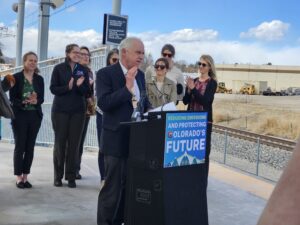
Colorado Energy Office Executive Director Will Toor discusses plans to lower greenhouse gas emissions during a 2024 news conference at Westminster Station.
Whether a similar balance can be found on a long-delayed bill to require utilities to go beyond their 80% emissions cuts required by 2030 is yet to be seen.
Polis administration leaders originally planned to push a bill that would require the sector to get to net-zero energy by 2040. But utility executives teamed with business organizations and with labor leaders who feared loss of jobs from such a regulation and pushed back hard, forming the Colorado Energy Crossroads group in late 2025 to oppose the measure, among other aims.
Further emissions cuts for utilities coming?
A draft bill that began circulating in February removed the net-zero 2040 requirement in favor of a mandatory 95% cut versus 2005 levels by 2040. But with major opposition mounting to a number of provisions in that bill, a new draft dated April 15 removed most of the bill, leaving just the 95% reduction standard — if the Public Utilities Commission considers utilities’ submitted clean-energy plans to be technically feasible and to come at a reasonable cost to consumers.
Sector leaders say that they are receiving mixed signals over whether that bill, still controversial because it does not include a cap on rate increase that could serve as an off-ramp for infeasible plans, will be introduced before the May 13 end of session. Hoefner said that utilities that pluck lower-hanging fruit to make the first 80% of reductions will find it more expensive to do so as the require percentages rise, and he emphasized this must be — and is becoming — a part of the discussions.

Union leader Gary Arnold speaks to business leader Loren Furman on a panel at December’s Colorado Energy Crossroads Summit.
“You have to really seriously think about ‘How much do you want to soak the ratepayers to accomplish additional carbon reductions?’” he said. “There are really increased costs and decreased rewards for each increment you want to pursue.”
And that’s before one even considers the increase in demand that would come from data centers, the massive, energy-consuming facilities that store cloud data for the increasing of number of programs that require it. While areas like Weld County want to get in the business of attracting the facilities, which come with massive construction spending, some cities like Denver are pausing new data centers as they examine their impacts.
Data centers debate still to come
Legislators have introduced seemingly opposing bills that have ground to a halt. House Bill 1030, which would offer 100% state sales-tax exemptions on data-center construction materials, has yet to come up for its first hearing. And Senate Bill 102, which bars special utility economic-development agreements for the centers, while putting a host of safeguards around their potential emissions and energy usage, received a hearing in its first committee last month but has yet to get a vote.
The primary author of HB 1030 circulated a proposed overhaul of the bill last week that sought to boost environmental protections around the centers, affirm local siting authority and require new centers to pay for grid modernization and community benefits. Then on Wednesday, SB 102 backers circulated their own strike-below amendment offering some leeway on clean-energy requirements while continuing to require data centers pay the full cost of needed new grid infrastructure without offering incentives. Neither have been scheduled to go back before a committee just yet.
The data centers are an important part of this conversation because while both bills require most or all of their energy to come from renewable sources, the baseloads needed to ensure reliability of that energy likely would have to come from gas- or coal-fired plants. And that would force Colorado leaders to discuss once more whether they can meet these new energy demands while still cutting emissions in significant ways.
Colorado legislators will have the chance to discuss those tradeoffs on multiple bills over the next two weeks. But the conversations are likely just to be the precursors for longer discussions to come.
Search
RECENT PRESS RELEASES
Related Post