Fed Chair Jerome Powell Just Broke 75 Years of Precedent With a Move That’s Likely to Frus
May 9, 2026
Jerome Powell’s term as chair of the Federal Reserve’s Board of Governors ends on May 15. However, Powell plans to remain on the board for an indefinite period.
Powell is eligible to do so because his term on the board of governors officially ends in early 2028. The move breaks 75 years of precedent, in which the Fed chair vacates their position on the board when their time as chair ends.
The move has also likely frustrated President Donald Trump, who has not hidden his disdain for Powell. Could Powell’s unprecedented move impact the stock market?
Why Powell is deciding to break precedent
Since Trump’s second term began, his relationship with Powell, whom he appointed as Fed chair during his first term, has soured. Trump wants the Fed to cut interest rates much more than it has, and he has ratcheted up the pressure on Powell over the past year. Rate cuts make it easier to borrow money and typically support higher stock prices.
The feud came to a boiling point when the U.S. Department of Justice (DOJ) launched a criminal investigation into Powell over allegations that Powell lied to Congress when discussing the renovation of the Federal Reserve’s Washington, D.C. headquarters, which ended up costing much more than expected.
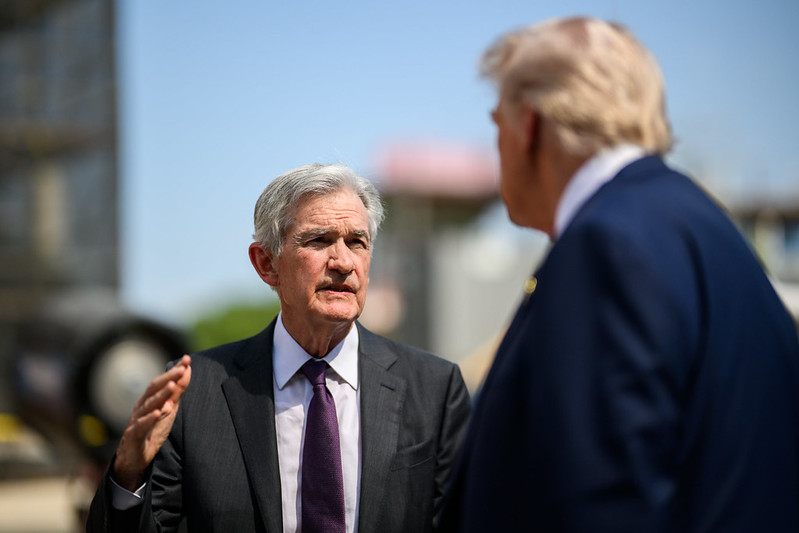
Image source: Getty Images.
Following the announcement of the investigation, Powell took an extraordinary step and posted a public video, calling the DOJ’s probe punishment by Trump because the Fed did not follow his wishes regarding interest rate cuts.
The probe sparked outrage from many, including Sen. Thom Tillis (R-N.C.), who is a member of the Senate Banking Committee. Tillis said he would not vote in favor of incoming Fed Chair Kevin Warsh unless the DOJ dropped the investigation.
In late April, the DOJ dropped its investigation of Powell but referred it to the Federal Reserve inspector general to investigate the $2.5 billion building project. Apparently, the move wasn’t enough for Powell, who recently said he would stay on the Fed’s board.
“I’ve said that I will not leave the board until this investigation is well and truly over with transparency and finality, and I stand by that,” Powell said, according to CNBC. “I’m encouraged by recent developments, and I’m watching the remaining steps in this process carefully.”
Powell has drawn some criticism for the move, notably from Senate Banking Committee Chair Tim Scott (R-S.C.), who had previously been supportive of Powell.
“He’s breaking 75 years of precedent. Every time you get a new chairman, the former chairman leaves. That’s good news because what you don’t want are these philosophies in conflict,” Scott said at a recent conference. “I think for the country and for the Fed, it would be best if he left.”
How will this impact the stock market?
All seven members of the Fed’s board serve as voting members of the Federal Open Market Committee (FOMC), which decides on the federal funds rate — the Fed’s overnight benchmark lending rate — and changes to the Fed’s balance sheet.
While the Fed chair has significant influence on the FOMC, it’s still a voting committee, and the FOMC has arguably never been more divided than it is now. At Powell’s final meeting as chair, the FOMC voted 8-4 to keep the federal funds rate unchanged, within a range of 3.50% to 3.75%.
There haven’t been four dissenting votes since October 1992.
Fed Governor Stephen Miran, a recent Trump appointee, dissented because he wanted to see a quarter-point interest rate cut.
The other three dissenting members agreed with keeping interest rates steady but did not support statements in the Fed’s policy statement that many interpret to be dovish and suggest that the Fed’s next move will be a rate cut.
Since Powell did not dissent, he did not object to the policy statement’s dovish sentiment and stood with the majority. So while he’s not helping Trump’s case as much as Miran, he’s also not Trump’s biggest problem on the FOMC.
Powell’s departure from the board would allow Trump to appoint someone more like Miran, who supports multiple rate cuts this year. This might make rate cuts more likely, since the Trump administration would likely only nominate new Fed board members with a dovish slant.
But any FOMC decision requires a majority, so it’s still not clear that Powell staying on the board realistically changes a whole lot right now.
Search
RECENT PRESS RELEASES
Related Post