Ford CEO Jim Farley on China, EVs, Tariffs, and American Carmakers
April 24, 2026
A
dversity is a hallmark of the global auto industry. For all the wealth it’s generated over more than a century, it remains fundamentally cyclical, reacting violently to market and social changes. Recessions, depressions, wars, pandemics, political meddling, stock market crashes, regulation, and recalls have repeatedly threatened carmakers’ continued survival. When you layer never-ending technological change, international geopolitics, and cutthroat competition on top of fickle buyer behavior, you have to ask why any sensible person would even consider working in the business.
Lately, however, things have gotten worse.
With technology advancing at lightning speed, the current era may be the worst of bad times for legacy American carmakers. They’re internal-combustion specialists with smokestack roots who suddenly need to build software-heavy, self-driving electric cars in clean rooms — like a defensive tackle being required to perform a triple axel. But they don’t have a choice. With immense profit dancing on the horizon as the world goes electric, shiny new technologies have the upper hand, whether everyone — or even anyone — likes or wants them.
American carmakers hold the worst end of this ugly stick. Their global footprint and their domestic market both have withered away over the last half-century, the finger of blame largely pointing at themselves. A reduced menu of cars is one reason, with ordinary sedans, station wagons, and pretty much anything compact killed off in favor of full-size pickups and SUVs. They are the U.S. industry’s happy place, frosty 12-packs of delicious profit. Expansive and expensive, their gym-bro looks and proportions broadcast their poor fuel economy. It is a transportation option that wouldn’t even occur to the average non-U.S. motorist.
Industry leaders know they’re in a tight spot. After decades of denial, most manufacturers acknowledge the impact of carbon-emitting products on climate. They long for a future where they are not blamed. But they’re not exactly sure how to go about it. A U.S. government that actively thwarts investment in electric vehicle (EV) technology and keeps moving the football with costly tariffs hasn’t helped. Nor have skyrocketing gasoline prices. And the rapid rise of the Chinese automobile industry, with its superior EV technologies and significant cost advantages, from government support to lower wages and lighter designs, is a threat so great that some legacy-brand CEOs now ponder the worst-case scenario for their companies — the end of the road.
One of the executives sounding the alarm most vocally these days is Ford Motor Company’s CEO, James D. “Jim” Farley, Jr. The grandson of a Ford line worker (Henry Ford’s hire Number 389, who signed onto the Blue Oval at age 14), Farley, 63, just marked five years in the role. He’s a Georgetown grad with an MBA who knew from boyhood that he wanted to work in the auto industry. He joined Ford in 2007, following 17 years with Toyota and its sub-brand Lexus, and rose to the top in Dearborn after holding positions in marketing, international operations, product planning, manufacturing, and labor relations. He also serves on the board of Harley-Davidson. Still, he seems to have some discomfort being labeled a “car guy.”
“I’m a grandson of a factory worker, that’s true,” Farley says. “But my dad was also vice chairman of Citibank. So, he’s like, ‘Don’t define yourself with your career, buddy. Someday they’ll tap you on your shoulder and it’ll all be over, and you better define yourself differently.’ I don’t work on cars anymore, even though everybody thinks I’m a car guy. I love cars, but that’s not my job anymore. What I’m passionate about is the sustainability of the company. All I really care about is fixing our quality and our safety and our cost and making it a safe place to work, in all definitions of safety, and to have a great future, so we could do more social good as well, like my grandfather, but also return lots of rewards to our shareholders. So, I guess I’m an old-school guy, maybe. You can’t put your finger on me. I would say that’s another thing you should figure out quickly.”
A focused, intense character, Farley smoothly shifts from serious to funny and irreverent. When he’s cracking wise, you see the strong family resemblance he bears to his late first cousin, Saturday Night Live star Chris Farley, with whom he was close. Over two in-person conversations, one in Carmel, California, and another at Ford’s headquarters in Dearborn, Michigan, we spoke about the state of the industry, mistakes and lessons of the past, his stance on Trump’s tariffs, and his favorite roads to drive.
If you could compare this moment, specifically the threat from the modern Chinese industry and the fight to save your company, to any in automotive history, what would it be?
The 1920s. The Model T, like Tesla, had completely revolutionized the industry. And then the competitors came. Back then, it wasn’t Chinese, of course, it was Chevrolet. They started taking [market] share from [Henry Ford]. And by the mid-Twenties we were in deep trouble. The board’s telling Henry, “You have to develop a new car.” And he’s saying no. Henry intellectually understands, but he doesn’t want to get rid of his beautiful Model T, this thing that changed the world. His son Edsel, thank God, pushed them into doing the Model A [in 1929, which saved the company] and building the [River] Rouge [plant in Dearborn]. This moment is very similar to that.

Matthew LaVere/Courtesy Ford Motor Company
It feels like we’re on the eve of enormous change, for society but also in the world of transportation. Much of the automobile industry is in a pickle.
There are three key perfect-storm moments for the auto industry today. You have the emergence of China being the most important market and the most important OEMs [original equipment manufacturers] in the world. Not long ago, China was dominated by Western OEMs. So, having Chinese OEMs is saying a lot.
Second, you have the software-defined vehicles, a completely different product to engineer and build.
And probably the biggest change of the three, the march to lower CO₂ and lower emissions. Everyone thought the first inning or the second and third inning would be pure electric vehicles. It turns out it’s degrees of electrification based on [how people use their cars].
It’s a lot like when General Motors and Ford dueled it out in the 1920s. The dynamics are different today, and they’re playing out in different parts of the world. But, basically, this is a “come to Jesus” moment, or whatever metaphor you want to use, for the industry. It’ll be the ultimate fitness test for anyone to get through this wormhole as a vibrant company. A lot of companies will make it through, but as a vibrant company, that’s a whole different thing.
When did it dawn on you that the Chinese were coming for you?
This all emerged during Covid. So, it was kind of invisible to us. We couldn’t travel to China. We didn’t go to auto shows. We’d gotten a couple of Chinese cars [for review in Dearborn] four years ago, right in the middle of Covid, and John Lawler, our vice chair [who oversaw Ford’s China operation] looked at me and went, “What the fuck just happened here?” And I was like, “This car is amazing, John.” And he goes, “But they used to be just as good as we are. Now they make it better than us, and faster.”
“We went to an auto show in China and were like, ‘Holy shit, what happened? We’re really far behind.’”
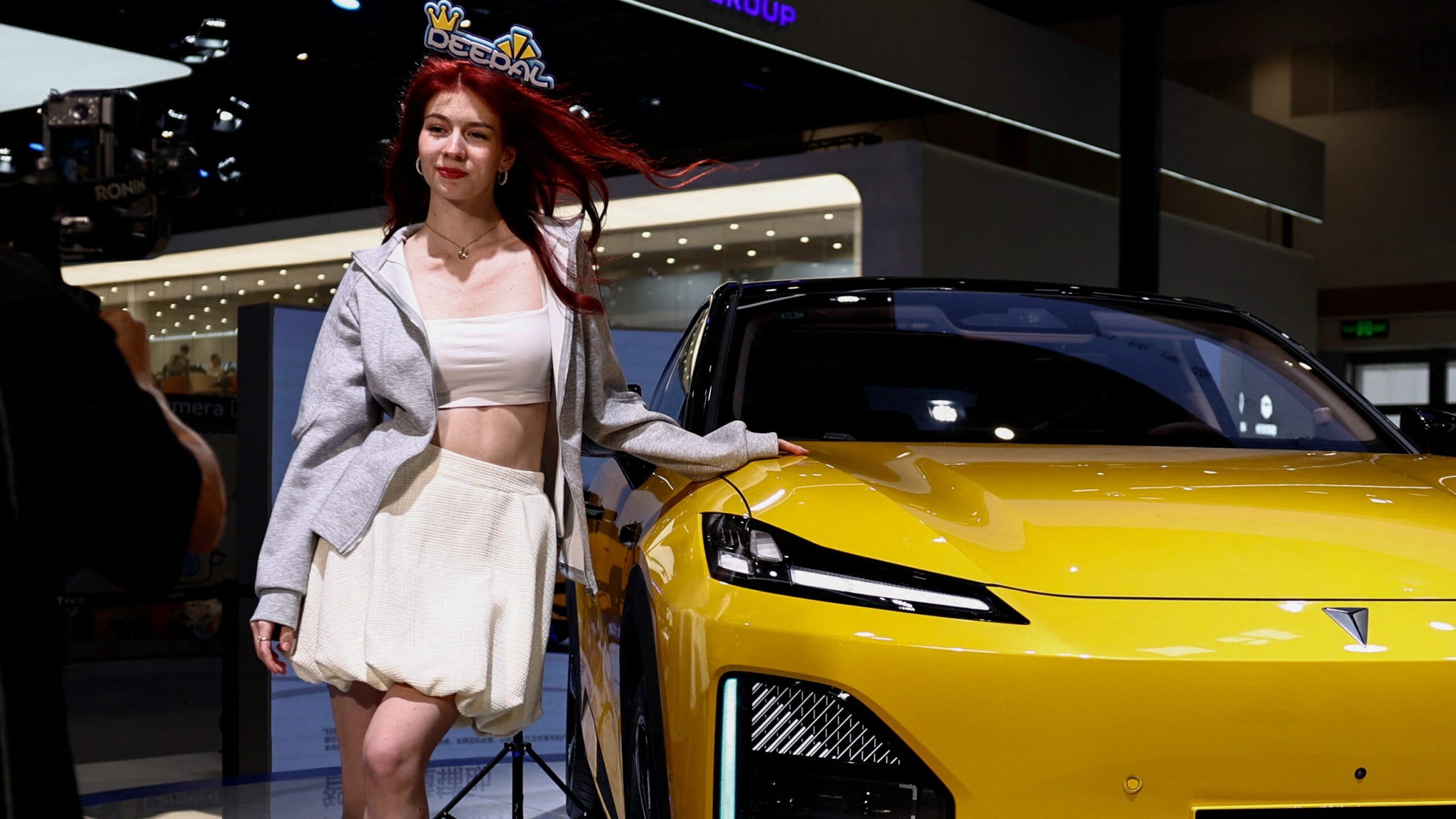
Then [following Covid] we went to an auto show in China. After about an hour, we both looked at each other. And we were again like, “Holy shit, what the hell happened?” I mean, what the heck? Their cars went from clearly behind us to ahead of us. Designs were beautiful. They were electric cars. [Chinese carmaker] Nio had battery-swapping [capabilities]. It was just shocking, frankly. More shocking than the 1980 Tokyo Auto Show I went to as a young man. At the time, that was many executives’ “oh, my God” moment. This was mine. And John turned to me and said, “Holy crap, Jim. We are really far behind.”
And since then, we’ve started to see something else new: speed to market. They can develop cars in literally half the time Toyota [a leader in this area] needed. In terms of power train, they already have moved from pure electric to EREVs [extended range electric vehicles] with 150-mile [range] batteries charged by a small combustion engine. During Chinese New Year, they can go home and can charge on the fly, a technology I think will be wildly successful here.
How did the Chinese move so fast? And why did no one see coming that at some point, once the Western companies had been invited in for 50-50 joint ventures with government-backed Chinese startups, those Western entities would be frozen out after sharing centuries of collective know-how?
I think there’s a generation of us leaders who knew something was going to happen. You had a gut feeling. Looking at those VW and GM profits [from China] for a while, I think all of us thought, “Man, this is too good to be true. There’s no way this is going to work out.” Obviously, everything is completely clear in the rearview mirror. But anyone in the auto industry who didn’t feel like something was going to happen in China five years ago was fooling themselves. Certainly, I felt that way. But would we know that the companies would get that good that fast? No way.
BYD, China’s bestselling brand, is now duking it out with Ford for third- or fourth-largest carmaker in the world.
A lot of people say, “Well, BYD sells more cars than Tesla.” Like they’re surprised; they think that’s a recent phenomenon. But BYD has been making all-electric vehicles for 20 years. They were literally 10 years ahead of Tesla. And Warren Buffett was one of the biggest investors in BYD. Smart guy, he did his homework.

Courtesy of Ford Motor Company
For decades, the German automotive industry [and others] basically printed money in China. And then the Chinese government used the conversion to pure EVs to end subsidies, to change the level playing field, to tilt it in the local OEMs’ favor. And the local OEMs had completely done their 50 percent in terms of excellent product, great manufacturing. With the support of the government, they’ve built themselves into powerhouse brands.
Massive government support explains a big part of their success. Anything else?
In China, they have state-owned car companies, run by politicians, funded by the government. When they export to Mexico, they’re exporting those subsidies, the low or zero taxes, the free land. It goes on and on. We don’t have those. It’s a phenomenal competitive advantage, we think worth five, six, seven thousand dollars a car.
Also, they do things totally differently there. For one thing, their cell phone companies got involved. Huawei, outlawed for their routers [over security concerns] in the U.S., but huge in China, and Xiaomi, the Apple of China, with a very charismatic founder, got into the car business.
Huawei says, “We’re going to partner with every car company. We’ll make the entire digital experience, with you as a technology partner.” It’s not just cool graphics, content inside, facial recognition, AI assistant. It’s far beyond that. It’s ADAS [advanced driver assistance systems] autonomy, too.
And Xiaomi says, “No, we don’t want to do that. We’re going to offer our mobile phone and our mobile rice-cooker customers a car.” And they come out with a vehicle that is literally a third of the price of a Porsche Taycan, zero to 60 in two seconds. I mean, it’s a fabulous car. I’ve also been driving a Xiaomi SUV, the SU7, which is the most impressive vehicle I’ve driven for a long time. And they never made a car before [that].
So, the whole industry transformed in front of our eyes and the locals won. It was like, can you imagine overcoming a 100-year deficit? We couldn’t. Yet they did. They learned how to make great cars. And now we have this fight on our hands.
Stepping back to look out our respective governments, economies, and political systems, the Chinese are a case study where the government just showers money on the industry — I read there are 108 companies building cars in China now. But the state is thinking 20 years ahead. It makes your job harder than hell.
The question you’re asking is, can an American or Western system beat the Chinese or South Korean systems? Well, that is a cool question, one I’ve had to think pretty deeply about. It’s a good question. But the Chinese need us. They don’t have a distribution network. We’ve spent 120 years building these great dealers in every market. And five years ago, everyone thought direct [to consumer] distribution [a la Tesla] was going to be this great savior for the auto industry. And it turns out they were dead wrong. This old system can be evolved and tweaked so that it’s actually quite responsive to new technology, helping people like we did with our first buyers, to get off horses and learn how to use the Model T. But now we’ll be getting them familiar with an electric vehicle and the digital experience.
Apparently the electric F-150 Lightning pickup, which Ford recently discontinued after three years in production, wasn’t the answer to that question. Looking back, do you think you would have taken this truck — America’s first electric pickup — to market?
I totally would’ve done it differently. I mean, look, we didn’t know what we didn’t know. So, in retrospect, [the entire Lightning project] looked pretty feeble.
When we turn on the assembly line, as you know, you’re going to be wrong every 50 seconds or you’re going to be right every 50 seconds. With the Super Duty [Ford’s largest gasoline-powered pickups] we’re right, so far. Our EVs? We’ve been wrong every 50 seconds. We’ve lost money.
Covid totally was a false signal. There was such high demand for all vehicles. If you could build a vehicle, you were going to sell it basically at 30 or 40 percent higher prices than before Covid. And it didn’t take us long to learn that our internal combustion engine prejudice was so high that we actually hadn’t designed the cars right. But also, I’m glad that we made the mistake with our core vehicles and that we didn’t put generic vehicles out. We had a Mustang, we had an E-Transit [van], we had a Lightning, and people loved these products. The problem was they were never going to pay the cost we put into [developing and building] the vehicles.

Bill Pugliano/Getty Images
What was wrong with your EVs? The Lightning was expensive, close to $100,000 for certain models, and heavy, at about 8,500 pounds and up. Clearly the market for a big, expensive electric pickup wasn’t there. But what about the Mustang Mach E? It seemed to do alright.
Well, it was the number two utility in the country behind Tesla’s Model Y; it just didn’t make money. But let’s not forget, here’s Ford, a traditional company who didn’t do what the internal people wanted to do. They wanted to have an [electric] Explorer. And I said, “No, we want the electric vehicle to be aspirational. Let’s do an electric Mustang.”
But when we ripped apart the Model Y and the Mach E, and we weighed the wiring harness [the collection of interconnected cables that control a car’s various systems], ours was 70 pounds heavier. And 1.3 kilometers longer. And then you say, “Well, why would you do that if it costs you $200 a battery?” Literally hauling the extra weight of the wiring harness around, not giving the customer any benefit. Why would Tesla have a wiring harness that was so different than Ford? Ford, after 120 years.
The fact is, when you build an electric car, the battery’s so expensive that you have to think about your budget for all the other systems in the car to reduce the size of the battery. Extra weight means more batteries required. So, Tesla knew if they could get 70 pounds of weight out with advanced flat wiring, even though it would cost way more than [the wiring harnesses] we bought for the F-150 or Mach E, it was worth it.
We didn’t look at system design that way. When we had the teardown of the Model Y, I was just flabbergasted by that wiring harness. It was the absolute, lucid moment of, “Oh, my God, the second generation has to be designed completely different.”
How could that happen with all the people singing Tesla’s praises?
They had no prejudice. We had prejudice. We went to our supply chain person and said, “Buy a wiring harness.” [Tesla] didn’t have any prejudice. They said, “Let’s design the vehicle for the lowest, smallest battery.” Totally different approach.
But that was our first-inning approach. We got the vehicle out before others did. We’ve been in the EV market four years now. I think we’re number two to Tesla for three years. I never thought it would last that long. I thought Hyundai, Kia, or Toyota or someone [would have that spot].
“I asked my EV designer, ‘What do we have to do to beat Tesla?’ He’s like, ‘Give me some money. Let me hire whoever I want. And stay the fuck away from me.’”
But the creation of our product was done with a 120-year prejudice informed by the internal combustion world. And when we fully realized that, that’s when I got the idea of building a skunk works, a group of engineers isolated from the company and its prejudices. I got Doug Fields [a veteran of Apple and Teslawho joined Ford in 2021as chief EV digital and design officer, until departing the company last week] on the team and said, “Doug, what do we have to do to beat Tesla?” He’s like, “Give me some money. Let me hire whoever I want. And stay the fuck away from me.”
Are we going to figure it out? I don’t know. But it was our best chance. It was either that or a 70-pound wiring harness.
You’ve announced plans for a new, lighter Ford Universal EV platform that will go into production in 2027, first as a mid-sized four-door pickup with a target price around $30,000. It’s scheduled to be built in a Kentucky plant utilizing a reimagined assembly line you’ve claimed to be as revolutionary as the line that over 100 years ago made Ford the world’s biggest carmaker. You’ve referred to this as a “Model T moment” for the company.
I don’t think there’s anyone at Ford that thinks that we can just go back to where we were. Now, there are a lot of people who hope we can go back, but there’s very deep recognition now that it’s go time. It’s the same old story we’ve seen time and time again in business. When one or two or three forces come into play, the second and third inning don’t look anything like people forecasted. Five years ago, we were talking about being a mobility company [focused not just on cars but autonomous taxis, scooters, ride-shares, electric bikes, and so forth]. We had a scooter company. Five years ago [prior to reversals on emissions standards and energy policy by the Trump administration and some world leaders in Europe], we thought that EVs were the future. Five years ago, we thought that by now robo-taxis would be a really big, scaled business, and it’s played out completely differently. The execution of those things wound up being harder or cost more.
Batteries didn’t come down [in cost] for electrification as much as we thought they would. [Full vehicular] autonomy is a really hard problem to solve. The mobility business turns out to be not a great profitable business. The second and third inning of this nine-inning game is going to be actually the most consequential, and it’s complicated. So, my job as a CEO, where you’re kind of moving money — basically, you’re making your bets and you’re moving the chips around on the gambling table. And if you don’t make the right bet, the company will not exist. It’s not economic cycles like the 2007 crash. If we don’t put our chips on the right number and the right color, Ford could maybe not exist.

Mandel NGAN/AFP/Getty Images
Let’s talk about the tariffs imposed by the second Trump administration. There’s very little support for them among economists, and I can’t see how they make your life easier. It must be misery for a car company to deal with constantly fluctuating tariffs and different materials getting dinged at different rates than other ones or when suppliers are based in different countries.
I would say there are three mega-trends in the government space. They’re different for every company. I’ll do them in order of significance for Ford. The first is the massive relaxation of the emissions standards. Huge change. My whole career, 40 years in the industry, has been marked by CARB [California Air Resources Board emissions standards] and the EPA and the dance with the fuel economy standards. So that’s a huge change, the biggest for Ford. And what that really means is, if there are no regulations, then every OEM is going to go back to their cultural norm. At Ford, our cultural norm is to think for ourselves. So we will offer people pure EVs, even though maybe that’s not the most profitable answer. We will offer EREVs and hybrids when others just say, “We don’t need to spend the money on that stuff.”
There’s a practical reason for doing that and a philosophical reason. Philosophically, the company is a family company. They’ve been through a lot for six generations and they want the company to have a good, modern capability. And there’s a practical reason: The administration could change. And as long as emissions control standards are really governed by the executive branch, every four years we could get a different regime. It’s played out that way for the last three [presidencies]. The only answer for our country on that one is to use the legislative branch to finally have permanency in a 50-state requirement for all emissions — not just CO2, but everything. That would be great if we could legislate it.
The second big policy area is certainly the tariffs. And Ford’s an unusual situation. Something like 80 percent of our vehicles sold in the U.S. are made here. My competitors are like 50 to 60 [percent] — Toyota, GM, others. Now they’re trying to change that, but it’ll take them decades or years to catch up to Ford. They have big plants in Mexico, big plants in Japan and South Korea and in Canada. And those cost advantages were material — like Japan and South Korea, $5,000 to $6,000 per car. Even with the 15 percent tariff — which was rumored to be 35 percent, now it’s more like 15 percent, 12 and a half for Japan — that’s maybe a thousand dollars headwind. But you have a $5,000 head start, so not significant as tariffs roll through.
We were so used to people importing their advantage. We just kind of dealt with it. And how we dealt with it is, we kept our footprint in the U.S. and we started to make that a bigger consumer issue. “The most American company.” We used to never say that in the past. But we imported a lot of parts overseas to make our U.S.-assembled vehicles affordable. Well, that gave us this huge tariff bill, counterintuitively, even though we made most of our vehicles in the U.S. So, we’ve been working with the president to try to minimize that, and that’s what’s happened. Our tariff bill’s about a billion dollars. But it was like three to four billion [when he first instituted the tariffs]. That’s 40 percent of our profit gone. Now it’s about 10 percent.
The third area is definitely going to be how we deal with China. Now, Europe really had some modest tariffs, but China is the most advantaged of all the locations. They have the most subsidies from the government, plus their OEMs are really good. Our [profit] margins are low — 5 to 8 percent as an industry — so that sort of advantage would basically double our profit, almost triple it. It is an enormous, unfathomable advantage.
“This is not like the 2007 crash. If we don’t put our chips on the right number and the right color, Ford could maybe not exist.”
But it turns out the thing that everyone can land on, regardless of your party or politics, is that the vehicles have 50 computers, they have nine cameras… They have to listen to you and what you’re doing. Cars are so sophisticated now. The systems for safety, driver assistance, controlling the vehicle, are so sophisticated and there’s so much software in the vehicles that are sensing devices. If you’re scared about your router spying on you, you should think about a car. Because cars go in and out of our military [facilities]. They drive by our essential infrastructure, like substations. Meaning the importance of national defense when it comes to the car business is unbelievable. I remember reading that in China, Elon [Musk] was trying to ask their equivalent of the Defense Department to approve his self-driving system. And it was tricky, because the Chinese saw Tesla as a [potential] missile, as a weapon. And now we have a regulatory environment — a lot of people don’t even know it got passed during the Biden administration — that everyone supports, which is how do you treat the electronics and the privacy of these cars? And that really is a huge obstacle for the Chinese now.
I’ve long dreaded the day when my car suddenly locks itself and drives me to the police station and they go, “Yeah, we didn’t like what you said about the Secretary of Homeland Security and you’re coming with us.” It raises the question about data collection.
Of course we have lots of data about our customers. Ford has a million subscribers to software. We have one million customers who pay us every month for use of software for their vehicle.
The majority of them are professional customers buying data. Fuel-card fraud is a huge issue. If you own a large fleet of company-owned vehicles, and you give all your employees fuel cards, we can now detect whether they’re driving their vehicle on the weekend for personal use and using their company fuel card. That fraud is worth millions. For a rental car company: How accurate are people self-reporting their fuel levels? You don’t have to guess anymore. We have the data. Now we can control speed. We can control access on the weekend for vehicles that are owned by fleet customers, municipalities and government agencies.
That’s valuable because the vehicles are used as tools. And they’re more effectively used. We have driver coaching now. If you’re too hard on the brakes, accelerate too hard, the owner of the fleet will get notified, “Hey, you need to slow down. You’re using too much fuel.”
Good for teenagers.
Yes. My daughter would definitely be included.
How did you get into cars?
When [my family] moved to Greenwich, Connecticut, the [North American Ferrari distributor, Luigi] Chinetti building was right on the Post Road. I had a paper route, and after I was done with my route on Saturdays, I’d get my money and ride my Schwinn over and spend pretty much the whole day with the Italian mechanics in the basement of that building. And he had all his old NART [North American Racing Team] racing cars. We would go through each one, and the mechanics would joke about the customers and talk about racing these cars all around America. It was great. My first introduction to the car business.

Ford Motor COmpany
You do some racing yourself. Last summer, you thrashed your class at the Monterey Historics, the annual vintage-car race in Northern California, in a Ford-powered 1963 AC Cobra. But when you’re not on the track, what are your favorite roads to drive?
I think those roads in northern New Jersey or in Westchester County [New York] or southern Connecticut, like Bedford, New York — I mean, they’re some of the best roads I’ve ever driven on in my life, anywhere in the world. They don’t get enough credit.
How is American car culture distinct from car culture in other countries?
China’s more of a rational car culture, whereas in Japan, India, Europe, and the U.S., the car is still a very emotional product that plays heavily in the culture. In the Sixties and Seventies, cars made their way into music and film. I can’t tell you how many famous musicians I’ve met through cars. ZZ Top wouldn’t be ZZ Top if it wasn’t for those [music] videos. And so music and film and cars kind of borrowed from each other.
You could start to see that in the Twenties, with the silent film actors. Charlie Chaplin and the others, they started to buy these really expensive cars. They would have these pictures — you know, you’ve seen them all, on the fender of their 12-cylinder Lincolns or Packards. Since Eleanor [the Mustang in the 1974 film Gone in 60 Seconds], there’ve been movies about cars. There are actors who are famously connected to cars, like Jerry Seinfeld. Steve McQueen’s [Bullitt] Mustang sold for $5 million.
But then this tough time happened where brands started to buy their way into films through product placement. It was a bad time, actually, as a car lover. I was like, “That car is no longer in that movie because someone chose it. It’s in the movie because someone paid them to put it in.” The Transformers movie — oh, my god. As a car culture person, I got bummed out.
Who are some of the musicians you’ve gotten to know through car culture?
Last night I got a call from Neil Young. He’s a total car person, and he is really into electrification. He had an electric Continental, the Lincoln Volt, I think, 20 years ago, before electric cars became a thing, before Tesla. And he also electrified his famous touring bus. And so he always has some good ideas about more efficient power trains. When I lived in London [running Ford of Europe], I got to know Mark Knopfler. I love Dire Straits.
You live in Michigan now, the center of American car culture and history. Is there a musician who embodies that to you?
Living here, I don’t think there’s a musician that captures this place more than Seeger for me. Of course, there’s Eminem and there’s a lot of great electronica out here, but for me, the storyteller is Seeger. The story he tells about a young skinny kid in a cornfield trying to figure out his girlfriend — to me, that’s Michigan.
Search
RECENT PRESS RELEASES
Related Post