Former Fed Chair Jerome Powell Did Something That’s Only Been Done Once Before in 30 Years
May 31, 2026
A new era has begun at the world’s largest central bank. Jerome Powell handed his position as Federal Reserve chair over to Kevin Warsh earlier this month, and on May 22, Warsh was sworn in, marking the start of his leadership. Some early signs of Warsh’s intentions and policy may come as early as June 16, with the first Federal Open Market Committee (FOMC) meeting under his direction.
Ahead of this next chapter, though, investors focused on the stock market may be interested in something former chair Powell did several months before handing over the reins. It stands out because it’s something that’s only been done once before in 30 years, and it could continue to send shockwaves through the stock market. Let’s check out this message from Powell.

Image source: Getty Images.
President Trump and Jerome Powell
So, first, a quick note about the final months of Powell’s term. President Donald Trump openly criticized the Fed chair for his decisions multiple times — while Trump called for aggressive rate cuts, Powell took more of a wait-and-see approach amid various uncertainties, from conflict in Iran to the U.S. economic outlook. After taming inflation with interest rate increases a few years ago, Powell initiated a period of rate cuts back in 2024 — but, in recent times, he’s left rates unchanged. For example, Powell cut rates by a quarter point in December, then kept them steady during meetings so far this year.
As mentioned, a new chapter may be just ahead under the leadership of Warsh, and this is something investors should keep on their radar screens, as his moves could impact the direction of the stock market. At the same time, it’s important to remember what Powell did several months before handing the position over to Warsh. It’s something that’s only been done once before in 30 years.
Fed chairs usually don’t comment on stock prices and valuations; instead, the Fed focuses on making monetary policy efforts to maintain maximum employment and price stability. So, when a Fed chair does comment on valuation, it suggests the valuation situation is far from ordinary.
This happened back in December of 1996, when then-Chairman Alan Greenspan spoke of “irrational exuberance” in the stock market. (Since that time, chair Janet Yellen in 2017 spoke of “elevated” valuations, but without expressing significant concern: “The fact that those valuations are high doesn’t mean that they are necessarily overvalued,” she said during a press conference, noting that a low interest rate environment generally supports these higher valuations. )

S&P 500 Index
Today’s Change
(0.22%) $16.43
Current Price
$7580.06
Powell’s view of stock prices
This brings us to recent times and Powell’s comment, nearly 30 years after Greenspan’s. Back in September, at a speech in Rhode Island, Powell said: “By many measures… equity prices are fairly highly valued.”
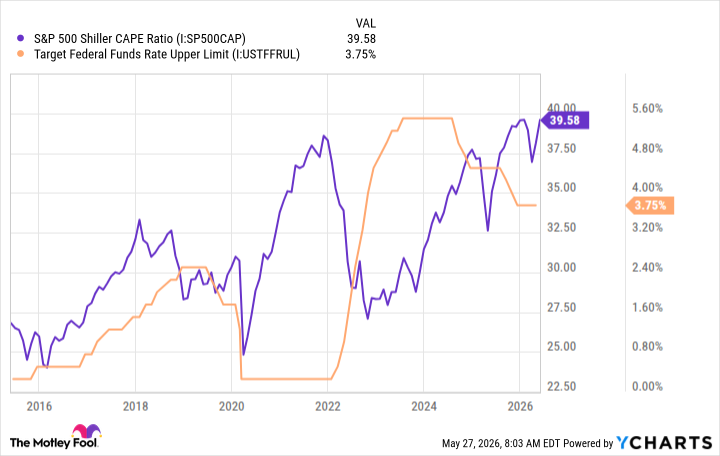
The chart below shows the S&P 500 Shiller CAPE ratio along with the federal funds rate, and we can see that the situation back in 2017, with lower interest rates, differs from today’s environment. So stocks at that time, as Yellen suggested, may not have been overvalued.
S&P 500 Shiller CAPE Ratio data by YCharts
Today, though, the Shiller CAPE ratio, which looks at stock price and earnings per share over a 10-year period, shows that valuations are at one of their highest levels ever. And Powell’s comment about valuation may be seen as a warning to Wall Street that stocks have become expensive.
What happens next? Well, over time, when the Shiller CAPE ratio reaches high levels, the S&P 500 has gone on to decline. The dot-com bubble burst in 2000, just a few years following Greenspan’s comments on valuation.
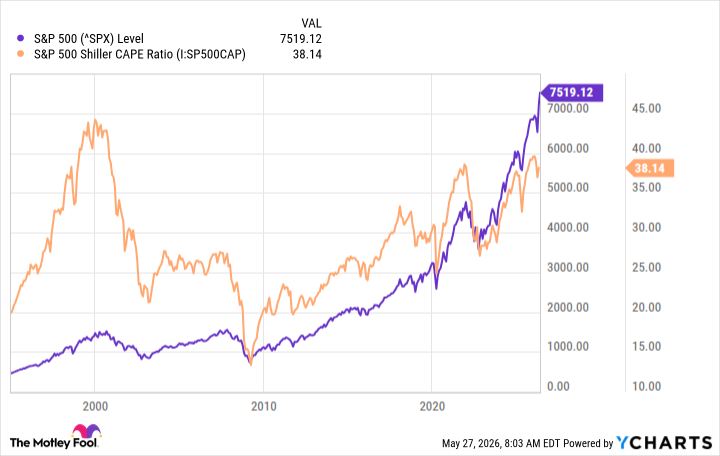
Does this mean Powell’s words signal a drop may be on the way? Even though the S&P 500 has pulled back at certain points, valuation still remains at historically high levels — so if history is right, stocks could slip again in the coming months or farther down the road.
That said, it’s important to remember one key point: The S&P 500 and quality stocks have always advanced over time, so savvy investors shouldn’t worry too much about any short-term declines. Instead, investors may actually look to a pullback as a time to get in on certain players at lower valuations — and benefit as they soar over time.
Search
RECENT PRESS RELEASES
Related Post