Fossil Industry Distortions Make the Energy Transition Harder to Imagine
February 8, 2026
Oil and gas account for just 7.8% of Canada’s GDP. Some of the country’s top MBA students came back with estimates 10 times higher. We’ll need some serious myth-busting to deliver on a clean economy.

I was absolutely gobsmacked earlier this week by just how pervasive certain myths are, and realizing how much work we in the clean economy have to do before Canadians will believe we can make the transition.
And before a critical mass of Canadians see the clean economy as a real option that can displace the fossil fuel industry as an engine for prosperity, employment, improved health, a better environment, and also, a little climate action.
At the invitation of greenwashing expert Dr. Wren Montgomery (Clean50 2026), I took the clean economy show down Highway 401 to London, Ontario and Western University, my alma mater. I was addressing two fourth year Honours Business Administration (HBA) classes at Ivey, arguably Canada’s top business school.
Before I began my description of Canada’s clean economy, I asked both classes a lead-off question: What percentage does Canada’s oil and gas business contribute to our GDP?
Their answers blew me (and Wren) away.
The students came back with a wide range of responses. The closest, from just one of the ~20 students who answered, suggested 35%. Most of the others? Between 50 and 65%. One said 40% and a couple came in at 70%, with one outlier suggesting 90%.
It was literally breathtaking.
Murmurs of ‘Wow’
When I shared that the answer was actually 7.8% (all in, including both direct and indirect economic impact—the direct contribution is only ~3.4%, according to Statistics Canada), I got a sharp intake of breath and murmurs of “wow” from both classes.
These are very sharp students. Some of them have already spent summers working for banks and consulting firms. And from all the attention we pay to the fossil fuel industry, the FUD (fear, uncertainty, and doubt) the industry spreads, and the amount politicians talk about it, students assumed its importance to Canada was literally 10 times bigger than it actually is.
Also of note, it’s only ~20% of Alberta’s GDP. Of course, if Premier Danielle Smith stopped making it impossible to roll out new wind and solar projects, that number would decrease quite rapidly.
My lecture then tabulated the clean economy numbers—clean/climate tech, renewable energy, green building, green fuels, biotech, venture investment, responsible investing, sustainability consulting. Counting only the numbers I could get with any accuracy, with lots of holes still to fill, the total for the clean economy was actually higher.
And so I was blessed to actually watch world views changing –and in real time!
We talked about where the fossil fuel industry is headed over the next 10 years (flat to down) vs. the clean economy (300% growth over next 10 years, if we keep pace with the rest of the world).
We talked about the incredible impact and massive risk of abandoned oil wells and the oil sands ($270 billion in estimated cleanup costs, with less than $2 billion held in reserve to do the job). How Big Oil offloads liabilities for cleanup by selling almost-depleted wells for pennies on the dollar to smaller companies that strip as much oil as possible—then abandon the business, the cleanup, and the liability, leaving taxpayers on the hook for yet one last VERY big subsidy.
To put this in perspective, the cleanup bill will get bigger, as 50% of existing wells are expected to become non-profitable/non-productive by 2030. And yet the cleanup tab is already half –HALF—of our federal budget for one year.
Solutions That Are Saleable World-Wide
But mostly, we talked about all the very cool companies in Canada doing so many things in the clean economy, how successful many have been at developing solutions that are saleable world-wide, in a way our dirty oil, steel, and lumber are not. And we talked about heading to where the puck is going—building new opportunities for them and their eventual kids in a massive growth industry, rather than propping up a 100-year-old industry whose recent annual profits are roughly equal to the subsidies taxpayers provide.
They were dumbfounded all this information was not already well understood by Canadians. That no one had ever shared it with them. One perceptively compared the fossil industry’s misinformation to that previously spread by the tobacco industry.
And they wanted this information spread widely!
We had a couple of dissenting voices in the crowd. “I don’t want government support going to the oil companies—but I don’t want it going to clean tech, either,” said one. Several nods from the free market bros around the room.
So we talked about why clean tech companies should get government support and why oil companies should not: Because clean tech is in a start-up phase, because it’s where the jobs are and where many more will come from, and mostly because intellectual property is highly portable. Other countries want ours, and our best are being pursued with significant government support, matching and top-ups for building facilities, easier access to capital—the list goes on. It means tomorrow’s Canadian business leaders can be lured south to the United States, to Europe, and even to China. taking the jobs with them. And so Canada needs to keep pace with investment, or lose them.
Nods from the free market types. They got it now…
After a lot of further conversation, the students expressed genuine frustration that no one had ever shared these facts with them before, then asked what they could do.
And then they committed to calling their MPs. And I’m holding them to it!
If you want to add your comments, there’s a shorter version of this story posted on LinkedIn.
Gavin Pitchford is founder and executive director of the Canada’s Clean50 sustainability leadership award program and CEO of Delta Management. This post originally appeared in the weekly Clean50 newsletter, and has been edited to match Energy Mix style.
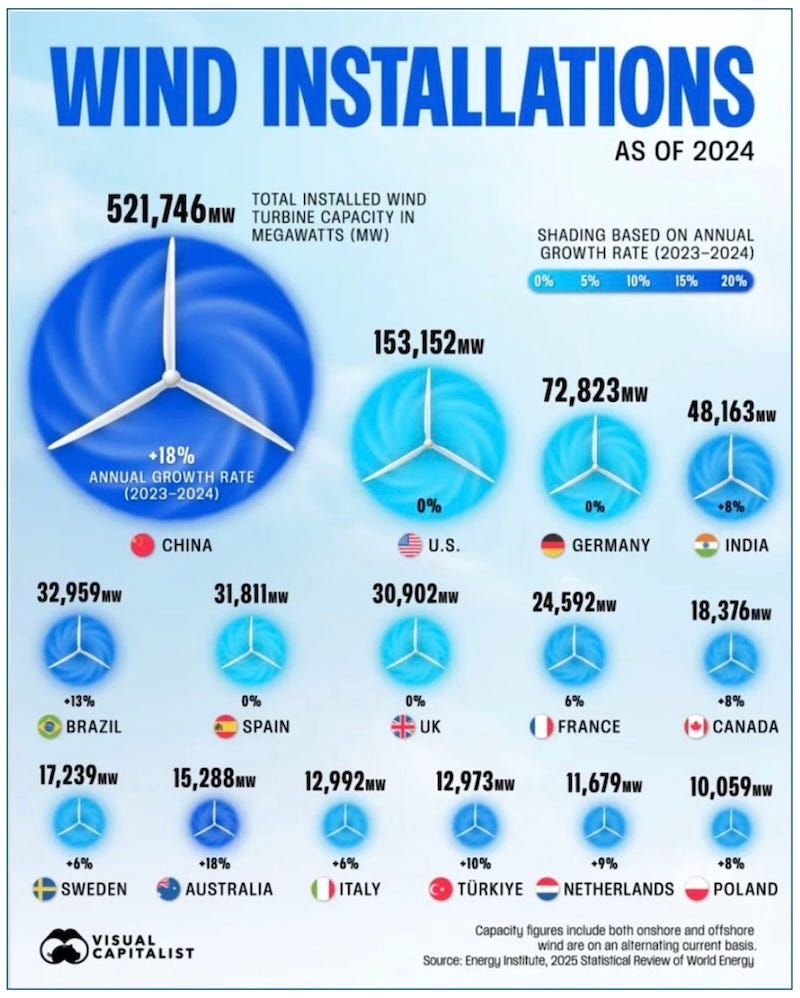
Chart of the Week

Local Economies Pushed Aside as Newfoundland LNG Megaproject Presses Ahead
Solar, Wind Emerge as Canada’s Cheapest New Power as Prices Fall by Half
Washington Post Scales Back Climate Team as Bezos Caves to Trump
House Committee Backs Climate Aligned Finance Act, Urges Tougher Transition Rules for Banks
EU Fears Dependence on U.S. LNG, Looks to Canada
Study Ties Particle Pollution From Wildfire Smoke to 24,100 U.S. Deaths per Year
New Auto Sector Strategy to Scrap EV Sales Mandate, Restore Purchase Incentive
Pimicikamak Faces Long Road to Repair After Havoc-Wreaking Power Outage
Canadians Want Heavy Emitters Barred from Winter Sports Ads: Poll

The Trump administration has secretly rewritten nuclear safety rules (National Public Radio)
U.S. moves to open Venezuela’s vast crude reserves to Big Oil (Financial Times)
Trump’s pro-coal directives could raise U.S. energy prices by billions (Washington Post)
Can Carney’s example prod corporates to talk about climate action again? (Reuters)
Norway’s $2T wealth fund stress tests effects of climate shocks, AI correction (Financial Times)
With a southern Ontario battery farm humming, bidders are lining up to build more just like it (The Narwhal)
Darlington nuclear plant refit completed early and under budget (Toronto Star)
Chinese power stocks surge on State Grid’s record US$574B investment plan (South China Morning Post)
Africa Solar Capacity Seen Rising Sixfold After 2025 Record (Bloomberg)
UK’s first rapid-charging battery train ready for boarding (The Guardian)
Pangnirtung MLA voices concerns over proposed Iqaluit hydro project (Canadian Broadcasting Corporation)
Landslides on one side, floods on the other: the Costa Rican village desperate to escape the climate crisis (The Guardian)
Search
RECENT PRESS RELEASES
Related Post