FSU chemist named Rising Star for contributions to clean energy discovery, storage
January 9, 2026
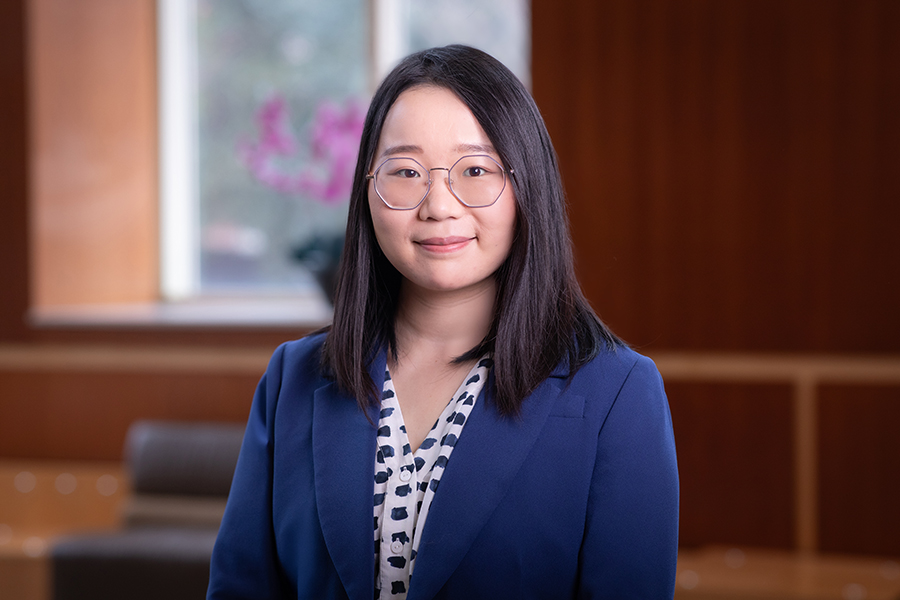
A Florida State University researcher has been honored for her work developing new materials that enable more efficient energy storage and produce cleaner energy for daily use, ranging from phones and laptops to electric cars and renewable energy systems.
Assistant Professor of Chemistry and Biochemistry Yan Zeng has earned a 2025 Materials Today Rising Star Award in recognition of her contributions to the field of energy conversion and storage, including her work in designing sodium-ion batteries for electric vehicles. This year, she is one of nine researchers worldwide to receive this distinction and is the first-ever honoree from FSU.
“It is an honor to be recognized by the community, and I feel thankful to everyone who has supported my work,” Zeng said. “It is especially meaningful because it recognizes our early efforts in energy conversion and storage research; the award encourages me to keep pushing this work forward and continue to grow as a researcher.”
First granted by the Materials Today Family of Journals in 2018, the Materials Today Rising Star Awards recognize early career researchers who are poised to become future leaders in the fields of materials science and engineering, highlighting the exceptional potential of their works’ real-world impact.
“Our goal in the Zeng Research Lab is to create better materials for storing energy, which ultimately affects everyday technologies,” Zeng said. “Even though the chemistry is complex, the goal is simple: make energy safer, cleaner, and more reliable for everyone.”
In early 2024, Zeng joined the U.S. Department of Energy’s $50 million Low-cost Earth-abundant Na-ion Storage Consortium, or LENS Consortium, which aims to discover, develop, and demonstrate a new class of sodium-ion batteries for use in electric vehicles.
Most electric vehicles use lithium-ion batteries. While these cut down on emissions, lithium poses several risks, both environmental and economic. Mining lithium often requires large amounts of water in arid areas; this process not only damages ecosystems, but manufacturing lithium-ion batteries is also energy intensive and produces considerable greenhouse gas emissions. These challenges, among others, contribute to the supply chain risks associated with lithium.
Sodium-ion batteries, on the other hand, show promise as an eco-friendly and affordable alternative. By swapping sodium for lithium, Zeng’s research hopes to reduce reliance on critical elements, or chemicals that are in high demand but limited supply. However, sodium is heavier than lithium, which means sodium-ion batteries provide less energy than lithium-ion batteries of the same weight and size. Zeng aims to push past this barrier by designing brand-new element and structure combinations that will allow sodium-ion batteries to not only compete with but outperform their lithium-ion counterparts.
“I am most inspired by the possibility of discovering entirely new materials that could transform energy technologies,” Zeng said. “The combination of creative chemistry, data-driven tools, and curiosity-driven exploration keeps the work exciting every day. My lab leverages artificial intelligence and automation to accelerate discovery and optimization, opening up opportunities to uncover design principles and innovations.”
Zeng’s approach to creating and optimizing new materials is unique for its integration of automation and AI to accelerate the research process. For example, an automated robotic arm is used to complete some of the lab’s repetitive work, such as carrying out individual chemical reactions. After each successful synthesization, or creation of a new substance, Zeng employs AI as a springboard for new ideas, considering what types of tweaks could optimize the new material.
“Designing solid-state materials has been challenging due to chemical complexity, and gaining empirical knowledge via human repetitive work is very costly and time consuming,” said Wei Yang, chair of the Department of Chemistry and Biochemistry. “Dr. Zeng is a pioneer in her field for integrating AI with robotics, a method that has attracted tremendous national and international attention.”
To learn more about Zeng’s work and research, visit the FSU Department of Chemistry and Biochemistry website.
Search
RECENT PRESS RELEASES