Gas nears $5. Why aren’t electric vehicles selling in the US?
May 26, 2026
With gas averaging $4.50 per gallon in the United States, and the international waterway through which 20% of the world’s oil flows effectively closed, it might seem like a good time for Americans to buy an electric vehicle.
Instead, EV sales in the US are projected to fall from 1.5 million to 1.2 million this year, according to the International Energy Agency (IEA), an organization that works with governments and industry to shape a secure and sustainable energy future. Meanwhile, Car and Driver magazine reports that auto manufacturers from Acura to Volvo have recently canceled or discontinued their EV models.
Why the disconnect?
“The market is not a simple, single-variable function,” said Juner Zhu, an associate professor of mechanical and industrial engineering at Northeastern who researches battery sustainability. “The market depends somewhat on the cost of EV compared to gasoline-powered vehicles, but there are more variables.”

The US Department of Energy cites a state of Vermont law that defines an EV as a vehicle that can be powered by an electric motor that draws electricity from a battery and is capable of being charged from an external source. This technically includes vehicles that are only powered by an electric battery and hybrid electric vehicles, those that can use gas as well as some electricity
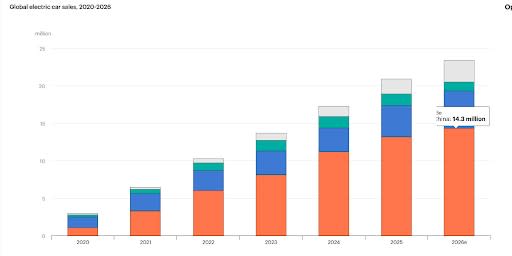
The picture elsewhere looks different as, globally, electric vehicles are going strong.
Approximately 20 million EVs were sold across the world in 2025, according to the IAE, growing 20% from 2024. This year, EV sales are expected to rise to 23 million and account for nearly 30% of all cars sold worldwide, according to the newest edition of the IEA’s annual Global EV Outlook. A lot of that growth is happening in China, where 55% of new vehicles sold were EVs, according to the report. Meanwhile, EV battery prices have fallen by 99% in the past 30 years, according to Our World in Data, a project of the Global Change Data Lab, a nonprofit organization based in the United Kingdom.
These statistics make the IEA seem optimistic overall about EVs.
“Electric car sales set new records in close to 100 countries last year. The growing popularity of EVs has marked a major shift for car markets and the energy system as a whole – and it is providing some relief now amid the largest oil supply shock in history,” IEA Executive Director Fatih Birol said earlier this month in an announcement of the annual report. “Looking ahead, the falls we have seen in battery prices and the potential policy responses to the current global energy crisis are set to provide further momentum in EV markets.”
It would seem like the War in Iran would bring that momentum to the United States, given the landscape of fuel prices.
Gasoline rose to an average of $4.50 a gallon on Monday in the US, according to the American Automobile Association (AAA). Meanwhile, it costs $0.42 per kilowatt hour on average to charge an electric vehicle in the US, AAA said. According to the online calculator from Kelley Blue Book (KBB), a resource for vehicle values and information,this means it costs about $64.65 to charge at home or $169 at a public charging station to drive 1,015 miles per month (the US average). To drive the same mileage in a gas-fueled car, you’d have to fill up the 12-gallon gas tank on your smaller passenger car, hatchback, or subcompact crossover three times at roughly $54 a pop.

But Sanjeev Mukerjee, distinguished professor of chemistry and chemical biology at Northeastern, said gas prices are not the only economic factor that must be considered.
He said that EVs typically cost around $10,000 more than a similar gas-powered vehicle. KBB said the average new EV cost $55,614 in Jan. 2025 compared to $48,641 for the average new gas-powered vehicle. For example, Zhu also noted that it costs more to insure an EV – 49% more in 2025 than a gasoline-powered vehicle, according to Aftermarket Matters, a business-to-business automotive aftermarket digital publication. EVs also depreciate to, essentially, nothing at the end of their roughly 10-year battery life, Mukerjee noted. Although it varies by model, EVs generally depreciate by 13% more over a five-year period than the overall market and some plummet in value more rapidly, as reported by CNBC citing iSeeCars, which tracks the used car market.
Then there is convenience. Without a regular, reliable network of charging stations in the United States, EV drivers in many parts of the country “really have to plan,” Mukerjee said, making it harder to go on impromptu road trips.
“The charging infrastructure has always been the bane,” Mukerjee said. “Because no AAA guy can come in with a can of gas.”
There are also perceptions of safety concerns.
The nonprofit National Fire Prevention Association, which writes fire safety codes, said “there is no current evidence to suggest EVs are more likely to be involved in a fire than [internal combustion engine] vehicles,” even as it acknowledges there is insufficient data in the United States to really draw that conclusion. Advocacy groups and fire safety businesses, meanwhile, say electric vehicles are significantly safer than vehicles with internal combustion engines.
In a AAA survey released in June 2025, 63% of Americans said they would be ‘unlikely’ or ‘very unlikely’ to buy a fully electric car, the highest since 2022. Of those who were unlikely or very unlikely to be an EV, 31% cited safety concerns.
Zhu likened the fear to fears about nuclear energy.
“I think (scientists) generally agree that we have technology to safely use nuclear,” Zhu said. “But in many places, public concern about nuclear is still there.”
Finally, there is a lack of government incentives.
On September 30, 2025, the federal government ended tax credits worth up to $7,500 for new and $4,000 for used EVs.
In comparison, China’s success story is owing to the fact that the country built a supply chain for battery materials, scaled up battery manufacturers, limited driving hours for gas-powered vehicles, and basically, “mandated its way into the electric future,” Mukerjee said.
“Here, you can’t do that, so you have to make sure it makes economic sense and also makes sense in terms of convenience,” Mukerjee said. “An EV is not there.”
Search
RECENT PRESS RELEASES
Related Post